



 Chat with AI
Exam 2: Foundations of Independent Practice

Exam 1: Advanced Clinical Medicine1 k+ Questions
Exam 2: Foundations of Independent Practice597 Questions
Select questions type


A 65-year-old man comes to the clinic for follow-up treatment of hypertension. He is on 2 antihypertensive agents and says he is compliant with his medication regimen. The patient has no other medical problems. Blood pressure is 134/88 mm Hg and pulse is 78/min and regular. BMI is 32 kg/m2. Physical examination is otherwise unremarkable. His fasting blood glucose levels on 2 recent laboratory workups were 108 mg/dL and 111 mg/dL. He is concerned about his risk of dementia because his father suffers from Alzheimer dementia.
Based on the study results, which of the following is the best response to this patient's concerns?
(Multiple Choice)
4.9/5  (73)
(73) A 44-year-old man is rescued from a house fire and brought to the emergency department with nausea, headache, and altered mental status. The fire likely began due to the stove accidently being left on overnight. He has no chronic medical problems and takes no medications. The patient had smoked a pack of cigarettes a day for 10 years but quit several years ago. He does not use illicit drugs. Temperature is 36.7 C (98 F), blood pressure is 110/70 mm Hg, pulse is 112/min, and respirations are 28/min. Pulse oximetry is 97% on room air. The patient has soot around the mouth and oropharynx, flushed cheeks, pink palmar skin, and breath that smells strongly of smoke. He is lethargic but has spontaneous movement in all extremities. Cardiopulmonary auscultation reveals clear lung fields and normal heart sounds with occasional ectopic beats. Laboratory results are as follows: 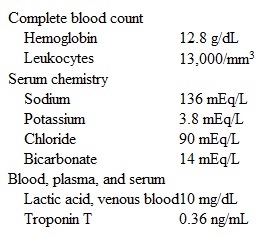 Chest-x ray reveals no infiltrates. ECG shows T-wave inversions in leads I, aVL, V5, and V6 that were not present on previous ECGs. Which of the following is most likely to confirm the underlying diagnosis?
 (Multiple Choice)
4.8/5 (79)
(79) A 30-year-old woman, gravida 2 para 1 aborta 1, comes to the office for preconception counseling. The patient's first pregnancy 10 years ago ended in a term cesarean delivery due to fetal malpresentation. That pregnancy was otherwise uncomplicated. She is now with a new partner and recently had a first-trimester spontaneous abortion. The patient has no chronic medical conditions and has had no surgeries other than the cesarean delivery. She has no history of sexually transmitted infections. Her last Pap test, 2 years ago, was normal. She takes a prenatal vitamin daily. The patient does not use cigarettes or illicit drugs but drinks a glass of wine on the weekend. She drinks 3 cups of coffee each morning. The patient participates in a 30-minute aerobics class 3 times a week and plays tennis every weekend. Blood pressure is 110/60 mm Hg and pulse is 68/min. BMI is 22 kg/m2. Physical examination reveals a small, nontender, retroverted uterus; no adnexal masses or tenderness; and a cervix with no visible lesions or discharge. The patient wants to know what she can do to prepare for her next pregnancy. Which of the following is the most appropriate response regarding this patient's risk for another spontaneous abortion?
(Multiple Choice)
4.8/5 (85)
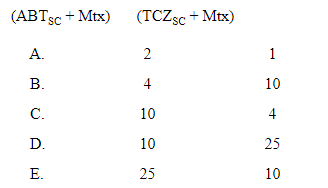
(85) A 46-year-old woman comes to the office due to persistent joint pains. She has a history of rheumatoid arthritis and, for the past 6 months, has been on methotrexate (Mtx) therapy. However, her symptoms have shown little improvement. She has morning stiffness that lasts for >1 hour, and her erythrocyte sedimentation rate is 40 mm/hr. A discussion is initiated regarding modifying her therapy to include either subcutaneous (SC) tocilizumab (TCZSC) or SC abatacept (ABTSC) in addition to Mtx. The patient expressed wanting to attempt the most effective treatment and avoid having to modify her treatment again.
Based on the study results, compared to Mtx therapy alone, what is the approximate number needed to treat over 1 year to prevent 1 additional clinical response of <70% improvement with (ABTSC + Mtx) and (TCZSC + Mtx) ?
(Multiple Choice)
4.9/5 (80)
(80) A 65-year-old man comes to the emergency department after 2 episodes of bloody bowel movements. The patient felt well until approximately 3 hours ago when he had a sudden urge to defecate, followed by passage of a large amount of bright red blood. He had another small amount of bloody stool several minutes later, but has had no bleeding since then. The patient has never had similar symptoms before and reports no fever, nausea, vomiting, hematemesis, abdominal pain, or weight loss. Medical history includes hypertension, for which he takes lisinopril. His most recent colonoscopy was 5 years ago, which revealed diverticulosis and 2 colonic polyps that were removed. The patient is a former smoker and drinks alcohol socially. Temperature is 37.2 C (99 F), blood pressure is 116/70 mm Hg without orthostatic changes, and pulse is 94/min. Lungs are clear to auscultation, and heart sounds are normal. The abdomen is nondistended, soft, and nontender without masses or hepatosplenomegaly. Rectal examination reveals bright red blood in the rectal vault and internal hemorrhoids, but no palpable mass or tenderness. Which of the following is the most likely source of this patient's rectal bleeding?
(Multiple Choice)
4.9/5 (68)
(68) A 27-year-old woman with no medical history comes to the office due to recent-onset chest pain. She gives a dramatic, vague, and nonspecific description of the pain, which she continues even when pressed for details. The patient is dressed in revealing clothing and mentions having seen the physician several times at a nearby grocery store. Physical examination, including vital signs, is unremarkable. Laboratory evaluation and an ECG are normal and suggest no medical etiology for chest pain. Despite reassurance that more serious causes of chest pain are highly unlikely, the patient insists on scheduling a follow-up appointment. On the day of the second appointment, she arrives as the office is closing and intercepts the physician in the parking lot. The patient reports that the chest pain has disappeared; however, she is very concerned about feeling fatigued. She says, "I frequently have insomnia, but it's been worse than usual lately and I am so tired." The patient insists on calling the physician by first name, apologizes profusely for being late, and requests an after-hours appointment. At the next scheduled appointment, the patient does not mention the chest pain or fatigue but reports that she has "bad headaches and feels horribly depressed and in a black hole" following a romantic breakup a week ago. She adds, "I was sure this was the person for me, but to be honest, I am thrilled to be free again. You're also single, aren't you?" The patient has difficulty describing the nature of the depression but reports that her moods go "up and down" during the day. She denies current suicidal ideation or significant disturbances in sleep and appetite. As the appointment is ending, the patient shows the physician a photograph from a recent beach vacation and then expresses disappointment when no compliments are offered. This patient's behavior is most consistent with which of the following disorders?
(Multiple Choice)
4.9/5 (80)
(80) A 57-year-old man visits his primary care physician due to fatigue, cough, and unintentional weight loss of 18.1 kg (40 lb). Following an extensive evaluation, he is found to have squamous cell lung carcinoma with metastases to the liver and is classified as stage IV. The patient is referred to an oncologist, who begins a standard chemotherapy regimen. On follow-up several weeks later, his tumors appear to have decreased by approximately 45%. At that time, the patient requests a family meeting with his primary care physician and oncologist to discuss future planning with his wife and 2 college-aged children. At the meeting, the patient is tearful and says that he knows that he may not have long to live and wants to spend as much quality time as possible with his family before he becomes too ill. He is also concerned about how his family will cope when he is gone. Which of the following interventions would best address the patient's concerns?
(Multiple Choice)
4.7/5 (67)
(67) A clinical trial was conducted to compare the effects of ACE inhibitors and diuretics in elderly patients with hypertension. The investigators believed that ACE inhibitors provide some additional survival benefits over diuretics use in elderly subjects because of their neurohumoral effects. The study lasted 5 years and the investigators presented the following results after the completion of the study: According to the information given, which of the following is the best interpretation of the study results?
(Multiple Choice)
4.8/5 (87)
(87) A 4-year-old girl is brought to the office by her mother for evaluation of vaginal discharge. The mother states that the discharge started about 2 days ago; she has also noticed that her daughter has been scratching and pulling at her underwear. The mother tried using baby wipes, diaper cream, and an over-the-counter ointment each time her daughter went to the bathroom, with no relief of symptoms. The patient has no chronic medical conditions or previous surgeries. Her vaccinations are up to date. She takes no daily medications and has no known drug allergies. The patient lives with her mother, mother's boyfriend, and 1-year-old stepbrother. She attends day care 3 days a week. Vital signs are normal. On inspection of the external genitalia, the vulva is edematous and erythematous; a malodorous discharge is at the vaginal introitus. There is no hymenal notching, tearing, or bleeding. Perianal inspection reveals no hemorrhoids, anal fissures, or tags. Mild eczema is seen behind the knees and on the arms. The pH of the discharge is 6, and wet-mount microscopy reveals pear-shaped motile organisms. The mother asks about the cause of the girl's symptoms. Which of the following is the most appropriate response?
(Multiple Choice)
5.0/5 (82)
(82) A systematic review examines the effect of drug X, a commonly used medication, on all-cause mortality in patients with a chronic pulmonary problem. A systematic search identified 12 retrospective cohort studies. The pooled odds ratio of mortality with drug X use was 0.72 (95% confidence interval: 0.61-0.79). The authors also reported the following funnel plot of the 12 studies, centered around the log of the pooled odds ratio: 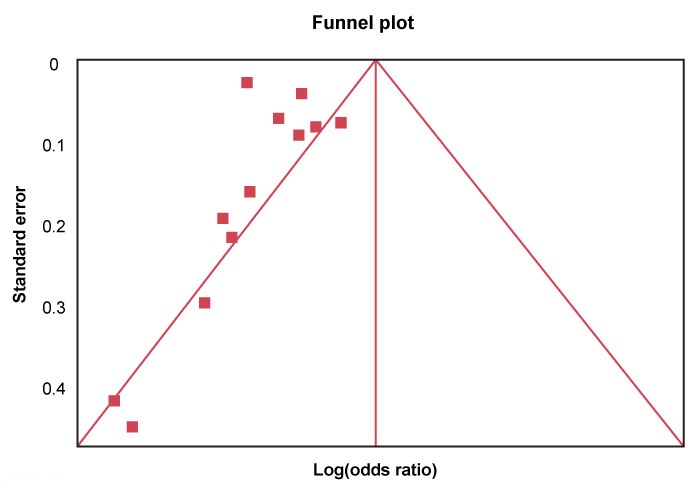 The graphical findings suggest the presence of which of the following?
 (Multiple Choice)
4.9/5 (88)
(88) A 5-day-old girl is brought to the office by her adoptive parents for her first newborn visit. The girl has been doing well. The parents are concerned about her risk of having hemophilia A. The birth father and his brother (the paternal uncle) have hemophilia A. The birth mother does not, and there is no history of bleeding in her family, including in male relatives. The girl is well-appearing and has no abnormalities on examination. Which of the following is the most appropriate response?
(Multiple Choice)
4.8/5 (75)
(75) A 55-year-old Caucasian male presents to your office complaining of easy fatigability. He used to be physically active and always preferred to walk to work, which is five blocks away from where he lives. Now he says, "Doc, I get short of breath when I walk even two blocks." He denies any palpitations, chest pain, cough, or lower extremity swelling. He does not feel down and has no problems with sleep. His past medical history is insignificant. He is currently not taking any medications. His blood pressure is 120/70 mm Hg and heart rate is 95/min. The physical examination is significant for pallor of the conjunctivae and oral mucosa. His laboratory values are: 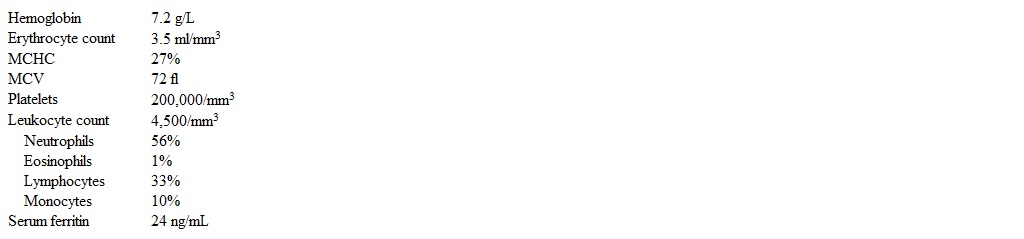 Blood smear analysis shows microcytic erythrocytes with anisocytosis. What is the best next step in the management of this patient?
 (Multiple Choice)
5.0/5 (85)
(85) A 70-year-old Caucasian male presents to clinic complaining of "some very disturbing whirling attacks." He says that on three occasions in this past week, he suddenly began to feel dizzy, nauseated, and found himself unable to walk or speak properly. During these episodes he also noticed a tingling sensation in his lips and that he had double vision. The symptoms resolved gradually after lasting approximately eight to ten minutes. The episodes happened at different times of day, both while at rest and during activity. His medical history is significant for diabetes mellitus, chronic obstructive pulmonary disease, hypertension, hypercholesterolemia, and a remote myocardial infarction. His current medications include metformin, enalapril, hydrochlorothiazide, simvastatin, albuterol, and aspirin. He has a fifty-pack-year smoking history and drinks 1-2 beers per night. He denies having ever used recreational drugs. His temperature is 36.7C (98F), blood pressure is 142/88 mm Hg, pulse is 82/min, and respirations are 14/min. Funduscopic examination shows some neovascularization of the retinal surfaces. Tympanic membranes are translucent and the light reflex is present. Heart sounds are normal. Auscultation of the chest reveals wheezing and diffusely decreased breath sounds. He is barrel-chested. Abdomen is nontender and bowel sounds are present. Mild peripheral edema is evident. There is a loss of vibratory sensation and altered proprioception and impairment of pain, light touch, and temperature in a bilateral stocking-glove distribution. Ankle reflexes are decreased. His most recent laboratory evaluation included the following: 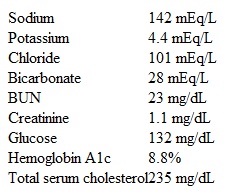 What is the most likely diagnosis?
 (Multiple Choice)
4.8/5 (66)
(66) A graduate student conducting research on the association between vitamin D3 supplementation and cancer is reviewing the abstract of a recently published journal article. The graduate student is interested in conducting further studies among individuals with BMI <25 kg/m2. Which of the following statements regarding these individuals is best supported by the abstract?
(Multiple Choice)
4.9/5 (91)
(91) A 3-year-old boy is brought to the office due to ear drainage. His mother reports that he was well until the previous day, when he developed a fever of 38.9 C (102 F), accompanied by crankiness, decreased appetite, and frequent crying. He was given acetaminophen for his symptoms, but they did not improve. Today his mother put him in his room for a nap; when she returned, thick white liquid was leaking from his right ear. Since waking from his nap, he has not been cranky, but the drainage has persisted. Temperature is 38.3 C (101 F), pulse is 114/min, and respirations are 18/min. On physical examination, he appears alert and active. The pupils are equal and reactive; the nasal turbinates are clear, and there is no erythema or exudate in the pharynx. The left tympanic membrane is normal, but the right tympanic membrane is not visible due to copious purulent drainage in the canal. The pinna appears normal and there is no tenderness on manipulation of the ear. The neck is supple without lymphadenopathy. Cardiopulmonary examination is within normal limits. What is the most likely explanation for this patient's findings?
(Multiple Choice)
4.9/5 (80)
(80) A cross-sectional study is investigating the association between smoking and latent tuberculosis infection (LTBI) in adults age ≥21 in a rural community. Interferon-γ release assay (IGRA) results are used to determine LTBI status; subjects with a positive IGRA result undergo chest x-ray to exclude active pulmonary tuberculosis. Sociodemographic, lifestyle, and health-related information are collected by a standardized questionnaire administered by trained interviewers. The reported results on IGRA positivity among smokers are as follows: 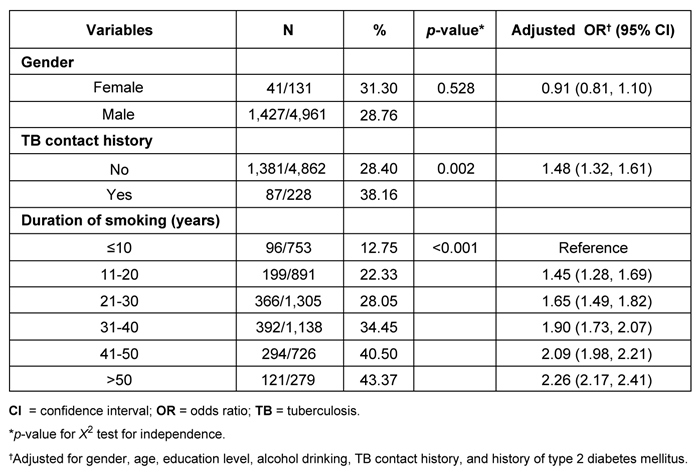 Which of the following factors strongly suggests a potential causal relationship between smoking and LTBI?
 (Multiple Choice)
4.9/5 (75)
(75) A group of researchers is designing a study to investigate the role of a new diet in treating patients with mild hypertension. The researchers are using the following parameters to calculate the sample size required for the study: Expected change (decrease) in systolic blood pressure (SBP) with the new diet: 8 mm HgExpected standard deviation for SBP in the population: 10 mm HgValue for α: 0.01Power: 0.85
Based on these parameters, they estimate the minimum sample size required for a 2-tailed test to be 21. In which of the following situations would a sample size >21 be needed to appropriately address the research question?
(Multiple Choice)
4.9/5 (82)
(82) A 62-year-old woman comes to the physician due to lower extremity edema. She has never had such edema before. She has no dyspnea, cough, or palpitations. Her concurrent medical problems include hypertension, type 2 diabetes mellitus, and chronic bronchitis. She smokes 1.5 packs of cigarettes a day but does not use alcohol or illicit drugs. She brings in a shopping bag of medications, including a variety of antihypertensive and antidiabetic medications, but is uncertain which ones she takes and which she does not. Her blood pressure is 140/90 mm Hg and pulse is 65/min. Physical examination shows symmetric lower extremity edema but is otherwise unremarkable. Which of the following is the most likely potential cause of this patient's condition?
(Multiple Choice)
4.8/5 (71)
(71) A 16-year-old boy is brought to the office by his mother, who is worried that he has been acting "strange" for the past week. She says, "He stays up late at night and is unable to sleep. He eats very little and is really irritable. He seems nervous and hyper and argues with the family, which is not like him. I am a little worried because his father has bipolar disorder. I don't think he would use drugs, but I know that he has some friends who recently got in trouble for smoking marijuana." Medical history includes a football injury and arthroscopic surgery for an anterior cruciate repair 3 months ago. The patient has no other medical issues. He takes no medications other than diphenhydramine, which his mother has given him over the past week to help him sleep. Family history is significant for bipolar disorder and hypertension in his father and attention-deficit hyperactivity disorder in his younger brother, who is treated with medication. When interviewed alone, the patient states that he does not use alcohol, tobacco, or illicit drugs. He says, "I was nervous about final exams. After staying up late to study, it was hard to fall asleep." Temperature is 36.7 C (98 F), blood pressure is 130/90 mm Hg, pulse is 102/min, and respirations are 20/min. Examination shows a restless but otherwise healthy-looking boy. He is slightly diaphoretic and has trouble sitting still. The pupils are dilated and the mouth is dry. Examination of the ears and nose is normal. The lungs are clear on auscultation. The patient's heart is tachycardic with a loud S2 heard on auscultation. Abdominal examination shows no abnormalities. There are no neurologic deficits and no meningeal signs. The patient is talkative and his speech is mildly pressured. Which of the following is the most likely diagnosis?
(Multiple Choice)
4.7/5 (89)
(89) A 5-week-old full-term boy is brought to the emergency department during winter due to intermittent respiratory pauses and cyanosis. He has had rhinorrhea and nasal congestion for the past 2 days. Over the past few weeks, the patient's father and older sibling have had nasal congestion and rhinorrhea but no fever or cough. The boy has received the hepatitis B vaccination and no other immunizations due to his young age. His temperature is 37.1 C (98.8 F). Physical examination shows bilateral crackles and wheezes and intermittent apnea. Leukocyte count is 9,000 cells/mm3, with 60% lymphocytes and 30% neutrophils. Which of the following is the most likely etiology of this patient's condition?
(Multiple Choice)
4.9/5 (78)
(78) 
Filters
- Essay(0)
- Multiple Choice(0)
- Short Answer(0)
- True False(0)
- Matching(0)