



 Chat with AI
Exam 2: Foundations of Independent Practice

Exam 1: Advanced Clinical Medicine1 k+ Questions
Exam 2: Foundations of Independent Practice597 Questions
Select questions type


A 71-year-old man comes to the office due to slowly progressive shortness of breath for the past year. He enjoys working in his garden, but shortness of breath has forced him to reduce the time he spends there. He also has a mild morning cough productive of whitish sputum. He estimates that his physical activity level is <30 min/day. The patient has a history of hypertension. He is a retired middle school teacher. He smoked 2 packs of cigarettes daily for 20 years and quit 15 years ago. Blood pressure is 127/85 mm Hg, pulse is 78/min, respirations are 14/min, and pulse oximetry is 93% on room air. BMI is 24 kg/m2. Occasional end-expiratory wheezes are present on lung examination, and the heart examination demonstrates a regular rate and rhythm. Chest x-ray shows hyperinflation, and pulmonary function test results are consistent with an obstructive defect.
Based on the results of the study, which of the following is most likely to occur if the patient increases his physical activity level to >60 min/day?
(Multiple Choice)
4.7/5  (80)
(80) A 27-year-old woman, gravida 0 para 0, comes to the office with her husband for an infertility evaluation. The patient discontinued her combination oral contraceptive pills 14 months ago, and the couple has been trying to conceive since that time. The patient was initially placed on oral contraceptives at age 19 for dysmenorrhea. Her menstrual periods occur every 27 days; she has 3 days of light bleeding with painful cramping moderately controlled with aspirin, acetaminophen, and heating pads. For the last 8 months, the couple has had intercourse at least every other day from day 9 to day 16 of the patient's cycle. The patient has no chronic medical conditions and has had no surgery. She takes a daily prenatal vitamin. The patient has no history of abnormal Pap tests or sexually transmitted infections. She does not use tobacco, alcohol, or illicit drugs. Her husband is age 34 and has no children from previous relationships. He has no chronic medical conditions or previous surgery. He reports normal pubertal development. The patient's blood pressure is 120/70 mm Hg and pulse is 76/min. Height is 157.5 cm (5 ft 2 in) and BMI is 24 kg/m2. Pelvic examination reveals a well-rugated vagina, a small anteverted uterus, and no adnexal masses. Physical examination of the husband shows normal secondary sexual characteristics and bilaterally descended testes. Which of the following is the most appropriate response to this couple's inability to conceive?
(Multiple Choice)
4.9/5 (76)
(76) A 79-year-old man is brought to the emergency department due to a 2-day history of fever and confusion. His wife reports he has a history of diabetes mellitus; he is frequently noncompliant with his insulin regimen, and his home blood glucose has been >400 mg/dL for the last few days. Temperature is 39.5 C (103.1 F), blood pressure is 90/60 mm Hg, pulse is 118/min, and respirations are 20/min. The patient is confused and ill appearing. He is oriented to person but not place or time. The perineum is erythematous, warm, and tender to palpation; areas of skin sloughing associated with malodorous discharge are present. CT scan of the abdomen and pelvis reveals necrotizing infection of the perineum. Intravenous fluids, insulin, and antibiotics are administered, and the surgical team is consulted. The emergency department physician has a discussion with the patient's wife about the diagnosis and treatment plan. The patient repeatedly says, "I just want to go home. Do not cut me." Which of the following is the best next step in management of this patient?
(Multiple Choice)
5.0/5 (65)
(65) A 43-year-old woman comes to the physician for a rash on her hands. The rash began 8-10 weeks ago. She moved to the community approximately 4 months ago and works as a nurse in the dialysis unit at a nearby hospital. The patient's past medical history is significant for hypertension treated with hydrochlorothiazide. She also takes naproxen regularly for headaches. Her hands are shown in the image below: 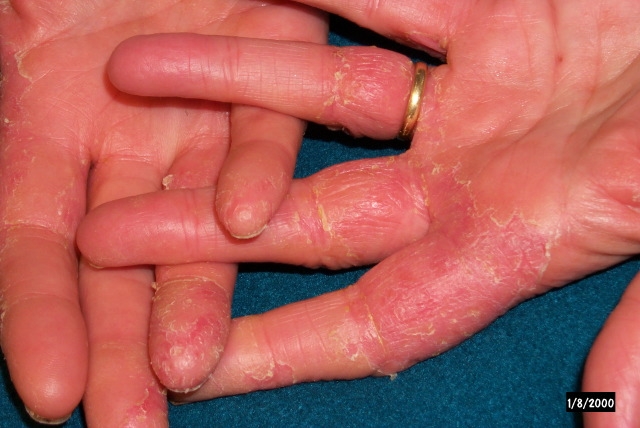 Which of the following is the most likely diagnosis?
 (Multiple Choice)
4.7/5 (63)
(63) A 2-year-old boy is brought to the office due to fever, cough, and irritability lasting 3 days. Medical history is significant for a perirectal abscess that was drained at age 9 months. Temperature is 38.9 C (102 F), blood pressure is 100/70 mm Hg, pulse is 124/min, and respirations are 24/min. Eyes, ears, nose, and throat examinations are normal. Bilateral patchy crackles are auscultated in the lower lobes. Chest x-ray confirms bilateral focal pneumonia. The patient receives empiric antibiotic therapy; however, he is persistently febrile after 3 days. CT scan of the chest reveals a small, left pleural effusion and enlarged paratracheal and hilar lymphadenopathy, in addition to the bilateral pneumonia. Fine-needle biopsy of the lymph nodes and lung tissue shows an inflammatory reaction with granuloma formation. Biopsy cultures grow Burkholderia (Pseudomonas) cepacia. What is the mechanism most likely responsible for this patient's current infection?
(Multiple Choice)
4.8/5 (80)
(80) A 5-year-old boy is brought to the emergency department by his babysitter due to his becoming increasingly irritable and sleepy. She says that the patient had a fever this morning; since then, he has become progressively sleepy and is now difficult to arouse. The child is refusing food and liquids and has vomited twice. The babysitter has watched the boy for the past 2 days while his parents attend a wedding. She tried calling the patient's parents on the way to the emergency department but was unable to reach them. The child's immunization status is unknown. Temperature is 38.9 C (102 F), blood pressure is 90/50 mm Hg, pulse is 114/min, and respirations are 20/min. Physical examination shows a lethargic, pale child who is difficult to arouse. Pupils are 4 mm and reactive to light. A funduscopic examination is deferred due to patient agitation. Nuchal rigidity is noted. Deep tendon reflexes are 2+ in all extremities. Before treatment is initiated, the parents call and say that they will arrive at the hospital within 15 minutes. They state that they will take the boy home and refuse all medical treatment because their religious beliefs preclude them from "interfering with God's will." They offer to have their minister contact the emergency department to explain their beliefs in detail. Which of the following is the most appropriate next step in management of this patient?
(Multiple Choice)
4.8/5 (93)
(93) A 65-year-old woman comes to the office due to osteoporosis that was recently diagnosed on a screening DXA. She feels well, eats a balanced diet, and gets regular exercise. Medical history is unremarkable, but the patient has a family history of osteoporosis in her mother and sister. Vital signs and physical examination are normal. Complete blood count and serum chemistry panel are normal. DXA reveals a T-score of −2.7 at the lumbar spine. The patient says, "I am interested in taking alendronate to prevent fractures. My sister takes it, and it kept her osteoporosis from getting worse." Which of the following tests should be performed prior to initiating this medication?
(Multiple Choice)
4.7/5 (79)
(79) A 23-year-old man is brought to the emergency department after a head-on motor vehicle collision in which both vehicles were traveling at moderate speed. The patient was a restrained driver in the collision. He has no significant medical history and takes no medications. Initially he reports pelvic pain only. Blood pressure on arrival is 132/65 mm Hg and pulse is 102/min. He is given bolus intravenous fluids and opioid analgesics for pain. The patient's cervical spine is clinically cleared for acute fractures, and he is diagnosed by plain film with a pelvic fracture. A pelvic binder is applied. One hour after initial presentation, the patient is short of breath and has chest pain. Blood pressure is 122/70 mm Hg and pulse is 84/min. Pulse oximetry shows 95% on room air. Physical examination shows the patient to be in no apparent distress lying supine. Mucous membranes are moist. No jugular venous distension or tracheal deviation is present. The patient is not using accessory respiratory muscles, and no penetrating chest trauma is noted. Breath sounds are diminished on the right upper lung field with hyperresonance to percussion and absent fremitus. The abdomen is soft and nontender. No distension, hepatomegaly, splenomegaly, or free fluid is present. The remainder of the examination is normal. Which of the following is the best initial test to assess for the suspected diagnosis of pneumothorax in this patient?
(Multiple Choice)
4.9/5 (84)
(84) It is estimated that the prevalence of smoking in a population is 50%. A cohort study conducted using a random sample from this population showed that the 5-year risk of ischemic stroke is 1:1000 among smokers and 0.5:1000 among non-smokers. What percentage of ischemic strokes observed in smokers can be attributed to their smoking status?
(Multiple Choice)
4.9/5 (69)
(69) A phase 3, randomized controlled trial was conducted to evaluate the effect of Drug X and Drug Y on serum parathyroid hormone (PTH) concentrations in patients receiving hemodialysis with severe secondary hyperparathyroidism. A total of 508 patients were randomly assigned to Drug X or Drug Y after each hemodialysis session for 26 weeks. The primary efficacy endpoint was the percentage of patients achieving >30% reduction in mean PTH from baseline during weeks 20-27. A secondary efficacy endpoint was the percentage of patients achieving mean PTH <300 pg/mL. An excerpt of the study results is as follows: 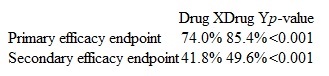 Based on these results, which of the following is a possible 95% confidence interval for the difference in the percentage of patients who achieved the primary efficacy endpoint between Drug X and Drug Y?
 (Multiple Choice)
4.8/5 (85)
(85) A retrospective cohort study examines the long-term risk of ischemic stroke in patients with perioperative atrial fibrillation following cardiac and noncardiac surgery. The following data are reported: Which of the following best describes the study results?
(Multiple Choice)
4.7/5 (69)
(69) A three-arm, randomized crossover trial is conducted to determine whether the profile of circulating micro RNAs (miRNAs) is altered after acute resistance training with blood flow restriction (BFR), as compared with unrestricted low- and high-volume training. Eighteen healthy volunteers (mean age 25) are enrolled. The arms are single bouts of leg flexion/extension resistance training at: 70% of the individual single-repetition maximum (1RM)30% of the 1RM30% of the 1RM with BFR (artificially applied by a cuff at 300 mm Hg)
During each training intervention, load-associated outcomes (fatigue, heart rate, and exhaustion) are monitored. Acute effects (circulating miRNAs and lactate) are determined using pre- and postintervention measurements. Preliminary results show that lower lactate concentrations tend to correspond with lower miR-143-3p expression, and that the relationship is very strong and statistically significant. Based on this information, which of the following statements is most correct about the correlation coefficient r for this relationship?
(Multiple Choice)
4.8/5 (82)
(82) A 64-year-old woman comes to an academic teaching hospital due to abdominal pain and nausea. Physical examination shows low-grade fever and right lower quadrant abdominal tenderness. CT scan of the abdomen is consistent with acute appendicitis and a laparoscopic appendectomy is planned. The surgeon discusses the risks and benefits of the procedure and alternate treatment options. The patient agrees to undergo the surgery. The surgeon plans to delegate certain noncritical components of the surgery to the senior resident. Which of the following is the most appropriate approach regarding the resident's involvement in the care of this patient?
(Multiple Choice)
4.9/5 (85)
(85) A 14-year-old girl is brought to the office due to recurrent headaches. The headaches began 2 weeks ago while she was studying for end-of-semester exams. Since then, the patient has had headaches almost daily but has been able to continue school and other daily activities. The headaches are of moderate intensity, bifrontal, non-throbbing, exacerbated by loud noise, and relieved by sleep. She has had no nausea or vomiting. Her mother has a history of migraine. Vital signs are within normal limits. BMI is 28 kg/m2. Nasal and oropharyngeal mucosae and tympanic membranes are normal. Neurological examination shows normal bilateral pupillary response and normal motor strength, sensation, and deep tendon reflexes. There is no neck rigidity. Which of the following is the most likely cause of this patient's headaches?
(Multiple Choice)
4.9/5 (80)
(80) A 13-year-old girl comes to the physician for evaluation of her third episode of maxillary sinusitis during the past 7 months. She complains of fever, headache, nasal congestion, and facial pain that began 3 days ago. Except for previous sinusitis episodes, her medical history is unremarkable. The patient has no known allergies. Her family history is unremarkable, but both parents smoke cigarettes. On examination, she has maxillary sinus tenderness and purulent nasal discharge. The remainder of the examination is normal. Computed tomography scan demonstrates mucosal thickening, opacification, and air-fluid levels in the maxillary sinuses. Which of the following should the physician say to the patient's parents?
(Multiple Choice)
4.9/5 (74)
(74) A newborn boy is delivered by cesarean delivery at 39 weeks gestation to a 26-year-old woman, gravida 1 para 1, with gestational diabetes mellitus. First-trimester laboratory testing was normal, and second-trimester ultrasound showed no anomalies. At 28 weeks gestation, oral glucose tolerance testing indicated hyperglycemia, for which the patient initiated dietary modification and exercise. At 34 weeks gestation, maternal fasting blood sugars were consistently >100 mg/dL. She was started on subcutaneous insulin therapy but was frequently hyperglycemic. Other than prenatal vitamins, the patient's mother did not take any medications and did not use tobacco, alcohol, or illicit drugs. The infant's birthweight is 3.99 kg (8.8 lb). Temperature is 36.8 C (98.2 F), blood pressure is 70/40 mm Hg, pulse is 150/min, and respirations are 62/min. Pulse oximetry on room air is 92% in the right upper extremity and 93% in the left lower extremity. Examination shows a nondysmorphic infant with mild tachypnea, nasal flaring, and retractions. Auscultation reveals a heart murmur, but breath sounds are clear. Chest radiograph reveals mild pulmonary congestion.
An echocardiogram in this neonate would most likely show which of the following findings?
(Multiple Choice)
4.8/5 (69)
(69) A 33-year-old woman comes to the clinic for a routine health maintenance examination. She has no lower abdominal pain, vaginal bleeding, or vaginal discharge. Her past medical history is remarkable for 1 episode of uncomplicated urinary tract infection treated with a short course of antibiotics. She is currently not taking any medications. She has had 5 sexual partners in her life and has used barrier contraception the majority of the time. Her latest sexual relationship began 3 months ago. Her last cervical cancer screening examination was a Pap smear performed at the age of 23 that showed no abnormalities. She does not use tobacco, alcohol, or illicit drugs. During her visit, she requests screening for cervical cancer and appears extremely concerned as her older sister was recently diagnosed with it. During the study, women with abnormal Pap test results or a positive HPV test underwent colposcopy and biopsy, as did a random sample of women with negative test results. The purpose of performing a colposcopy and a biopsy on women with negative test results is to reduce which type of bias?
(Multiple Choice)
4.9/5 (80)
(80) A pharmaceutical company sales representative comes into the office to provide information on a new discount program for the company's antidepressant medication. One of the office staff members performs a search of the practice electronic record system; she finds 2 patients on the schedule for the following week who are taking the drug and provides the names and addresses to the sales representative so that he can send information about the program. Later that day, when the clinician is notified of what happened, she immediately instructs the sales representative to not contact the patients and delete their information from his laptop computer. Which of the following is the most appropriate next step in addressing this situation?
(Multiple Choice)
4.9/5 (65)
(65) A 30-month-old boy is admitted to the hospital due to a 3-day history of fever, cough, and dyspnea. He has a history of recurrent infections, including 4 episodes of cervical lymphadenitis that responded slowly to treatment with clindamycin. Temperature is 38.2 C (100.8 F), blood pressure is 90/60 mm Hg, pulse is 100/min, and respirations are 30/min. The anterior cervical lymph nodes are palpated bilaterally with several firm, 1- to 1.5-cm nodes that are nontender, nonfluctuant, and without overlying erythema. Breath sounds are diminished at the left lower lung base. The abdomen is soft, nontender, and nondistended without hepatosplenomegaly. A chest x-ray reveals a patchy infiltrate in the left lower lobe and a moderately sized pleural effusion. A chest tube is placed, and cloudy fluid is obtained. Laboratory results are as follows: 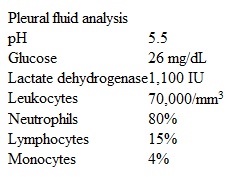 Microscopy of pleural fluid shows numerous, intact gram-negative rods within neutrophils; cultures ultimately grow Burkholderia cepacia. The patient's condition improves with appropriate treatment. Which of the following is most appropriate for infection prophylaxis for this patient?
 (Multiple Choice)
4.8/5 (75)
(75) A 22-year-old soccer player comes to the emergency department with knee pain. During her practice earlier that day she tried to run around another player on the right when she felt a popping sensation in her right knee followed by pain and rapid swelling. The patient has no other injury or blow to the knee. She has had no significant prior knee injuries. Her past medical history is unremarkable. On physical examination, the right knee is significantly swollen and tender. Ambulation appears awkward and she hesitates to bear weight on the right leg. Aspiration of the knee yields grossly bloody joint fluid. Which of the following is the most likely diagnosis?
(Multiple Choice)
4.9/5 (73)
(73) 
Filters
- Essay(0)
- Multiple Choice(0)
- Short Answer(0)
- True False(0)
- Matching(0)