Multiple Choice
A 65-year-old man is scheduled for hip replacement surgery. He is worried about possible complications of the surgery, particularly the risk of heart attack. A retrospective cohort study identified 98,102 patients who underwent total knee replacement (TKR) or total hip replacement (THR) surgery and compared their rates of myocardial infarction (MI) with those of controls matched by age, sex, and geographic region. The following curves for hazard ratios (HR) were obtained. 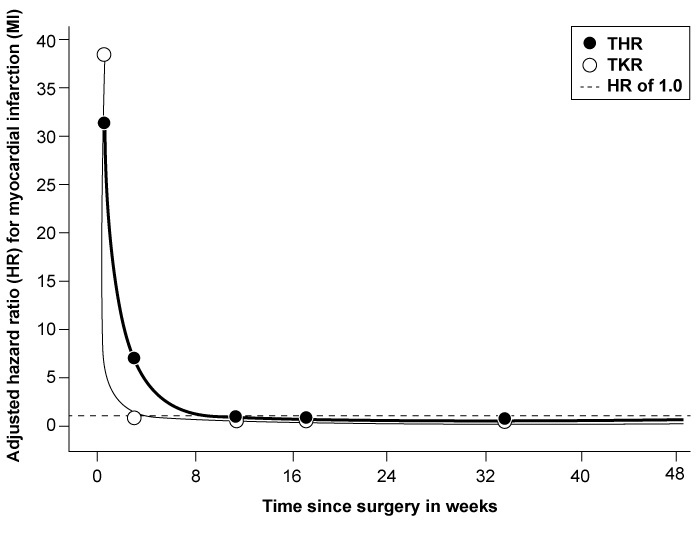 Based on the study results and assuming statistical significance, which of the following provides the best explanation to the patient?
A) Although there is no risk of heart attack immediately following surgery, the risk increases after hospital discharge.
B) There is an increased risk of heart attack after surgery, which is best explained by risk factors and comorbidities.
C) There is an increased risk of heart attack right after surgery, but it returns to baseline after 4 weeks.
D) There is an increased risk of heart attack up to approximately 8-10 weeks after the surgery.
E) There is no substantial proof that the surgery is associated with a higher risk of heart attack.
Correct Answer:

Verified
Correct Answer:
Verified
Q163: A 48-year-old woman complains of persistent fatigue
Q164: Researchers are evaluating a diagnostic test for
Q165: A 42-year-old man of white ethnicity comes
Q166: A 42-year-old Caucasian woman comes to the
Q167: A 30-year-old Caucasian male comes to your
Q169: A 16-year-old Caucasian male presents with decreased
Q170: An 84-year-old man is being treated for
Q171: A 32-year-old man comes to the emergency
Q172: A team of neurologists and psychologists researching
Q173: A 20-year-old man develops substernal chest pain