



 Chat with AI
Exam 14: Mendelian Genetics

Exam 1: Biology and Its Themes46 Questions
Exam 2: Atoms and Molecules61 Questions
Exam 3: The Chemistry of Water55 Questions
Exam 4: Carbon: the Basis of Molecular Diversity52 Questions
Exam 5: Biological Macromolecules and Lipids71 Questions
Exam 6: Energy and Life65 Questions
Exam 7: Cell Structure and Function66 Questions
Exam 8: Cell Membranes67 Questions
Exam 9: Cellular Signaling62 Questions
Exam 10: Cell Respiration68 Questions
Exam 11: Photosynthetic Processes64 Questions
Exam 12: Mitosis63 Questions
Exam 13: Sexual Life Cycles and Meiosis64 Questions
Exam 14: Mendelian Genetics65 Questions
Exam 15: Linkage and Chromosomes54 Questions
Exam 16: Nucleic Acids and Inheritance65 Questions
Exam 17: Expression of Genes70 Questions
Exam 18: Control of Gene Expression66 Questions
Exam 19: Dna Technology56 Questions
Exam 20: The Evolution of Genomes47 Questions
Exam 21: How Evolution Works60 Questions
Exam 22: Phylogenetic Reconstruction66 Questions
Exam 23: Microevolution65 Questions
Exam 24: Species and Speciation65 Questions
Exam 25: Macroevolution58 Questions
Exam 26: Introduction to Viruses54 Questions
Exam 27: Prokaryotes61 Questions
Exam 28: The Origin and Evolution of Eukaryotes66 Questions
Exam 29: Nonvascular and Seedless Vascular Plants72 Questions
Exam 30: Seed Plants64 Questions
Exam 31: Introduction to Fungi56 Questions
Exam 32: An Introduction to Animal Diversity58 Questions
Exam 33: Invertebrates58 Questions
Exam 34: Vertebrates66 Questions
Exam 35: Plant Structure and Growth68 Questions
Exam 36: Transport in Vascular Plants73 Questions
Exam 37: Plant Nutrition51 Questions
Exam 38: Reproduction of Flowering Plants59 Questions
Exam 39: Plant Signals and Behavior60 Questions
Exam 40: The Animal Body58 Questions
Exam 41: Chemical Signals in Animals62 Questions
Exam 42: Animal Digestive Systems58 Questions
Exam 43: Animal Transport Systems58 Questions
Exam 44: Animal Excretory Systems49 Questions
Exam 45: Animal Reproductive Systems64 Questions
Exam 46: Development in Animals68 Questions
Exam 47: Animal Defenses Against Infection65 Questions
Exam 48: Electrical Signals in Animals62 Questions
Exam 49: Neural Regulation in Animals69 Questions
Exam 50: Sensation and Movement in Animals68 Questions
Exam 51: An Overview of Ecology71 Questions
Exam 52: Behavioral Ecology64 Questions
Exam 53: Populations and Life History Traits73 Questions
Exam 54: Biodiversity and Communities71 Questions
Exam 55: Energy Flow and Chemical Cycling in Ecosystems80 Questions
Exam 56: Conservation and Global Ecology75 Questions
Select questions type


Which of the following best describes how an individual with genotype AaBbCCDdEE can make haploid gametes with different genotypes?
(Multiple Choice)
4.9/5  (91)
(91) Which of the following phenotypes is an example of polygenic inheritance?
(Multiple Choice)
4.8/5 (76)
(76) A gene for the MN blood group has codominant alleles M and N. If both children in a family are of blood type M, which of the following situations is possible?
(Multiple Choice)
4.7/5 (97)
(97) If the parent or offspring genotypes or phenotypes are known, the pattern of inheritance can be predicted. Two organisms, with genotypes BbDD and BBDd, are mated. Assuming independent assortment of the two loci, which of the following genotypic ratios in offspring would occur?
(Multiple Choice)
4.9/5 (72)
(72) In rabbits, the homozygous genotype LCLC has straight legs, LCLc results in deformed legs, and LcLc results in very short legs. The genotype FBFB produces black fur, FBFb brown fur, and FbFb white fur. If a cross is made between brown rabbits with deformed legs and white rabbits with deformed legs, what percent of the offspring would be expected to have deformed legs and white fur?
(Multiple Choice)
4.8/5 (74)
(74) Gene S controls the sharpness of spines in a type of cactus. Cacti with the dominant allele, S, have sharp spines, whereas homozygous recessive ss cacti have dull spines. Also, a second gene, N, determines whether or not cactuses have spines. Homozygous recessive nn cactuses have no spines at all. What phenotypes would be expected from a cross between a true-breeding sharp-spined cactus and a spineless cactus?
(Multiple Choice)
4.7/5 (77)
(77) Mendel crossed true breeding yellow-seeded and green-seeded pea plants and then allowed the offspring to self-pollinate to produce an F2 generation. The results were as follows: 6,022 yellow and 2,001 green (8,023 total). Which of the following statements correctly describes the relationship of the allele for green seeds to the allele for yellow seeds?
(Multiple Choice)
4.8/5 (78)
(78) Which of the following statements correctly describes the terms monohybrid cross and dihybrid cross?
(Multiple Choice)
4.8/5 (82)
(82) Phenylketonuria is an inherited disease caused by a recessive allele. If a woman and her husband are both carriers, what is the probability that their first child will be a girl without phenylketonuria?
(Multiple Choice)
5.0/5 (78)
(78) Phenylketonuria (PKU) is a recessive human disorder in which an individual cannot appropriately break down the amino acid phenylalanine. This amino acid is not naturally produced by humans. Which of the following treatments would be most effective for people with PKU?
(Multiple Choice)
4.7/5 (70)
(70) In a particular plant, green seed color is dominant to blue. If two plants with green seeds were crossed and resulted in 302 green and 98 blue seed plants, what was the most probable genotype of each parent?
(Multiple Choice)
4.9/5 (93)
(93) The following question refers to the figure of a family's pedigree chart, some of whose members exhibit the dominant trait, W. Affected individuals are indicated by a dark square or circle. 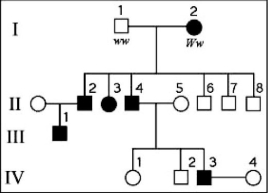 What is the likelihood that a future child of IV-3 and IV-4 will have the trait?
 (Multiple Choice)
4.9/5 (77)
(77) One of two major forms of neurofibromatosis results from inheriting a dominant allele of a gene with affected individuals having phenotypes that range from mild to very severe. Which of the following is the best explanation for why a young child is the first in her family to be diagnosed with a severe form of the condition?
(Multiple Choice)
4.9/5 (78)
(78) How many unique gametes could be produced through independent assortment by an individual with the genotype AaBbCCDdEE?
(Multiple Choice)
4.9/5 (87)
(87) Skin color in a certain species of fish is inherited via a single gene with four different alleles. Each allele confers a unit of color darkness such that having allele S1 confers one unit of color, S2 has two units, S3 has three units, and S4 confers four units. A fish of this type has the genotype S1S3, and its mate has the genotype S2S4. What proportion of their offspring would be expected to have five units of color?
(Multiple Choice)
4.8/5 (68)
(68) In some parts of Africa, the frequency of individuals who are heterozygous for the sickle-cell anemia allele is higher than the frequency in North America, presumably because this reduces the frequency of malaria. Such a relationship is related to which of the following?
(Multiple Choice)
4.8/5 (91)
(91) Which of the following best describes how an individual with genotype AaBbCCDdEE can make gametes with eight different genotypes.
(Multiple Choice)
4.8/5 (71)
(71) Use the figure and the following description to answer the question.
In a particular plant, leaf color is controlled by gene locus D. Plants with at least one allele D have dark green leaves, and plants with the homozygous recessive dd genotype have light green leaves. A true-breeding, dark-leaved plant is crossed with a light-leaved one, and the F1 offspring is allowed to self-pollinate. The predicted outcome of the F1 cross is diagrammed in the Punnett square shown in the figure, where 1, 2, 3, and 4 represent the genotypes corresponding to each box within the square. 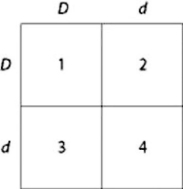 Which of the boxes marked 1-4 correspond to plants that will be true-breeding?
 (Multiple Choice)
4.8/5 (81)
(81) A diploid animal is dihybrid at the Head shape (H) and Tail length (T) loci. Which of the following gamete genotypes can it produce?
(Multiple Choice)
5.0/5 (74)
(74) Why did all of the F1 offspring of Mendel's purple and white flowered pea cross always look like one of the two parental varieties?
(Multiple Choice)
4.8/5 (78)
(78) 
Filters
- Essay(0)
- Multiple Choice(0)
- Short Answer(0)
- True False(0)
- Matching(0)