



 Chat with AI
Exam 39: Plant Signals and Behavior

Exam 1: Biology and Its Themes46 Questions
Exam 2: Atoms and Molecules61 Questions
Exam 3: The Chemistry of Water55 Questions
Exam 4: Carbon: the Basis of Molecular Diversity52 Questions
Exam 5: Biological Macromolecules and Lipids71 Questions
Exam 6: Energy and Life65 Questions
Exam 7: Cell Structure and Function66 Questions
Exam 8: Cell Membranes67 Questions
Exam 9: Cellular Signaling62 Questions
Exam 10: Cell Respiration68 Questions
Exam 11: Photosynthetic Processes64 Questions
Exam 12: Mitosis63 Questions
Exam 13: Sexual Life Cycles and Meiosis64 Questions
Exam 14: Mendelian Genetics65 Questions
Exam 15: Linkage and Chromosomes54 Questions
Exam 16: Nucleic Acids and Inheritance65 Questions
Exam 17: Expression of Genes70 Questions
Exam 18: Control of Gene Expression66 Questions
Exam 19: Dna Technology56 Questions
Exam 20: The Evolution of Genomes47 Questions
Exam 21: How Evolution Works60 Questions
Exam 22: Phylogenetic Reconstruction66 Questions
Exam 23: Microevolution65 Questions
Exam 24: Species and Speciation65 Questions
Exam 25: Macroevolution58 Questions
Exam 26: Introduction to Viruses54 Questions
Exam 27: Prokaryotes61 Questions
Exam 28: The Origin and Evolution of Eukaryotes66 Questions
Exam 29: Nonvascular and Seedless Vascular Plants72 Questions
Exam 30: Seed Plants64 Questions
Exam 31: Introduction to Fungi56 Questions
Exam 32: An Introduction to Animal Diversity58 Questions
Exam 33: Invertebrates58 Questions
Exam 34: Vertebrates66 Questions
Exam 35: Plant Structure and Growth68 Questions
Exam 36: Transport in Vascular Plants73 Questions
Exam 37: Plant Nutrition51 Questions
Exam 38: Reproduction of Flowering Plants59 Questions
Exam 39: Plant Signals and Behavior60 Questions
Exam 40: The Animal Body58 Questions
Exam 41: Chemical Signals in Animals62 Questions
Exam 42: Animal Digestive Systems58 Questions
Exam 43: Animal Transport Systems58 Questions
Exam 44: Animal Excretory Systems49 Questions
Exam 45: Animal Reproductive Systems64 Questions
Exam 46: Development in Animals68 Questions
Exam 47: Animal Defenses Against Infection65 Questions
Exam 48: Electrical Signals in Animals62 Questions
Exam 49: Neural Regulation in Animals69 Questions
Exam 50: Sensation and Movement in Animals68 Questions
Exam 51: An Overview of Ecology71 Questions
Exam 52: Behavioral Ecology64 Questions
Exam 53: Populations and Life History Traits73 Questions
Exam 54: Biodiversity and Communities71 Questions
Exam 55: Energy Flow and Chemical Cycling in Ecosystems80 Questions
Exam 56: Conservation and Global Ecology75 Questions
Select questions type


Which of the following colors of visible light induces phototrophic curvature in coleoptiles most effectively?
(Multiple Choice)
4.8/5  (75)
(75) Which of the following environmental factors can be sensed by plants?
I. gravity
II. pathogens
III. wind
IV. light
(Multiple Choice)
4.9/5 (79)
(79) If a farmer wanted less tightly packed clusters of grapes, he would most likely spray the immature bunches with which of the following hormones?
(Multiple Choice)
4.9/5 (67)
(67) Which of the following is an adaptation that allows woody species to survive freezing temperatures?
(Multiple Choice)
5.0/5 (73)
(73) A gardener in Canada wants to surprise his mother on her birthday and make her favorite hibiscus bush flower in May instead of at the end of June. The bush is growing in the greenhouse. Which of the following treatments is most likely to make the hibiscus bush flower early?
(Multiple Choice)
4.7/5 (74)
(74) A particular type of virus carries a gene for salicylate hydroxylase, an enzyme that breaks down salicylic acid. Which of the following responses is most likely?
(Multiple Choice)
4.8/5 (74)
(74) An individual plant was discovered that could not grow towards light. After some research, it was determined that the reason was a defective gene that did not allow for the level of cell elongation necessary for a phototropic response. This mutation greatly reduces the fitness of the individual plant. Which of the following best explains the reduction in fitness in the mutant plant?
(Multiple Choice)
4.8/5 (83)
(83) You want to alter the shape of a growing plant, causing it to bend by applying auxin to one side of the stem. Application at which of the following positions, A, B, C, or D would produce the greatest bending? 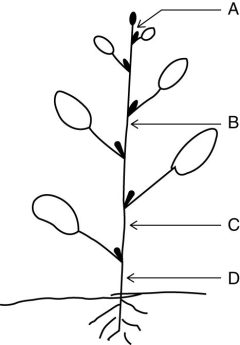
(Multiple Choice)
4.8/5 (84)
(84) Which of the following plant responses requires integration of auxin, cytokinin, and strigolactone?
(Multiple Choice)
4.9/5 (81)
(81) Corn seeds were germinated on two petri dishes of agar containing a colored pH indicator. The dishes were placed on edge with the seedling oriented either vertically (A) or horizontally (B). After 24-hours growth, the plates appeared as in C and D. Dark areas in D indicate lower pH. 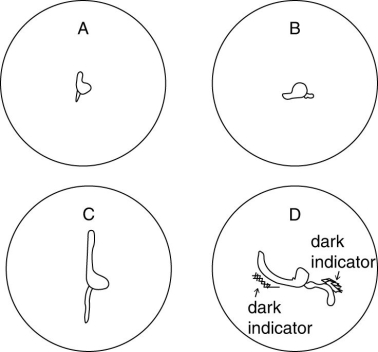 Which of the following statements is supported using the data?
 (Multiple Choice)
4.9/5 (97)
(97) Which of the following mechanisms is most directly responsible for controlling circadian rhythms in plants?
(Multiple Choice)
4.9/5 (70)
(70) Seed packets give a recommended planting depth for the enclosed seeds. Which of the following is the most likely reason some seeds are to be covered with only a thin layer of soil after planting?
(Multiple Choice)
4.8/5 (77)
(77) Mammalian eyes sense light because the photoreceptor cells have molecules called opsins that change structure when exposed to light. Which of the following plant molecules is most analogous to mammalian opsins in their light-sensing ability?
(Multiple Choice)
4.8/5 (82)
(82) Which of the following is involved in the rapid leaf movements resulting from a response to touch (thigmotropism)?
(Multiple Choice)
4.9/5 (72)
(72) A plant scientist was hired by a greenhouse operator to devise a way to force iris plants to bloom in the short days of winter. Iris normally blooms as a long-day (short-night) plant. Which of the following treatments has the best chance of creating iris blooms in winter?
(Multiple Choice)
4.7/5 (76)
(76) Which of the following must occur for a plant to initiate chemical responses to herbivory, before it is directly affected by herbivores?
(Multiple Choice)
4.9/5 (73)
(73) Most scientists agree that climate change is underway; thus, it is important to know how plants respond to heat stress. Which of the following would be a useful line of inquiry to try and improve plant response and survival to heat stress?
(Multiple Choice)
4.9/5 (86)
(86) Which of the following detects light during de-etiolation (greening) of a tomato plant?
(Multiple Choice)
4.8/5 (81)
(81) Use the figure to answer the following question. 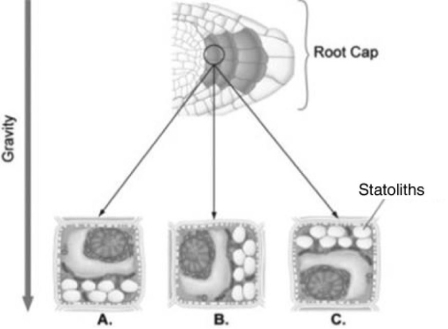 Suppose you laid a seedling on its side so that the root was parallel to the ground as shown in the figure. Several hours after the change in position, in which labeled position(s), A, B, or C in the figure, are statoliths most likely to be located?
 (Multiple Choice)
4.8/5 (83)
(83) 
Filters
- Essay(0)
- Multiple Choice(0)
- Short Answer(0)
- True False(0)
- Matching(0)