



 Chat with AI
Exam 39: Plant Signals and Behavior

Exam 1: Biology and Its Themes46 Questions
Exam 2: Atoms and Molecules61 Questions
Exam 3: The Chemistry of Water55 Questions
Exam 4: Carbon: the Basis of Molecular Diversity52 Questions
Exam 5: Biological Macromolecules and Lipids71 Questions
Exam 6: Energy and Life65 Questions
Exam 7: Cell Structure and Function66 Questions
Exam 8: Cell Membranes67 Questions
Exam 9: Cellular Signaling62 Questions
Exam 10: Cell Respiration68 Questions
Exam 11: Photosynthetic Processes64 Questions
Exam 12: Mitosis63 Questions
Exam 13: Sexual Life Cycles and Meiosis64 Questions
Exam 14: Mendelian Genetics65 Questions
Exam 15: Linkage and Chromosomes54 Questions
Exam 16: Nucleic Acids and Inheritance65 Questions
Exam 17: Expression of Genes70 Questions
Exam 18: Control of Gene Expression66 Questions
Exam 19: Dna Technology56 Questions
Exam 20: The Evolution of Genomes47 Questions
Exam 21: How Evolution Works60 Questions
Exam 22: Phylogenetic Reconstruction66 Questions
Exam 23: Microevolution65 Questions
Exam 24: Species and Speciation65 Questions
Exam 25: Macroevolution58 Questions
Exam 26: Introduction to Viruses54 Questions
Exam 27: Prokaryotes61 Questions
Exam 28: The Origin and Evolution of Eukaryotes66 Questions
Exam 29: Nonvascular and Seedless Vascular Plants72 Questions
Exam 30: Seed Plants64 Questions
Exam 31: Introduction to Fungi56 Questions
Exam 32: An Introduction to Animal Diversity58 Questions
Exam 33: Invertebrates58 Questions
Exam 34: Vertebrates66 Questions
Exam 35: Plant Structure and Growth68 Questions
Exam 36: Transport in Vascular Plants73 Questions
Exam 37: Plant Nutrition51 Questions
Exam 38: Reproduction of Flowering Plants59 Questions
Exam 39: Plant Signals and Behavior60 Questions
Exam 40: The Animal Body58 Questions
Exam 41: Chemical Signals in Animals62 Questions
Exam 42: Animal Digestive Systems58 Questions
Exam 43: Animal Transport Systems58 Questions
Exam 44: Animal Excretory Systems49 Questions
Exam 45: Animal Reproductive Systems64 Questions
Exam 46: Development in Animals68 Questions
Exam 47: Animal Defenses Against Infection65 Questions
Exam 48: Electrical Signals in Animals62 Questions
Exam 49: Neural Regulation in Animals69 Questions
Exam 50: Sensation and Movement in Animals68 Questions
Exam 51: An Overview of Ecology71 Questions
Exam 52: Behavioral Ecology64 Questions
Exam 53: Populations and Life History Traits73 Questions
Exam 54: Biodiversity and Communities71 Questions
Exam 55: Energy Flow and Chemical Cycling in Ecosystems80 Questions
Exam 56: Conservation and Global Ecology75 Questions
Select questions type


Which of the following describes a difference between hormonal regulation in plants compared to animals?
(Multiple Choice)
4.8/5  (81)
(81) Which hormone prevents seeds from germinating until conditions are favorable for the growth of the plant?
(Multiple Choice)
4.9/5 (69)
(69) Suppose a plant had a photosynthetic pigment that absorbed far-red wavelengths of light. In which of the following environments is the plant most likely to thrive?
(Multiple Choice)
5.0/5 (82)
(82) Auxins frequently interact with other plant hormones to cause a particular process. Which of the following processes is attributed ONLY to auxin?
(Multiple Choice)
4.7/5 (87)
(87) What are the primary sites of auxin (IAA) production in plants?
(Multiple Choice)
5.0/5 (89)
(89) If you were shipping green bananas to a supermarket thousands of miles away, removing which of the following chemicals from the plants' environment will best prevent premature fruit ripening?
(Multiple Choice)
4.8/5 (90)
(90) If a long-day plant has a critical night length of 9 hours, which 24-hour cycle would prevent flowering?
(Multiple Choice)
4.8/5 (85)
(85) Plants often use changes in day length (photoperioD) to trigger events such as dormancy and flowering. Which of the following best explains why day-neutral plants are more common in the tropics than in temperate zones?
(Multiple Choice)
5.0/5 (82)
(82) A population of plants experienced several years of severe drought. Most of the plants died due to lack of water, but a few individuals survived. The surviving plants probably produced higher levels of which of the following hormones?
(Multiple Choice)
4.9/5 (89)
(89) Which type of mutant is most likely to produce a bushier phenotype?
(Multiple Choice)
4.9/5 (89)
(89) Unlike animal hormones, plant hormones can have multiple functions depending on which of the following factors?
I. site of action
II. concentration
III. developmental stage
IV. chronological age
(Multiple Choice)
5.0/5 (85)
(85) The hormone that helps plants respond to drought is ________.
(Multiple Choice)
4.8/5 (101)
(101) Upon exposure to blue light, plants not only begin to grow toward the light, but redistribute the chloroplasts to the sunny side of each cell. Which of the following best explains the adaptive advantage of moving chloroplasts to the sunny side of each cell?
(Multiple Choice)
4.9/5 (76)
(76) Many plants flower in response to day-length cues. Which of the following statements correctly describes the relationship between day length and flowering?
(Multiple Choice)
4.7/5 (83)
(83) You have a small tree in your yard that is the height that you want it, but does not have as many branches as you want. Which of the following pruning strategies will trigger increased branching?
(Multiple Choice)
4.8/5 (77)
(77) In an experiment investigating phototropism, pieces of shoot apices were applied to small blocks of agar with light shining from one side only. The apices were either partly or completely divided in two with a barrier that also divided the blocks. The figure summarizes the results of the experiment. Numbers indicate the percent of auxin moving from the apex into the agar segment below it. 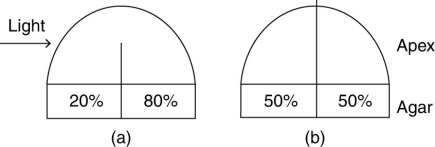 Which of the following hypotheses is best supported by the data?
 (Multiple Choice)
4.8/5 (85)
(85) Cytokinins, produced primarily in roots, travel by which of the following structures to influence branching in a recently topped tree (tree whose upper branches have been trimmed off)?
(Multiple Choice)
4.9/5 (78)
(78) The signaling molecule for flowering might be released earlier than usual in a long-day plant exposed to flashes of ________.
(Multiple Choice)
4.8/5 (80)
(80) Which event during the evolution of land plants favored the synthesis of secondary compounds?
(Multiple Choice)
4.8/5 (70)
(70) 
Filters
- Essay(0)
- Multiple Choice(0)
- Short Answer(0)
- True False(0)
- Matching(0)