



 Chat with AI
Exam 4: Carbon: the Basis of Molecular Diversity

Exam 1: Biology and Its Themes46 Questions
Exam 2: Atoms and Molecules61 Questions
Exam 3: The Chemistry of Water55 Questions
Exam 4: Carbon: the Basis of Molecular Diversity52 Questions
Exam 5: Biological Macromolecules and Lipids71 Questions
Exam 6: Energy and Life65 Questions
Exam 7: Cell Structure and Function66 Questions
Exam 8: Cell Membranes67 Questions
Exam 9: Cellular Signaling62 Questions
Exam 10: Cell Respiration68 Questions
Exam 11: Photosynthetic Processes64 Questions
Exam 12: Mitosis63 Questions
Exam 13: Sexual Life Cycles and Meiosis64 Questions
Exam 14: Mendelian Genetics65 Questions
Exam 15: Linkage and Chromosomes54 Questions
Exam 16: Nucleic Acids and Inheritance65 Questions
Exam 17: Expression of Genes70 Questions
Exam 18: Control of Gene Expression66 Questions
Exam 19: Dna Technology56 Questions
Exam 20: The Evolution of Genomes47 Questions
Exam 21: How Evolution Works60 Questions
Exam 22: Phylogenetic Reconstruction66 Questions
Exam 23: Microevolution65 Questions
Exam 24: Species and Speciation65 Questions
Exam 25: Macroevolution58 Questions
Exam 26: Introduction to Viruses54 Questions
Exam 27: Prokaryotes61 Questions
Exam 28: The Origin and Evolution of Eukaryotes66 Questions
Exam 29: Nonvascular and Seedless Vascular Plants72 Questions
Exam 30: Seed Plants64 Questions
Exam 31: Introduction to Fungi56 Questions
Exam 32: An Introduction to Animal Diversity58 Questions
Exam 33: Invertebrates58 Questions
Exam 34: Vertebrates66 Questions
Exam 35: Plant Structure and Growth68 Questions
Exam 36: Transport in Vascular Plants73 Questions
Exam 37: Plant Nutrition51 Questions
Exam 38: Reproduction of Flowering Plants59 Questions
Exam 39: Plant Signals and Behavior60 Questions
Exam 40: The Animal Body58 Questions
Exam 41: Chemical Signals in Animals62 Questions
Exam 42: Animal Digestive Systems58 Questions
Exam 43: Animal Transport Systems58 Questions
Exam 44: Animal Excretory Systems49 Questions
Exam 45: Animal Reproductive Systems64 Questions
Exam 46: Development in Animals68 Questions
Exam 47: Animal Defenses Against Infection65 Questions
Exam 48: Electrical Signals in Animals62 Questions
Exam 49: Neural Regulation in Animals69 Questions
Exam 50: Sensation and Movement in Animals68 Questions
Exam 51: An Overview of Ecology71 Questions
Exam 52: Behavioral Ecology64 Questions
Exam 53: Populations and Life History Traits73 Questions
Exam 54: Biodiversity and Communities71 Questions
Exam 55: Energy Flow and Chemical Cycling in Ecosystems80 Questions
Exam 56: Conservation and Global Ecology75 Questions
Select questions type


Use the figures to answer the following question. 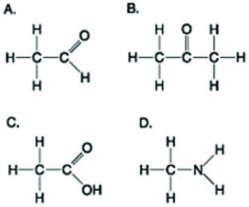 Which molecule shown can increase the concentration of hydrogen ions in a solution and is therefore an organic acid?
 (Multiple Choice)
4.9/5  (73)
(73) Which chemical group is most likely to be responsible for an organic molecule behaving as a base?
(Multiple Choice)
4.8/5 (77)
(77) Testosterone and estradiol are male and female sex hormones, respectively, in many vertebrates. In which of the following ways do these molecules differ from each other?
(Multiple Choice)
4.8/5 (80)
(80) Which of the following characteristics is responsible for the complexity and variety of organic molecules?
(Multiple Choice)
4.9/5 (77)
(77) Thalidomide was sold as "racemic mixture" to pregnant women to treat morning sickness during pregnancy but the drug was found to harm fetus in the womb. It was banned in 1962. Which of the following reasons is the best explanation of the harmful effects of the drug?
(Multiple Choice)
4.8/5 (70)
(70) Use the figures to answer the question. 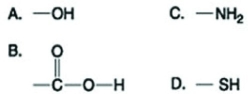 Which of the functional groups shown in the figure is present in hexanol but not in hexane?
 (Multiple Choice)
4.7/5 (65)
(65) The maximum number of hydrogen atoms in an alkane with six carbons is ________.
(Multiple Choice)
4.9/5 (82)
(82) How many electrons must one carbon atom share with other atom or atoms to complete its valence shell?
(Multiple Choice)
5.0/5 (85)
(85) Differences in which of the following chemical characteristics are responsible for the uniqueness of individuals organisms?
(Multiple Choice)
4.9/5 (74)
(74) Research indicates that ibuprofen, a drug used to relieve inflammation and pain, is a mixture of two enantiomers; what are enantiomers?
(Multiple Choice)
4.9/5 (67)
(67) 
Filters
- Essay(0)
- Multiple Choice(0)
- Short Answer(0)
- True False(0)
- Matching(0)