



 Chat with AI
Exam 4: Carbon: the Basis of Molecular Diversity

Exam 1: Biology and Its Themes46 Questions
Exam 2: Atoms and Molecules61 Questions
Exam 3: The Chemistry of Water55 Questions
Exam 4: Carbon: the Basis of Molecular Diversity52 Questions
Exam 5: Biological Macromolecules and Lipids71 Questions
Exam 6: Energy and Life65 Questions
Exam 7: Cell Structure and Function66 Questions
Exam 8: Cell Membranes67 Questions
Exam 9: Cellular Signaling62 Questions
Exam 10: Cell Respiration68 Questions
Exam 11: Photosynthetic Processes64 Questions
Exam 12: Mitosis63 Questions
Exam 13: Sexual Life Cycles and Meiosis64 Questions
Exam 14: Mendelian Genetics65 Questions
Exam 15: Linkage and Chromosomes54 Questions
Exam 16: Nucleic Acids and Inheritance65 Questions
Exam 17: Expression of Genes70 Questions
Exam 18: Control of Gene Expression66 Questions
Exam 19: Dna Technology56 Questions
Exam 20: The Evolution of Genomes47 Questions
Exam 21: How Evolution Works60 Questions
Exam 22: Phylogenetic Reconstruction66 Questions
Exam 23: Microevolution65 Questions
Exam 24: Species and Speciation65 Questions
Exam 25: Macroevolution58 Questions
Exam 26: Introduction to Viruses54 Questions
Exam 27: Prokaryotes61 Questions
Exam 28: The Origin and Evolution of Eukaryotes66 Questions
Exam 29: Nonvascular and Seedless Vascular Plants72 Questions
Exam 30: Seed Plants64 Questions
Exam 31: Introduction to Fungi56 Questions
Exam 32: An Introduction to Animal Diversity58 Questions
Exam 33: Invertebrates58 Questions
Exam 34: Vertebrates66 Questions
Exam 35: Plant Structure and Growth68 Questions
Exam 36: Transport in Vascular Plants73 Questions
Exam 37: Plant Nutrition51 Questions
Exam 38: Reproduction of Flowering Plants59 Questions
Exam 39: Plant Signals and Behavior60 Questions
Exam 40: The Animal Body58 Questions
Exam 41: Chemical Signals in Animals62 Questions
Exam 42: Animal Digestive Systems58 Questions
Exam 43: Animal Transport Systems58 Questions
Exam 44: Animal Excretory Systems49 Questions
Exam 45: Animal Reproductive Systems64 Questions
Exam 46: Development in Animals68 Questions
Exam 47: Animal Defenses Against Infection65 Questions
Exam 48: Electrical Signals in Animals62 Questions
Exam 49: Neural Regulation in Animals69 Questions
Exam 50: Sensation and Movement in Animals68 Questions
Exam 51: An Overview of Ecology71 Questions
Exam 52: Behavioral Ecology64 Questions
Exam 53: Populations and Life History Traits73 Questions
Exam 54: Biodiversity and Communities71 Questions
Exam 55: Energy Flow and Chemical Cycling in Ecosystems80 Questions
Exam 56: Conservation and Global Ecology75 Questions
Select questions type


Use the figures to answer the question. 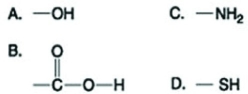 Which functional group shown in the figure can accept protons and raise the pH of the surrounding solution?
 (Multiple Choice)
4.7/5  (88)
(88) Use the figures to answer the following question. 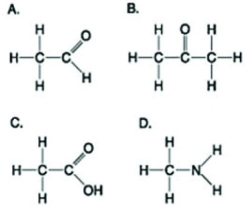 Which molecule shown has a carbonyl functional group in the form of a ketone?
 (Multiple Choice)
4.9/5 (81)
(81) Use the figures to answer the following question. 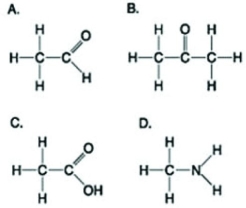 Which molecule(s) shown is (are) ionized in a cell?
 (Multiple Choice)
4.9/5 (71)
(71) Which of the following identifies the chemical relationship between glucose and fructose?
(Multiple Choice)
4.7/5 (85)
(85) Which of the following illustrations is not a structural isomer of an organic compound with the molecular formula C6H14? For clarity, only the carbon skeletons are shown; hydrogen atoms that would be attached to the carbons have been omitted.
(Multiple Choice)
4.9/5 (94)
(94) Visualize the structural formula of each of the following hydrocarbons. Which hydrocarbon has a double bond in its carbon skeleton?
(Multiple Choice)
5.0/5 (78)
(78) Use the figures to answer the following question. 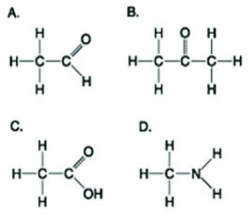 Which molecule shown has at least one carbon atom attached to three different chemical groups?
 (Multiple Choice)
4.8/5 (76)
(76) Which of the following functional groups gives amino acids their acidic character?
(Multiple Choice)
4.8/5 (74)
(74) 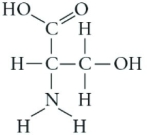
Which of the following explains why the valency of carbon is 4 even though it has 6 electrons?
(Multiple Choice)
4.9/5 (71)
(71) Compared to a hydrocarbon chain where all the carbon atoms are linked by single bonds, which of the following statements best describe a hydrocarbon chain with the same number of carbon atoms but with one or more double bonds?
(Multiple Choice)
4.9/5 (69)
(69) Which of the following unique feature of carbon allows it to support life on Earth?
(Multiple Choice)
4.8/5 (82)
(82) A carbon atom is most likely to form what kind of bond(s) with other atoms?
(Multiple Choice)
4.8/5 (68)
(68) Choose the term that correctly describes the relationship between these two sugar molecules. 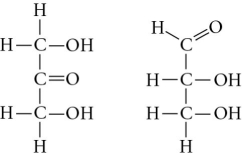
(Multiple Choice)
4.8/5 (85)
(85) Which two functional groups are always found in amino acids?
(Multiple Choice)
4.8/5 (70)
(70) Miller's classic experiment demonstrated that a discharge of sparks through a mixture of gases could result in the formation of a large variety of organic compounds. Miller did not use which one of the following gases in his experiment?
(Multiple Choice)
4.8/5 (82)
(82) Use the following figure to answer the question. 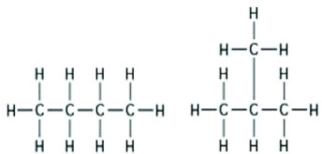 The two molecules shown in the figures are best described as ________.
 (Multiple Choice)
4.9/5 (60)
(60) Which of the following factors determines whether a carbon atom's covalent bonds with other atoms are in a tetrahedral configuration or a planar configuration?
(Multiple Choice)
4.8/5 (77)
(77) 
Filters
- Essay(0)
- Multiple Choice(0)
- Short Answer(0)
- True False(0)
- Matching(0)