



 Chat with AI
Exam 47: Animal Defenses Against Infection

Exam 1: Biology and Its Themes46 Questions
Exam 2: Atoms and Molecules61 Questions
Exam 3: The Chemistry of Water55 Questions
Exam 4: Carbon: the Basis of Molecular Diversity52 Questions
Exam 5: Biological Macromolecules and Lipids71 Questions
Exam 6: Energy and Life65 Questions
Exam 7: Cell Structure and Function66 Questions
Exam 8: Cell Membranes67 Questions
Exam 9: Cellular Signaling62 Questions
Exam 10: Cell Respiration68 Questions
Exam 11: Photosynthetic Processes64 Questions
Exam 12: Mitosis63 Questions
Exam 13: Sexual Life Cycles and Meiosis64 Questions
Exam 14: Mendelian Genetics65 Questions
Exam 15: Linkage and Chromosomes54 Questions
Exam 16: Nucleic Acids and Inheritance65 Questions
Exam 17: Expression of Genes70 Questions
Exam 18: Control of Gene Expression66 Questions
Exam 19: Dna Technology56 Questions
Exam 20: The Evolution of Genomes47 Questions
Exam 21: How Evolution Works60 Questions
Exam 22: Phylogenetic Reconstruction66 Questions
Exam 23: Microevolution65 Questions
Exam 24: Species and Speciation65 Questions
Exam 25: Macroevolution58 Questions
Exam 26: Introduction to Viruses54 Questions
Exam 27: Prokaryotes61 Questions
Exam 28: The Origin and Evolution of Eukaryotes66 Questions
Exam 29: Nonvascular and Seedless Vascular Plants72 Questions
Exam 30: Seed Plants64 Questions
Exam 31: Introduction to Fungi56 Questions
Exam 32: An Introduction to Animal Diversity58 Questions
Exam 33: Invertebrates58 Questions
Exam 34: Vertebrates66 Questions
Exam 35: Plant Structure and Growth68 Questions
Exam 36: Transport in Vascular Plants73 Questions
Exam 37: Plant Nutrition51 Questions
Exam 38: Reproduction of Flowering Plants59 Questions
Exam 39: Plant Signals and Behavior60 Questions
Exam 40: The Animal Body58 Questions
Exam 41: Chemical Signals in Animals62 Questions
Exam 42: Animal Digestive Systems58 Questions
Exam 43: Animal Transport Systems58 Questions
Exam 44: Animal Excretory Systems49 Questions
Exam 45: Animal Reproductive Systems64 Questions
Exam 46: Development in Animals68 Questions
Exam 47: Animal Defenses Against Infection65 Questions
Exam 48: Electrical Signals in Animals62 Questions
Exam 49: Neural Regulation in Animals69 Questions
Exam 50: Sensation and Movement in Animals68 Questions
Exam 51: An Overview of Ecology71 Questions
Exam 52: Behavioral Ecology64 Questions
Exam 53: Populations and Life History Traits73 Questions
Exam 54: Biodiversity and Communities71 Questions
Exam 55: Energy Flow and Chemical Cycling in Ecosystems80 Questions
Exam 56: Conservation and Global Ecology75 Questions
Select questions type


Benadryl is an antihistamine. Which of the following is most likely to occur if a person that was stung by a bee takes Benadryl?
(Multiple Choice)
4.9/5  (68)
(68) Mucus occurs in both the respiratory and digestive tracts. Which answer best describes the main immunological function of mucus?
(Multiple Choice)
4.7/5 (85)
(85) Which of the following statements about epitopes is incorrect?
(Multiple Choice)
4.9/5 (86)
(86) If a T cell antigen receptor was composed of only a single alpha chain, the receptor would ________.
(Multiple Choice)
4.9/5 (79)
(79) Which of the following statements describe a component of the clonal selection theory of how the adaptive immune system functions?
I. Each lymphocyte has a unique membrane receptor that recognizes one antigen.
II. When the lymphocyte binds an antigen, it is activated and begins dividing to form many identical copies of itself.
III. Cloned lymphocytes have slight differences and are selected by the spleen for removal if they do not bind an antigen.
IV. Cloned cells descend from an activated lymphocyte and persist even after the pathogen is eliminated.
(Multiple Choice)
4.9/5 (77)
(77) Which of the following protects both the eyes and the respiratory tract against infections?
(Multiple Choice)
4.9/5 (80)
(80) A certain cell type has existed in the blood and tissue of its vertebrate host's immune system for over 20 years. One day, it recognizes a newly arrived antigen and binds to it, subsequently initiating a secondary immune response in the body. Which of the following cell types most accurately describes this cell?
(Multiple Choice)
4.9/5 (88)
(88) Which option best describes why Jenner's use of cowpox virus as a vaccine against the smallpox virus was successful?
(Multiple Choice)
4.7/5 (84)
(84) Which of the following would not help a virus avoid triggering an adaptive immune response?
(Multiple Choice)
4.8/5 (73)
(73) Which of the following enhances phagocytosis of microbes by macrophages?
I. the binding of antibodies to the surface of microbes
II. antibody-mediated opsonization of microbes
III. the release of cytokines by activated B cells
(Multiple Choice)
4.9/5 (88)
(88) A phagocytic cell has a mutation in a gene for a hydrolytic enzyme that renders the enzyme nonfunctional. What is the most likely effect of the mutation when this phagocytic cell ingests a pathogen?
(Multiple Choice)
4.8/5 (85)
(85) Which of the following are typical features of an inflammatory response?
(Multiple Choice)
4.8/5 (90)
(90) A boy falls while riding his bike. A scrape on his hand almost immediately begins to bleed and becomes red, warm, and swollen. Which type of response is most consistent with these symptoms?
(Multiple Choice)
4.9/5 (93)
(93) Which option best describes how a viral antigen, like EBV, is recognized by T cells?
(Multiple Choice)
4.7/5 (82)
(82) Which of the following is crucial to activation of the adaptive immune response?
(Multiple Choice)
4.8/5 (79)
(79) Which of the following components make up a light chain of an immunoglobulin (Ig) molecule, of any class, with regions symbolized as C or V, H or L?
(Multiple Choice)
4.9/5 (79)
(79) Which statement best describes an account of immunological memory?
(Multiple Choice)
4.9/5 (73)
(73) Wiskott-Aldrich syndrome is an inherited X-linked recessive disorder characterized by low platelet count and a compromised immune system among other symptoms. Which answer best describes Wiskott-Aldrich syndrome?
(Multiple Choice)
4.8/5 (81)
(81) The figure shows the progress of an untreated HIV infection. Which curve represents the concentration of helper T cells in the blood? 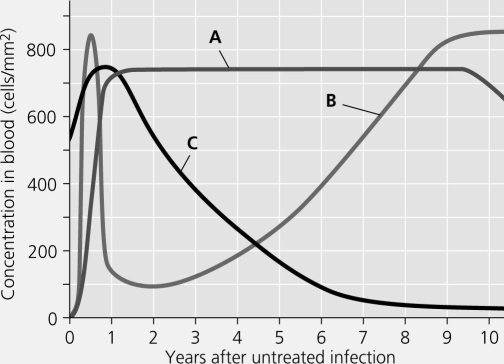
(Multiple Choice)
4.9/5 (78)
(78) 
Filters
- Essay(0)
- Multiple Choice(0)
- Short Answer(0)
- True False(0)
- Matching(0)