



 Chat with AI
Exam 50: Sensation and Movement in Animals

Exam 1: Biology and Its Themes46 Questions
Exam 2: Atoms and Molecules61 Questions
Exam 3: The Chemistry of Water55 Questions
Exam 4: Carbon: the Basis of Molecular Diversity52 Questions
Exam 5: Biological Macromolecules and Lipids71 Questions
Exam 6: Energy and Life65 Questions
Exam 7: Cell Structure and Function66 Questions
Exam 8: Cell Membranes67 Questions
Exam 9: Cellular Signaling62 Questions
Exam 10: Cell Respiration68 Questions
Exam 11: Photosynthetic Processes64 Questions
Exam 12: Mitosis63 Questions
Exam 13: Sexual Life Cycles and Meiosis64 Questions
Exam 14: Mendelian Genetics65 Questions
Exam 15: Linkage and Chromosomes54 Questions
Exam 16: Nucleic Acids and Inheritance65 Questions
Exam 17: Expression of Genes70 Questions
Exam 18: Control of Gene Expression66 Questions
Exam 19: Dna Technology56 Questions
Exam 20: The Evolution of Genomes47 Questions
Exam 21: How Evolution Works60 Questions
Exam 22: Phylogenetic Reconstruction66 Questions
Exam 23: Microevolution65 Questions
Exam 24: Species and Speciation65 Questions
Exam 25: Macroevolution58 Questions
Exam 26: Introduction to Viruses54 Questions
Exam 27: Prokaryotes61 Questions
Exam 28: The Origin and Evolution of Eukaryotes66 Questions
Exam 29: Nonvascular and Seedless Vascular Plants72 Questions
Exam 30: Seed Plants64 Questions
Exam 31: Introduction to Fungi56 Questions
Exam 32: An Introduction to Animal Diversity58 Questions
Exam 33: Invertebrates58 Questions
Exam 34: Vertebrates66 Questions
Exam 35: Plant Structure and Growth68 Questions
Exam 36: Transport in Vascular Plants73 Questions
Exam 37: Plant Nutrition51 Questions
Exam 38: Reproduction of Flowering Plants59 Questions
Exam 39: Plant Signals and Behavior60 Questions
Exam 40: The Animal Body58 Questions
Exam 41: Chemical Signals in Animals62 Questions
Exam 42: Animal Digestive Systems58 Questions
Exam 43: Animal Transport Systems58 Questions
Exam 44: Animal Excretory Systems49 Questions
Exam 45: Animal Reproductive Systems64 Questions
Exam 46: Development in Animals68 Questions
Exam 47: Animal Defenses Against Infection65 Questions
Exam 48: Electrical Signals in Animals62 Questions
Exam 49: Neural Regulation in Animals69 Questions
Exam 50: Sensation and Movement in Animals68 Questions
Exam 51: An Overview of Ecology71 Questions
Exam 52: Behavioral Ecology64 Questions
Exam 53: Populations and Life History Traits73 Questions
Exam 54: Biodiversity and Communities71 Questions
Exam 55: Energy Flow and Chemical Cycling in Ecosystems80 Questions
Exam 56: Conservation and Global Ecology75 Questions
Select questions type


What is the function of the round window in the mammalian inner ear?
(Multiple Choice)
4.9/5  (94)
(94) What happens if a skeletal muscle is deprived of adequate supplies of ATP?
(Multiple Choice)
4.9/5 (85)
(85) Which of the following organisms is most challenged by gravity when moving?
(Multiple Choice)
5.0/5 (85)
(85) Most of the ATP supplies for a skeletal muscle undergoing prolonged exercise come from ________.
(Multiple Choice)
4.8/5 (86)
(86) Use the figure to answer the following question. 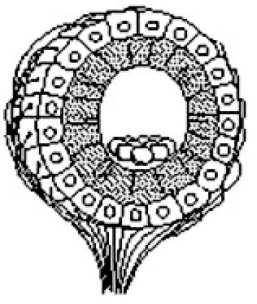 What is detected by the structure diagrammed in the figure above?
 (Multiple Choice)
4.7/5 (72)
(72) In a mammalian visual system, where is visual information processed and integrated?
(Multiple Choice)
4.9/5 (70)
(70) Damage to which of the following would be expected to produce partial or complete loss of the sensation of movement, position, and equilibrium?
(Multiple Choice)
4.9/5 (69)
(69) Which of the following sensory receptors is incorrectly paired with its category?
(Multiple Choice)
4.8/5 (81)
(81) Which of the following describes the change in the membrane potential of rod cells upon exposure to light?
(Multiple Choice)
4.9/5 (74)
(74) Which of the following is most likely a difference between the leg muscles of an Olympic sprinter and the leg muscles of an Olympic marathon runner?
(Multiple Choice)
4.9/5 (79)
(79) The muscles of a recently deceased human can remain in a contracted state, termed rigor mortis, for several hours. What prevents the muscles from relaxing soon after death?
(Multiple Choice)
4.8/5 (73)
(73) Which of the following is a characteristic found in grasshoppers that makes it very difficult to sneak up on them?
(Multiple Choice)
4.9/5 (92)
(92) Immediately after putting on a shirt, you are aware of the shirt touching your skin. After a few minutes, this perception fades. Which of the following processes results in the decreased responsiveness despite continued stimulation?
(Multiple Choice)
4.9/5 (81)
(81) Which of the following structures is responsible for movement of action potentials from one contractile cell to the next in the mammalian heart?
(Multiple Choice)
4.9/5 (70)
(70) Which type of receptor is most likely activated in the antennae of a moth when detecting pheromones?
(Multiple Choice)
4.8/5 (66)
(66) What type of receptors is in the appendages projecting from the rostral area of star-nosed moles?
(Multiple Choice)
4.8/5 (82)
(82) Which of the following is the first step of a sensory pathway?
(Multiple Choice)
4.8/5 (64)
(64) Although some sharks close their eyes just before they bite, their bites are on target. Researchers have noted that sharks often misdirect their bites at metal objects and that they can find batteries buried under sand. This evidence suggests that sharks keep track of their prey during the split second before they bite in the same way that ________.
(Multiple Choice)
4.8/5 (80)
(80) An action potential from a motor neuron arriving at the neuromuscular junction (NMJ) triggers a series of events leading to muscle contraction. Of the following four events, which occurs after the others?
(Multiple Choice)
4.9/5 (82)
(82) 
Filters
- Essay(0)
- Multiple Choice(0)
- Short Answer(0)
- True False(0)
- Matching(0)