



 Chat with AI
Exam 56: Conservation and Global Ecology

Exam 1: Biology and Its Themes46 Questions
Exam 2: Atoms and Molecules61 Questions
Exam 3: The Chemistry of Water55 Questions
Exam 4: Carbon: the Basis of Molecular Diversity52 Questions
Exam 5: Biological Macromolecules and Lipids71 Questions
Exam 6: Energy and Life65 Questions
Exam 7: Cell Structure and Function66 Questions
Exam 8: Cell Membranes67 Questions
Exam 9: Cellular Signaling62 Questions
Exam 10: Cell Respiration68 Questions
Exam 11: Photosynthetic Processes64 Questions
Exam 12: Mitosis63 Questions
Exam 13: Sexual Life Cycles and Meiosis64 Questions
Exam 14: Mendelian Genetics65 Questions
Exam 15: Linkage and Chromosomes54 Questions
Exam 16: Nucleic Acids and Inheritance65 Questions
Exam 17: Expression of Genes70 Questions
Exam 18: Control of Gene Expression66 Questions
Exam 19: Dna Technology56 Questions
Exam 20: The Evolution of Genomes47 Questions
Exam 21: How Evolution Works60 Questions
Exam 22: Phylogenetic Reconstruction66 Questions
Exam 23: Microevolution65 Questions
Exam 24: Species and Speciation65 Questions
Exam 25: Macroevolution58 Questions
Exam 26: Introduction to Viruses54 Questions
Exam 27: Prokaryotes61 Questions
Exam 28: The Origin and Evolution of Eukaryotes66 Questions
Exam 29: Nonvascular and Seedless Vascular Plants72 Questions
Exam 30: Seed Plants64 Questions
Exam 31: Introduction to Fungi56 Questions
Exam 32: An Introduction to Animal Diversity58 Questions
Exam 33: Invertebrates58 Questions
Exam 34: Vertebrates66 Questions
Exam 35: Plant Structure and Growth68 Questions
Exam 36: Transport in Vascular Plants73 Questions
Exam 37: Plant Nutrition51 Questions
Exam 38: Reproduction of Flowering Plants59 Questions
Exam 39: Plant Signals and Behavior60 Questions
Exam 40: The Animal Body58 Questions
Exam 41: Chemical Signals in Animals62 Questions
Exam 42: Animal Digestive Systems58 Questions
Exam 43: Animal Transport Systems58 Questions
Exam 44: Animal Excretory Systems49 Questions
Exam 45: Animal Reproductive Systems64 Questions
Exam 46: Development in Animals68 Questions
Exam 47: Animal Defenses Against Infection65 Questions
Exam 48: Electrical Signals in Animals62 Questions
Exam 49: Neural Regulation in Animals69 Questions
Exam 50: Sensation and Movement in Animals68 Questions
Exam 51: An Overview of Ecology71 Questions
Exam 52: Behavioral Ecology64 Questions
Exam 53: Populations and Life History Traits73 Questions
Exam 54: Biodiversity and Communities71 Questions
Exam 55: Energy Flow and Chemical Cycling in Ecosystems80 Questions
Exam 56: Conservation and Global Ecology75 Questions
Select questions type


Which of these is a consequence of biological magnification?
(Multiple Choice)
4.7/5  (73)
(73) Which of the following can be caused by nitrogen and sulfur oxide air pollutants, which are released during the burning of fossil fuels?
(Multiple Choice)
4.8/5 (76)
(76) Movement corridors can be harmful to certain species because they ________.
(Multiple Choice)
4.9/5 (90)
(90) Overharvesting encourages extinction and is most likely to affect?
(Multiple Choice)
4.7/5 (77)
(77) Use the following figure to answer the question. 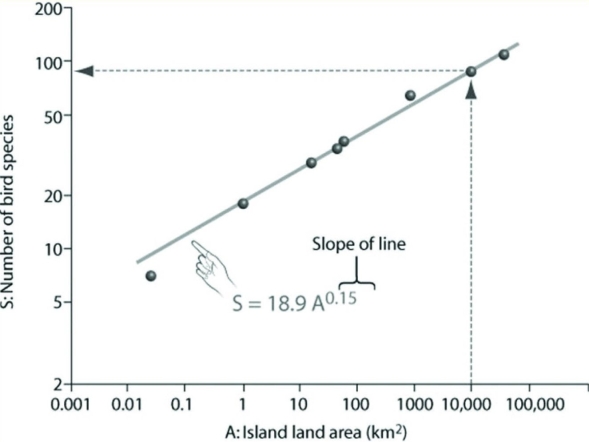 In looking at the species-area plot in the figure, what can be concluded?
 (Multiple Choice)
4.8/5 (85)
(85) Human-generated microplastics have thus been detected in all of the following places on Earth, except for ________.
(Multiple Choice)
4.9/5 (81)
(81) A parasitic fungus, Geomyces destructans, has decimated millions of bats in the United States since it was first observed in upstate New York in 2006. The disease has been named white-nose syndrome because of the white fungal hyphae that cover the bat upon infection. It is believed that this fungus was introduced from Europe by tourists entering into caves with hibernating bat populations. Which prediction most likely reflects changes that will occur in natural communities as a result of massive bat mortality?
(Multiple Choice)
4.8/5 (91)
(91) Which of the following outcomes is caused by excessive nutrient runoff into aquatic ecosystems?
(Multiple Choice)
4.8/5 (80)
(80) Philippe Bouchet and colleagues conducted a massive survey of marine molluscs on the west coast of New Caledonia. For 20% of the total species that were located and identified, only a single specimen was found. Which of the following claims about the diversity of molluscs in this area is best supported by the evidence?
(Multiple Choice)
4.7/5 (83)
(83) Which of the following statements about protected areas established to preserve biodiversity is true?
(Multiple Choice)
4.9/5 (73)
(73) Which of the following is necessary in order to better comprehend the magnitude of current extinctions?
(Multiple Choice)
4.8/5 (88)
(88) Use the following graph and information to answer the question.
Flycatcher birds that migrate from Africa to Europe feed their chicks a diet that is almost exclusively moth caterpillars. The graph shows the peak dates of flycatcher arrival in Europe, bird hatching, and peak caterpillar season for the years 1980 and 2000. The y-axis is a measure of the abundance of birds, hatching chicks, and caterpillars. 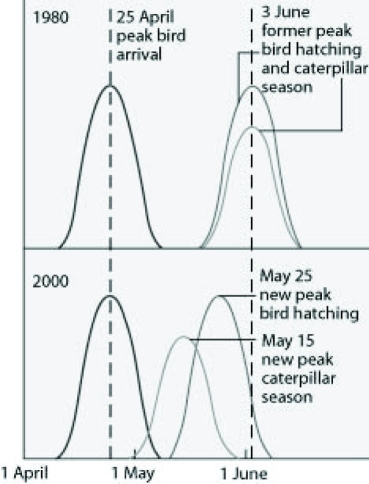 The shift in the peak of caterpillar season is most likely due to ________.
 (Multiple Choice)
4.9/5 (75)
(75) Which of the following strategies was used to rescue Illinois prairie chickens from a recent extinction vortex?
(Multiple Choice)
4.9/5 (88)
(88) Which of the following is the most significant single contributor to the increase in the amount of carbon dioxide in Earth's atmosphere over the past 170 years?
(Multiple Choice)
4.8/5 (88)
(88) Which of the following is an ecosystem service that includes processes that increase the quality of the abiotic environment?
(Multiple Choice)
4.9/5 (89)
(89) 
Filters
- Essay(0)
- Multiple Choice(0)
- Short Answer(0)
- True False(0)
- Matching(0)