



 Chat with AI
Exam 56: Conservation and Global Ecology

Exam 1: Biology and Its Themes46 Questions
Exam 2: Atoms and Molecules61 Questions
Exam 3: The Chemistry of Water55 Questions
Exam 4: Carbon: the Basis of Molecular Diversity52 Questions
Exam 5: Biological Macromolecules and Lipids71 Questions
Exam 6: Energy and Life65 Questions
Exam 7: Cell Structure and Function66 Questions
Exam 8: Cell Membranes67 Questions
Exam 9: Cellular Signaling62 Questions
Exam 10: Cell Respiration68 Questions
Exam 11: Photosynthetic Processes64 Questions
Exam 12: Mitosis63 Questions
Exam 13: Sexual Life Cycles and Meiosis64 Questions
Exam 14: Mendelian Genetics65 Questions
Exam 15: Linkage and Chromosomes54 Questions
Exam 16: Nucleic Acids and Inheritance65 Questions
Exam 17: Expression of Genes70 Questions
Exam 18: Control of Gene Expression66 Questions
Exam 19: Dna Technology56 Questions
Exam 20: The Evolution of Genomes47 Questions
Exam 21: How Evolution Works60 Questions
Exam 22: Phylogenetic Reconstruction66 Questions
Exam 23: Microevolution65 Questions
Exam 24: Species and Speciation65 Questions
Exam 25: Macroevolution58 Questions
Exam 26: Introduction to Viruses54 Questions
Exam 27: Prokaryotes61 Questions
Exam 28: The Origin and Evolution of Eukaryotes66 Questions
Exam 29: Nonvascular and Seedless Vascular Plants72 Questions
Exam 30: Seed Plants64 Questions
Exam 31: Introduction to Fungi56 Questions
Exam 32: An Introduction to Animal Diversity58 Questions
Exam 33: Invertebrates58 Questions
Exam 34: Vertebrates66 Questions
Exam 35: Plant Structure and Growth68 Questions
Exam 36: Transport in Vascular Plants73 Questions
Exam 37: Plant Nutrition51 Questions
Exam 38: Reproduction of Flowering Plants59 Questions
Exam 39: Plant Signals and Behavior60 Questions
Exam 40: The Animal Body58 Questions
Exam 41: Chemical Signals in Animals62 Questions
Exam 42: Animal Digestive Systems58 Questions
Exam 43: Animal Transport Systems58 Questions
Exam 44: Animal Excretory Systems49 Questions
Exam 45: Animal Reproductive Systems64 Questions
Exam 46: Development in Animals68 Questions
Exam 47: Animal Defenses Against Infection65 Questions
Exam 48: Electrical Signals in Animals62 Questions
Exam 49: Neural Regulation in Animals69 Questions
Exam 50: Sensation and Movement in Animals68 Questions
Exam 51: An Overview of Ecology71 Questions
Exam 52: Behavioral Ecology64 Questions
Exam 53: Populations and Life History Traits73 Questions
Exam 54: Biodiversity and Communities71 Questions
Exam 55: Energy Flow and Chemical Cycling in Ecosystems80 Questions
Exam 56: Conservation and Global Ecology75 Questions
Select questions type


Which of the following habitats would most likely have the highest species diversity?
(Multiple Choice)
4.9/5  (78)
(78) If the sex ratio in a population is significantly different from 50:50, then which of the following statements will always be accurate?
(Multiple Choice)
4.8/5 (88)
(88) Which of the following best describes how introduced species can have deleterious effects on the biological communities they invade?
(Multiple Choice)
4.8/5 (76)
(76) During the inventory of bacterial genes present in the Sargasso Sea, a deep isolated area in the middle of the Atlantic Ocean, a research team concluded that at least 1,800 bacterial species were present. Because habitat structure is usually highly correlated with species diversity, what kind of bacterial diversity would you expect to observe in tropical coral reef waters?
(Multiple Choice)
4.8/5 (98)
(98) The main cause of the increase in the amount of CO2 in Earth's atmosphere over the past 170 years is ________.
(Multiple Choice)
4.8/5 (82)
(82) Which of the following conditions is the most likely indicator of a population in an extinction vortex?
(Multiple Choice)
4.8/5 (72)
(72) Which of the following statements is best supported by the scientific consensus on factors affecting global warming?
(Multiple Choice)
4.7/5 (72)
(72) Which of the following possible actions by nations to reduce the warming of Earth's atmosphere would be best supported by the global scientific consensus?
(Multiple Choice)
4.9/5 (72)
(72) Use the graphs to answer the question. 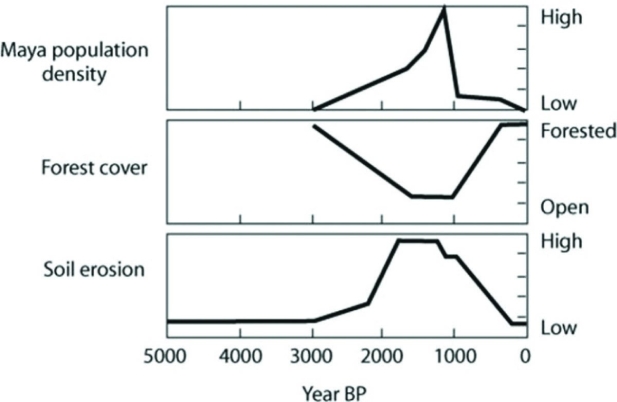 Copyright © 2003 American Institute of Biological Sciences. (Foster, D.R., F. Swanson et al., The importance of land-use and its legacies to ecology and environmental management. BioScience 53:77-88 [2003].)
Archeological, fossil, and geological data provide information on the Mayan populations and their environment in Mexico, in the Caribbean state of Yucatán. Based on the figure, what can you conclude about the history of land use in the southern Yucatán?
Copyright © 2003 American Institute of Biological Sciences. (Foster, D.R., F. Swanson et al., The importance of land-use and its legacies to ecology and environmental management. BioScience 53:77-88 [2003].)
Archeological, fossil, and geological data provide information on the Mayan populations and their environment in Mexico, in the Caribbean state of Yucatán. Based on the figure, what can you conclude about the history of land use in the southern Yucatán? (Multiple Choice)
4.7/5 (90)
(90) Which of the following criteria must be met for a species to qualify as invasive?
(Multiple Choice)
4.8/5 (74)
(74) Use the following figure to answer the question. 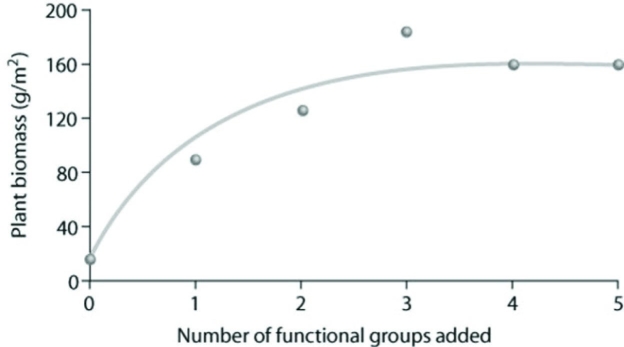 Functional groups are categories of plants, each containing numerous species, such as grasses and wildflowers, or trees and shrubs. Examine the figure and determine to what degree the data support the following hypothesis: Plant biomass increases with species richness.
 (Multiple Choice)
4.8/5 (80)
(80) Which one of the following is most likely to be a hot spot of biodiversity for birds?
(Multiple Choice)
4.9/5 (83)
(83) Use the following figure to answer the question. 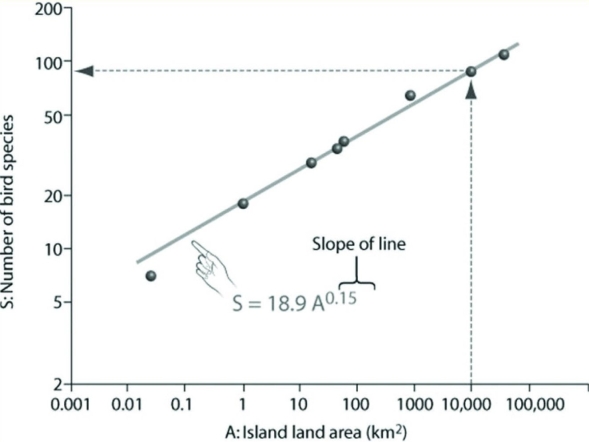 Based on the species-area plot in the figure, if habitable area on an island were reduced from 10,000 square kilometers (km2) to 1,000 km2, roughly what percentage of the species would disappear?
 (Multiple Choice)
4.8/5 (88)
(88) Erwin and Scott used an insecticidal spray to remove insects from the top section of an L. seemannii tree and collect them from the forest floor. Using the data collected, Erwin projected that this entire tree, from top to bottom, is host to about 600 unique arthropod species, which were not found on any other tree species. While the researchers also identified 900 beetle species from the top section, the vast majority of them were known to be found on many other tree species. If there are approximately 50,000 species of tropical trees, and assuming that every tree hosts a similar number of unique species, which of the following would be the best quantitative method to roughly estimate the total number of arthropod species, globally?
(Multiple Choice)
4.9/5 (71)
(71) Your friend is wary of environmentalists' claims that global climate change could lead to major biological change on Earth. Which of the following statements can you use in response to your friend's suspicions?
(Multiple Choice)
4.9/5 (92)
(92) Which of the following nations has become a world leader in the establishment of zoned reserves?
(Multiple Choice)
4.8/5 (77)
(77) Which of the following, if carefully monitored, could most reduce or prevent phytoplankton blooms in the Gulf of Mexico and formation of dead zone with low oxygen levels?
(Multiple Choice)
5.0/5 (92)
(92) If all individuals in the last remaining population of a particular frog species were all highly related, which type of diversity would be of greatest concern when planning to prevent the species from going extinct?
(Multiple Choice)
4.8/5 (94)
(94) Which of the following strategies would most rapidly increase the genetic diversity of a population in an extinction vortex?
(Multiple Choice)
4.7/5 (84)
(84) 
Filters
- Essay(0)
- Multiple Choice(0)
- Short Answer(0)
- True False(0)
- Matching(0)