



 Chat with AI
Exam 6: Energy and Life

Exam 1: Biology and Its Themes46 Questions
Exam 2: Atoms and Molecules61 Questions
Exam 3: The Chemistry of Water55 Questions
Exam 4: Carbon: the Basis of Molecular Diversity52 Questions
Exam 5: Biological Macromolecules and Lipids71 Questions
Exam 6: Energy and Life65 Questions
Exam 7: Cell Structure and Function66 Questions
Exam 8: Cell Membranes67 Questions
Exam 9: Cellular Signaling62 Questions
Exam 10: Cell Respiration68 Questions
Exam 11: Photosynthetic Processes64 Questions
Exam 12: Mitosis63 Questions
Exam 13: Sexual Life Cycles and Meiosis64 Questions
Exam 14: Mendelian Genetics65 Questions
Exam 15: Linkage and Chromosomes54 Questions
Exam 16: Nucleic Acids and Inheritance65 Questions
Exam 17: Expression of Genes70 Questions
Exam 18: Control of Gene Expression66 Questions
Exam 19: Dna Technology56 Questions
Exam 20: The Evolution of Genomes47 Questions
Exam 21: How Evolution Works60 Questions
Exam 22: Phylogenetic Reconstruction66 Questions
Exam 23: Microevolution65 Questions
Exam 24: Species and Speciation65 Questions
Exam 25: Macroevolution58 Questions
Exam 26: Introduction to Viruses54 Questions
Exam 27: Prokaryotes61 Questions
Exam 28: The Origin and Evolution of Eukaryotes66 Questions
Exam 29: Nonvascular and Seedless Vascular Plants72 Questions
Exam 30: Seed Plants64 Questions
Exam 31: Introduction to Fungi56 Questions
Exam 32: An Introduction to Animal Diversity58 Questions
Exam 33: Invertebrates58 Questions
Exam 34: Vertebrates66 Questions
Exam 35: Plant Structure and Growth68 Questions
Exam 36: Transport in Vascular Plants73 Questions
Exam 37: Plant Nutrition51 Questions
Exam 38: Reproduction of Flowering Plants59 Questions
Exam 39: Plant Signals and Behavior60 Questions
Exam 40: The Animal Body58 Questions
Exam 41: Chemical Signals in Animals62 Questions
Exam 42: Animal Digestive Systems58 Questions
Exam 43: Animal Transport Systems58 Questions
Exam 44: Animal Excretory Systems49 Questions
Exam 45: Animal Reproductive Systems64 Questions
Exam 46: Development in Animals68 Questions
Exam 47: Animal Defenses Against Infection65 Questions
Exam 48: Electrical Signals in Animals62 Questions
Exam 49: Neural Regulation in Animals69 Questions
Exam 50: Sensation and Movement in Animals68 Questions
Exam 51: An Overview of Ecology71 Questions
Exam 52: Behavioral Ecology64 Questions
Exam 53: Populations and Life History Traits73 Questions
Exam 54: Biodiversity and Communities71 Questions
Exam 55: Energy Flow and Chemical Cycling in Ecosystems80 Questions
Exam 56: Conservation and Global Ecology75 Questions
Select questions type


When ATP is hydrolyzed to activate a target protein, what is often the fate of the inorganic phosphate that is released?
(Multiple Choice)
4.7/5  (79)
(79) Use the following information to answer the question below. 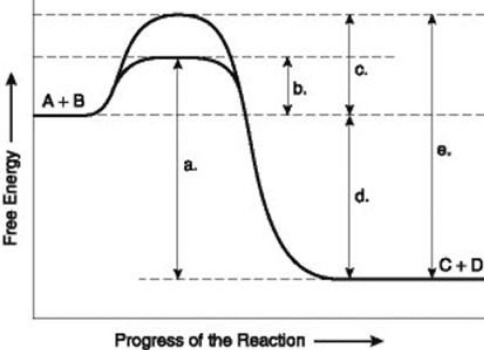 The figure illustrates the energy states associated with the reaction A + B ↔ C + D. Which of the lower-case letters represents the activation energy required for the enzyme-catalyzed reaction in the figure?
 (Multiple Choice)
4.9/5 (76)
(76) Zinc is an essential trace element for most organisms. Zinc is required in the active site of the enzyme carboxypeptidase where it most likely functions in which of the following ways?
(Multiple Choice)
4.9/5 (81)
(81) 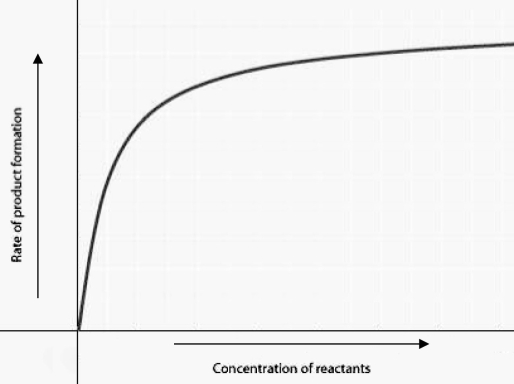 The figure displays the relationship between initial rate of product formation and reactant concentration in an enzyme-catalyzed reaction with a fixed amount of enzyme. Which of the following statements best explains the shape of the rate curve at high reactant concentration?
 (Multiple Choice)
5.0/5 (66)
(66) An enzyme is composed of four identical subunits. Binding of substrate to one subunit stimulates more rapid binding of substrate to each of the other three subunits. This enzyme is most likely regulated by which of the following mechanisms?
(Multiple Choice)
4.9/5 (77)
(77) How does a noncompetitive inhibitor decrease the rate of an enzyme-catalyzed reaction?
(Multiple Choice)
4.8/5 (78)
(78) Which of the following examples describes a type of potential rather than kinetic energy?
(Multiple Choice)
4.8/5 (84)
(84) Which of the following statements best describes metabolism in its entirety in all organisms?
(Multiple Choice)
4.9/5 (68)
(68) A clasping handshake may be used as an analogy for an enzyme-catalyzed reaction because it represents the specific manner in which an enzyme ________.
(Multiple Choice)
5.0/5 (78)
(78) In addition to activating or inhibiting enzymes through allosteric regulation, which of these mechanisms do cells also use to control enzymatic activity?
(Multiple Choice)
4.9/5 (86)
(86) Which of the following statements best summarizes a consequence of the second law of thermodynamics?
(Multiple Choice)
4.9/5 (76)
(76) Which of the following characteristics is most likely to be associated with an enzyme that catalyzes two different chemical reactions?
(Multiple Choice)
4.9/5 (86)
(86) Students conducting research observe the rate of an enzyme-catalyzed reaction under various conditions with a fixed amount of enzyme in each sample. When will increasing the substrate concentration likely result in the greatest increase in the reaction rate?
(Multiple Choice)
4.8/5 (68)
(68) Penicillin is an antibiotic that kills bacteria by binding to the active site of an enzyme involved in synthesis of the bacterial cell wall. Which of the following phenomena best describes the mechanism of action of penicillin?
(Multiple Choice)
4.9/5 (76)
(76) Which of the following molecules is most similar in structure to ATP?
(Multiple Choice)
4.9/5 (83)
(83) Use the following information to answer the question below. 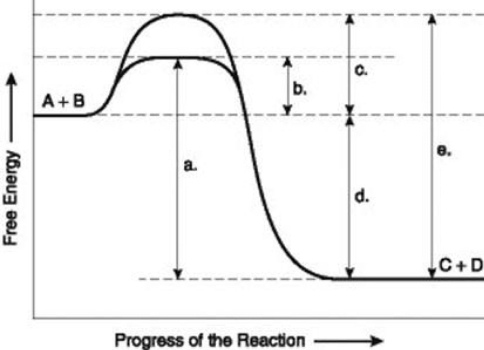 The figure illustrates the energy states associated with the reaction A + B ↔ C + D. Which of the lower-case letters in the figure represents a free energy change that would be the same in either an enzyme-catalyzed or a noncatalyzed reaction?
 (Multiple Choice)
4.8/5 (76)
(76) Which of the following statements best describes why hydrolysis reactions occur more readily in solution than dehydration reactions do?
(Multiple Choice)
4.9/5 (75)
(75) If an enzyme in solution is saturated with substrate, the most effective way to obtain a faster yield of products is to ________.
(Multiple Choice)
4.8/5 (76)
(76) The 3-D structure of an enzyme composed of a single polypeptide chain includes a large substrate-binding domain. It also has a separate binding site for a regulatory molecule. Based on these structural observations the enzyme is most likely regulated by which of the following mechanism?
(Multiple Choice)
4.9/5 (68)
(68) Which of the following terms most precisely identifies the cellular process of breaking down large molecules into smaller ones?
(Multiple Choice)
4.8/5 (89)
(89) 
Filters
- Essay(0)
- Multiple Choice(0)
- Short Answer(0)
- True False(0)
- Matching(0)