



 Chat with AI
Exam 6: Energy and Life

Exam 1: Biology and Its Themes46 Questions
Exam 2: Atoms and Molecules61 Questions
Exam 3: The Chemistry of Water55 Questions
Exam 4: Carbon: the Basis of Molecular Diversity52 Questions
Exam 5: Biological Macromolecules and Lipids71 Questions
Exam 6: Energy and Life65 Questions
Exam 7: Cell Structure and Function66 Questions
Exam 8: Cell Membranes67 Questions
Exam 9: Cellular Signaling62 Questions
Exam 10: Cell Respiration68 Questions
Exam 11: Photosynthetic Processes64 Questions
Exam 12: Mitosis63 Questions
Exam 13: Sexual Life Cycles and Meiosis64 Questions
Exam 14: Mendelian Genetics65 Questions
Exam 15: Linkage and Chromosomes54 Questions
Exam 16: Nucleic Acids and Inheritance65 Questions
Exam 17: Expression of Genes70 Questions
Exam 18: Control of Gene Expression66 Questions
Exam 19: Dna Technology56 Questions
Exam 20: The Evolution of Genomes47 Questions
Exam 21: How Evolution Works60 Questions
Exam 22: Phylogenetic Reconstruction66 Questions
Exam 23: Microevolution65 Questions
Exam 24: Species and Speciation65 Questions
Exam 25: Macroevolution58 Questions
Exam 26: Introduction to Viruses54 Questions
Exam 27: Prokaryotes61 Questions
Exam 28: The Origin and Evolution of Eukaryotes66 Questions
Exam 29: Nonvascular and Seedless Vascular Plants72 Questions
Exam 30: Seed Plants64 Questions
Exam 31: Introduction to Fungi56 Questions
Exam 32: An Introduction to Animal Diversity58 Questions
Exam 33: Invertebrates58 Questions
Exam 34: Vertebrates66 Questions
Exam 35: Plant Structure and Growth68 Questions
Exam 36: Transport in Vascular Plants73 Questions
Exam 37: Plant Nutrition51 Questions
Exam 38: Reproduction of Flowering Plants59 Questions
Exam 39: Plant Signals and Behavior60 Questions
Exam 40: The Animal Body58 Questions
Exam 41: Chemical Signals in Animals62 Questions
Exam 42: Animal Digestive Systems58 Questions
Exam 43: Animal Transport Systems58 Questions
Exam 44: Animal Excretory Systems49 Questions
Exam 45: Animal Reproductive Systems64 Questions
Exam 46: Development in Animals68 Questions
Exam 47: Animal Defenses Against Infection65 Questions
Exam 48: Electrical Signals in Animals62 Questions
Exam 49: Neural Regulation in Animals69 Questions
Exam 50: Sensation and Movement in Animals68 Questions
Exam 51: An Overview of Ecology71 Questions
Exam 52: Behavioral Ecology64 Questions
Exam 53: Populations and Life History Traits73 Questions
Exam 54: Biodiversity and Communities71 Questions
Exam 55: Energy Flow and Chemical Cycling in Ecosystems80 Questions
Exam 56: Conservation and Global Ecology75 Questions
Select questions type


The ΔG of ATP hydrolysis in a test tube under standard conditions is -7.3 kcal/mol. The ΔG for the reaction A+B C under the same conditions is +4.0 kcal/mol. How would the addition of an enzyme that catalyzes A+B C most likely alter the coupled reactions?
(Multiple Choice)
5.0/5  (88)
(88) Use the following information to answer the question below. 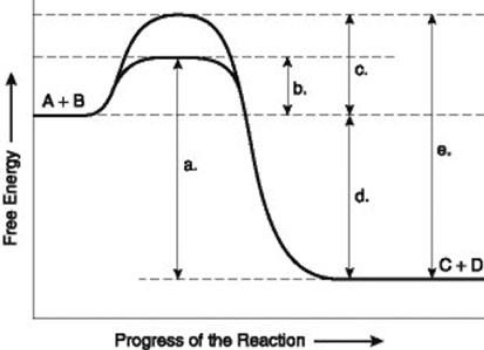 The figure illustrates the energy states associated with the reaction A + B ↔ C + D. Which of the following terms best describe the forward reaction in the figure?
 (Multiple Choice)
4.9/5 (86)
(86) Which of the following statements best describes a system at chemical equilibrium?
(Multiple Choice)
5.0/5 (77)
(77) Use the following information to answer the question below. 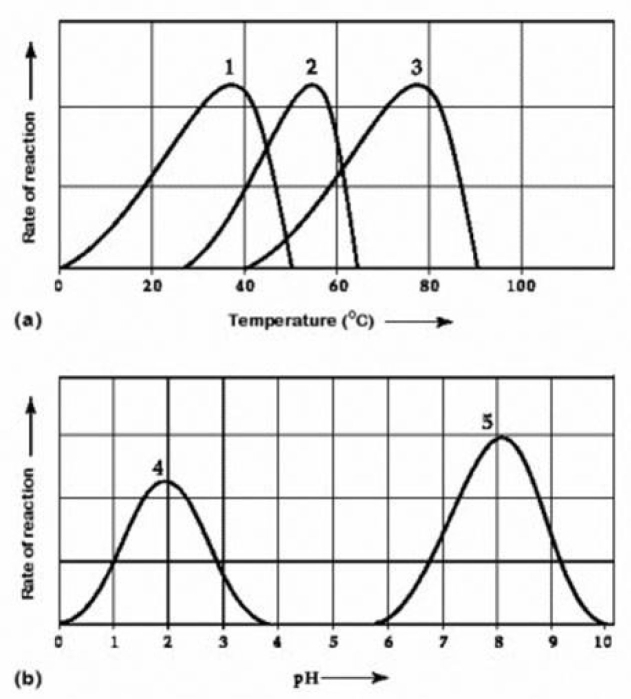 Activity of various enzymes at various temperatures (A) and at various pH (b)
Which temperature and pH profile curves on the graphs are most likely associated with an enzyme isolated from a human stomach where conditions are strongly acidic?
Activity of various enzymes at various temperatures (A) and at various pH (b)
Which temperature and pH profile curves on the graphs are most likely associated with an enzyme isolated from a human stomach where conditions are strongly acidic? (Multiple Choice)
4.9/5 (70)
(70) 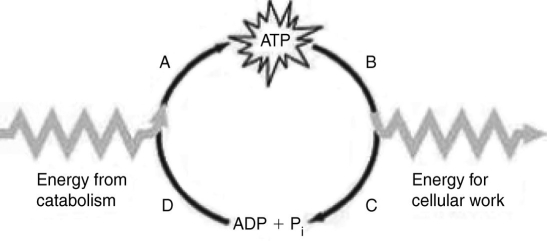 Which of the following statements best summarizes how the ATP cycle illustrated in the accompanying figure functions in cells?
 (Multiple Choice)
4.8/5 (95)
(95) Choose the pair of terms that correctly completes this sentence: Catabolism is to anabolism as ________ is to ________.
(Multiple Choice)
4.8/5 (80)
(80) In the citric acid cycle, succinate dehydrogenase catalyzes the conversion of succinate to fumarate. This reaction is inhibited by malonate, which resembles succinate but cannot be acted upon by succinate dehydrogenase. Increasing the ratio of succinate molecules to those of malonate in the reaction reduces the inhibitory effect of malonate. What role does malonate play with respect to succinate dehydrogenase?
(Multiple Choice)
4.9/5 (75)
(75) Which of the following statements best describes catabolic pathways?
(Multiple Choice)
4.8/5 (78)
(78) The ΔG of ATP hydrolysis in a test tube under standard conditions is -7.3 kcal/mol. The ΔG for the reaction A + B = C under the same conditions is +4.0 kcal/mol. What is the overall free-energy change for the coupled reactions under these conditions?
(Multiple Choice)
4.9/5 (71)
(71) Which of the following statements best describes the first law of thermodynamics?
(Multiple Choice)
4.8/5 (69)
(69) Which of the following statements best describes the central role that ATP plays in cellular metabolism?
(Multiple Choice)
4.9/5 (81)
(81) A series of enzymes catalyze the reactions in the metabolic pathway X → Y → Z → A. Product A binds to the enzyme that converts X to Y at a position remote from its active site. This binding decreases the activity of the enzyme. What does substance X represent in this pathway?
(Multiple Choice)
4.9/5 (71)
(71) Use the following information to answer the question below. 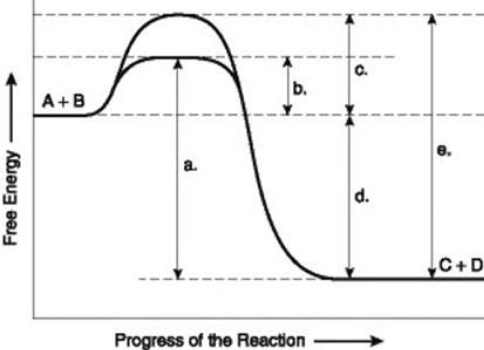 The figure illustrates the energy states associated with the reaction A + B ↔ C + D. Which of the lower-case letters represents the activation energy required for the non-enzyme-catalyzed reaction in the figure?
 (Multiple Choice)
4.8/5 (68)
(68) Which of the following statements is consistent with the second law of thermodynamics?
(Multiple Choice)
4.9/5 (88)
(88) Catalase is an enzyme that functions in human liver cells where the pH is approximately neutral. Which of the following graphs best reflects the activity profile of catalase from pH 5 to pH 9?
(Multiple Choice)
4.9/5 (86)
(86) Which of the following terms best describes a chemical reaction for which ΔG is positive?
(Multiple Choice)
4.8/5 (69)
(69) Which of the following statements best describes an exergonic reaction?
(Multiple Choice)
4.9/5 (83)
(83) Disruption of the active site of an enzyme would most likely result in which of the following?
(Multiple Choice)
4.8/5 (66)
(66) A change of a single amino acid at a position distant from the active site of an enzyme can alter the substrate specificity by changing the ________.
(Multiple Choice)
4.8/5 (78)
(78) 
Filters
- Essay(0)
- Multiple Choice(0)
- Short Answer(0)
- True False(0)
- Matching(0)