



 Chat with AI
Exam 46: The Mammalian Nervous System: Structure and Higher Functions

Exam 1: Studying Life246 Questions
Exam 2: Small Molecules and the Chemistry of Life246 Questions
Exam 3: Proteins, Carbohydrates, and Lipids246 Questions
Exam 4: Nucleic Acids and the Origin of Life246 Questions
Exam 5: Cells: the Working Units of Life248 Questions
Exam 6: Cell Membranes246 Questions
Exam 7: Cell Communication and Multicellularity246 Questions
Exam 8: Energy, Enzymes, and Metabolism246 Questions
Exam 9: Pathways That Harvest Chemical Energy246 Questions
Exam 10: Photosynthesis: Energy From Sunlight242 Questions
Exam 11: The Cell Cycle and Cell Division260 Questions
Exam 12: Inheritance, Genes, and Chromosomes250 Questions
Exam 13: Dna and Its Role in Heredity257 Questions
Exam 14: From Dna to Protein: Gene Expression252 Questions
Exam 15: Gene Mutation and Molecular Medicine251 Questions
Exam 16: Regulation of Gene Expression245 Questions
Exam 17: Genomes249 Questions
Exam 18: Recombinant Dna and Biotechnology243 Questions
Exam 20: Mechanisms of Evolution243 Questions
Exam 21: Reconstructing and Using Phylogenies246 Questions
Exam 22: Speciation247 Questions
Exam 23: Evolution of Genes and Genomes252 Questions
Exam 24: The History of Life on Earth246 Questions
Exam 25: Bacteria, Archaea, and Viruses262 Questions
Exam 26: The Origin and Diversification of Eukaryotes252 Questions
Exam 27: Plants Without Seeds: From Water to Land251 Questions
Exam 28: The Evolution of Seed Plants259 Questions
Exam 29: The Evolution and Diversity of Fungi261 Questions
Exam 30: Animal Origins and the Evolution of Body Plans248 Questions
Exam 31: Protostome Animals244 Questions
Exam 32: Deuterostome Animals246 Questions
Exam 33: The Plant Body243 Questions
Exam 34: Transport in Plants248 Questions
Exam 35: Plant Nutrition247 Questions
Exam 36: Regulation of Plant Growth246 Questions
Exam 37: Reproduction in Flowering Plants247 Questions
Exam 38: Plant Responses to Environmental Challenges246 Questions
Exam 39: Physiology, Homeostasis, and Temperature Regulation258 Questions
Exam 40: Animal Hormones249 Questions
Exam 41: Immunology: Animal Defense Systems265 Questions
Exam 42: Animal Reproduction261 Questions
Exam 43: Animal Development261 Questions
Exam 44: Neurons, Glia, and Nervous Systems250 Questions
Exam 45: Sensory Systems249 Questions
Exam 46: The Mammalian Nervous System: Structure and Higher Functions254 Questions
Exam 47: Musculoskeletal Systems259 Questions
Exam 48: Gas Exchange247 Questions
Exam 49: Circulatory Systems252 Questions
Exam 50: Nutrition, Digestion, and Absorption259 Questions
Exam 51: Salt and Water Balance and Nitrogen Excretion251 Questions
Exam 52: Animal Behavior249 Questions
Exam 53: The Physical Environment and Biogeography of Life248 Questions
Exam 54: Populations259 Questions
Exam 55: Species Interactions254 Questions
Exam 56: Communities247 Questions
Exam 57: Ecosystems238 Questions
Exam 58: A Changing Biosphere222 Questions
Select questions type


If a patient is in a coma, the primary region of the brain that is not activating neurons in the cortex is the
(Multiple Choice)
4.7/5  (64)
(64) Animals with eyes on the sides of the head have minimal overlap in their fields of vision, which is associated with
(Multiple Choice)
4.7/5 (98)
(98) In vertebrates, the brain and spinal cord make up the _______ nervous system.
(Short Answer)
4.8/5 (86)
(86) Humans and _______ have an expanded insular lobe and are among the relatively small number of species that can _______.
(Multiple Choice)
4.8/5 (87)
(87) The brain and spinal cord are connected to tissues and sensors of the body by the
(Multiple Choice)
4.9/5 (72)
(72) After a head injury, a patient notices a loss of fine motor control and general coordination of his movements, though his muscles are strong.These symptoms are likely to be caused by damage to the
(Multiple Choice)
4.9/5 (86)
(86) Which of the following correctly represents the flow of information about light, from the sensory cells in the retina to the brain?
(Multiple Choice)
4.9/5 (85)
(85) Choose the correct answer option to complete the table below.Answers should be ordered from 1 to 4 and concern whether on-center and off-center ganglion cells would be excited or inhibited by light falling on particular locations of the receptive field. 
(Multiple Choice)
4.8/5 (71)
(71) Neurons in the visual cortex are organized into _______ with _______ cells at the boarders of the columns.
(Multiple Choice)
4.8/5 (95)
(95) All of the following are specific lobes of the human cerebrum except:
(Multiple Choice)
4.8/5 (84)
(84) The flow of information in the brain that allows you to repeat spoken language is different from the flow of information that allows you to read a word out loud.Say the word: "biology." Which of the following represents the correct flow of information that allowed you to do this?
(Multiple Choice)
4.9/5 (69)
(69) In response to a loud noise, the autonomic nervous system sends messages to accelerate the heartbeat and inhibit digestive tract activity.The efferent pathway for these commands begins in the central nervous system, and the next synapse will occur in a(n) _______ outside of the central nervous system.
(Short Answer)
4.8/5 (74)
(74) Refer to the figure, which shows the rate of action potentials in a ganglion cell. 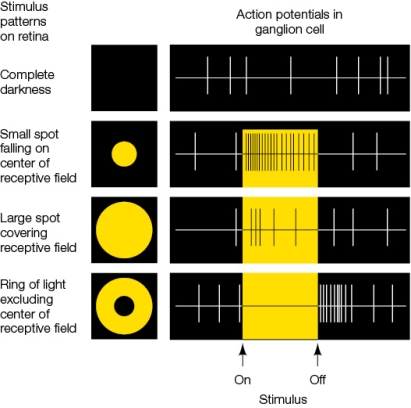 What can you conclude about the type of cell being monitored?
 (Multiple Choice)
4.7/5 (69)
(69) Researchers experimenting on ganglion cells of the retina wish to produce the highest number of action potentials possible.To accomplish this, they should direct their beam of light to the _______ of an _______ ganglion cell's receptive field.
(Multiple Choice)
4.8/5 (72)
(72) Refer to the figure below.The electroencephalogram (EEG) recordings for Awake and REM sleep are similar because 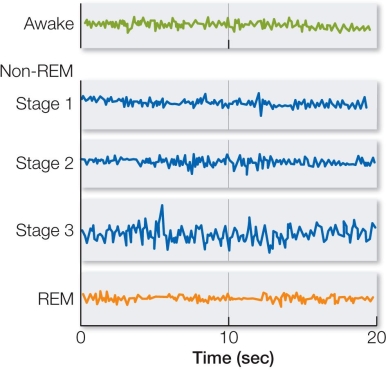
(Multiple Choice)
4.9/5 (71)
(71) Both the primary somatosensory cortex and the primary motor cortex have all regions of the body represented within each cortex.How is this representation organized?
(Multiple Choice)
4.9/5 (70)
(70) The region of the cerebral cortex that is involved in processing higher-order information is the
(Multiple Choice)
4.7/5 (85)
(85) Refer to the figure, which shows a cross section of an adult human brain. 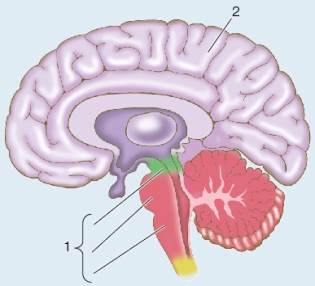 The three parts of structure 1 develop from the midbrain and regions of the hindbrain of an embryo and control many autonomic functions, such as breathing and basic motor patterns.Collectively these three parts are known as the
 (Multiple Choice)
4.8/5 (75)
(75) 
Filters
- Essay(0)
- Multiple Choice(0)
- Short Answer(0)
- True False(0)
- Matching(0)