



 Chat with AI
Exam 46: The Mammalian Nervous System: Structure and Higher Functions

Exam 1: Studying Life246 Questions
Exam 2: Small Molecules and the Chemistry of Life246 Questions
Exam 3: Proteins, Carbohydrates, and Lipids246 Questions
Exam 4: Nucleic Acids and the Origin of Life246 Questions
Exam 5: Cells: the Working Units of Life248 Questions
Exam 6: Cell Membranes246 Questions
Exam 7: Cell Communication and Multicellularity246 Questions
Exam 8: Energy, Enzymes, and Metabolism246 Questions
Exam 9: Pathways That Harvest Chemical Energy246 Questions
Exam 10: Photosynthesis: Energy From Sunlight242 Questions
Exam 11: The Cell Cycle and Cell Division260 Questions
Exam 12: Inheritance, Genes, and Chromosomes250 Questions
Exam 13: Dna and Its Role in Heredity257 Questions
Exam 14: From Dna to Protein: Gene Expression252 Questions
Exam 15: Gene Mutation and Molecular Medicine251 Questions
Exam 16: Regulation of Gene Expression245 Questions
Exam 17: Genomes249 Questions
Exam 18: Recombinant Dna and Biotechnology243 Questions
Exam 20: Mechanisms of Evolution243 Questions
Exam 21: Reconstructing and Using Phylogenies246 Questions
Exam 22: Speciation247 Questions
Exam 23: Evolution of Genes and Genomes252 Questions
Exam 24: The History of Life on Earth246 Questions
Exam 25: Bacteria, Archaea, and Viruses262 Questions
Exam 26: The Origin and Diversification of Eukaryotes252 Questions
Exam 27: Plants Without Seeds: From Water to Land251 Questions
Exam 28: The Evolution of Seed Plants259 Questions
Exam 29: The Evolution and Diversity of Fungi261 Questions
Exam 30: Animal Origins and the Evolution of Body Plans248 Questions
Exam 31: Protostome Animals244 Questions
Exam 32: Deuterostome Animals246 Questions
Exam 33: The Plant Body243 Questions
Exam 34: Transport in Plants248 Questions
Exam 35: Plant Nutrition247 Questions
Exam 36: Regulation of Plant Growth246 Questions
Exam 37: Reproduction in Flowering Plants247 Questions
Exam 38: Plant Responses to Environmental Challenges246 Questions
Exam 39: Physiology, Homeostasis, and Temperature Regulation258 Questions
Exam 40: Animal Hormones249 Questions
Exam 41: Immunology: Animal Defense Systems265 Questions
Exam 42: Animal Reproduction261 Questions
Exam 43: Animal Development261 Questions
Exam 44: Neurons, Glia, and Nervous Systems250 Questions
Exam 45: Sensory Systems249 Questions
Exam 46: The Mammalian Nervous System: Structure and Higher Functions254 Questions
Exam 47: Musculoskeletal Systems259 Questions
Exam 48: Gas Exchange247 Questions
Exam 49: Circulatory Systems252 Questions
Exam 50: Nutrition, Digestion, and Absorption259 Questions
Exam 51: Salt and Water Balance and Nitrogen Excretion251 Questions
Exam 52: Animal Behavior249 Questions
Exam 53: The Physical Environment and Biogeography of Life248 Questions
Exam 54: Populations259 Questions
Exam 55: Species Interactions254 Questions
Exam 56: Communities247 Questions
Exam 57: Ecosystems238 Questions
Exam 58: A Changing Biosphere222 Questions
Select questions type


Which of the following tasks would help a clinician distinguish between damage to Wernicke's area and damage to Broca's area?
(Multiple Choice)
4.9/5  (76)
(76) Vivid dreams can occur during REM sleep.What is occurring in our brains to keep us from acting out our dreams?
(Multiple Choice)
4.7/5 (78)
(78) Humans have binocular vision, which means that the eyes see overlapping but slightly different views of the world.In the pathway by which visual information travels to the visual cortex for processing, the place where some visual information crosses over to the opposite cerebral hemisphere is the
(Multiple Choice)
4.8/5 (88)
(88) Neurons localized in the brainstem that control autonomic functions communicate with their effectors via the
(Multiple Choice)
4.8/5 (78)
(78) Which statement about brain activity during the transition from wakefulness to sleep is false?
(Multiple Choice)
5.0/5 (76)
(76) Which of the following represents the correct flow of information when a person repeats a heard word?
(Multiple Choice)
4.8/5 (82)
(82) The afferent portion of the peripheral nervous system carries information
(Multiple Choice)
4.8/5 (86)
(86) Which of the following regions of the cerebral cortex may contribute to a sense of self in higher mammals, such as primates and elephants?
(Multiple Choice)
4.9/5 (86)
(86) Refer to the figure. 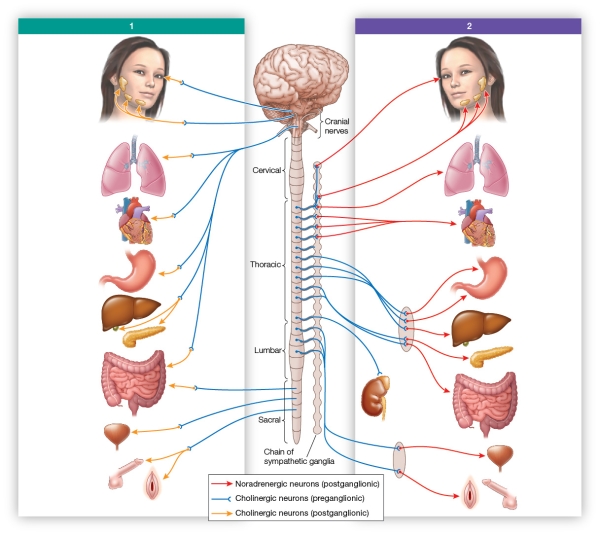 In the division labeled 1 in the figure, what would be the result if the peripheral nerve leading to the bladder were damaged?
 (Short Answer)
4.8/5 (79)
(79) Which of the following best represents what happens to axons from the retina at the optic chiasm?
(Multiple Choice)
4.7/5 (67)
(67) If you were hooked up to electrodes that gave you a reading of only your eye movements (an electroocculogram, or EOG) during the night, would you be able to learn anything about your sleep cycles, and why?
(Multiple Choice)
4.8/5 (83)
(83) Long-term potentiation may play a role in long-lasting synaptic changes associated with learning because it
(Multiple Choice)
4.7/5 (83)
(83) The hippocampus, which is part of the _______ system, is involved in spatial memory.
(Short Answer)
4.8/5 (80)
(80) Half of the information from each eye-that is, the information from the half of each retina that is closest to the nose-crosses to the opposite side of the brain for processing.What is the functional consequence of this crossing over?
(Multiple Choice)
4.7/5 (90)
(90) In a vertebrate embryo, damage to the hindbrain could influence development of which of the following structures?
(Multiple Choice)
4.8/5 (85)
(85) At the core of the forebrain are evolutionarily older structures that govern instincts, long-term memory formation, and physiological drives.These are known as the _______, and they develop from the embryonic _______.
(Multiple Choice)
4.8/5 (71)
(71) The activity in a person's brain can be visualized using positron emission tomography (PET).If the person is touching different objects with his right hand, where would you expect to see increased activity related to his hand movements?
(Multiple Choice)
4.9/5 (69)
(69) 
Filters
- Essay(0)
- Multiple Choice(0)
- Short Answer(0)
- True False(0)
- Matching(0)