



 Chat with AI
Exam 1: Biology and Its Themes

Exam 1: Biology and Its Themes46 Questions
Exam 2: Atoms and Molecules61 Questions
Exam 3: The Chemistry of Water55 Questions
Exam 4: Carbon: the Basis of Molecular Diversity52 Questions
Exam 5: Biological Macromolecules and Lipids71 Questions
Exam 6: Energy and Life65 Questions
Exam 7: Cell Structure and Function66 Questions
Exam 8: Cell Membranes67 Questions
Exam 9: Cellular Signaling62 Questions
Exam 10: Cell Respiration68 Questions
Exam 11: Photosynthetic Processes64 Questions
Exam 12: Mitosis63 Questions
Exam 13: Sexual Life Cycles and Meiosis64 Questions
Exam 14: Mendelian Genetics65 Questions
Exam 15: Linkage and Chromosomes54 Questions
Exam 16: Nucleic Acids and Inheritance65 Questions
Exam 17: Expression of Genes70 Questions
Exam 18: Control of Gene Expression66 Questions
Exam 19: Dna Technology56 Questions
Exam 20: The Evolution of Genomes47 Questions
Exam 21: How Evolution Works60 Questions
Exam 22: Phylogenetic Reconstruction66 Questions
Exam 23: Microevolution65 Questions
Exam 24: Species and Speciation65 Questions
Exam 25: Macroevolution58 Questions
Exam 26: Introduction to Viruses54 Questions
Exam 27: Prokaryotes61 Questions
Exam 28: The Origin and Evolution of Eukaryotes66 Questions
Exam 29: Nonvascular and Seedless Vascular Plants72 Questions
Exam 30: Seed Plants64 Questions
Exam 31: Introduction to Fungi56 Questions
Exam 32: An Introduction to Animal Diversity58 Questions
Exam 33: Invertebrates58 Questions
Exam 34: Vertebrates66 Questions
Exam 35: Plant Structure and Growth68 Questions
Exam 36: Transport in Vascular Plants73 Questions
Exam 37: Plant Nutrition51 Questions
Exam 38: Reproduction of Flowering Plants59 Questions
Exam 39: Plant Signals and Behavior60 Questions
Exam 40: The Animal Body58 Questions
Exam 41: Chemical Signals in Animals62 Questions
Exam 42: Animal Digestive Systems58 Questions
Exam 43: Animal Transport Systems58 Questions
Exam 44: Animal Excretory Systems49 Questions
Exam 45: Animal Reproductive Systems64 Questions
Exam 46: Development in Animals68 Questions
Exam 47: Animal Defenses Against Infection65 Questions
Exam 48: Electrical Signals in Animals62 Questions
Exam 49: Neural Regulation in Animals69 Questions
Exam 50: Sensation and Movement in Animals68 Questions
Exam 51: An Overview of Ecology71 Questions
Exam 52: Behavioral Ecology64 Questions
Exam 53: Populations and Life History Traits73 Questions
Exam 54: Biodiversity and Communities71 Questions
Exam 55: Energy Flow and Chemical Cycling in Ecosystems80 Questions
Exam 56: Conservation and Global Ecology75 Questions
Select questions type


Use the following information when answering the following question.
In 1668, Francesco Redi performed a series of experiments on spontaneous generation. He began by putting similar pieces of meat into eight identical jars. Four jars were left open to the air, and four were sealed. He then did the same experiment with one variation: Instead of sealing four of the jars completely, he covered them with gauze (the gauze excluded the flies while allowing the meat to be exposed to air). In both experiments, he monitored the jars and recorded whether or not maggots (young flies) appeared in the meat.
What hypothesis was being tested in the initial experiment with open versus sealed jars?
(Multiple Choice)
4.9/5  (79)
(79) Which of the following is the correct order of organization of genetic material from smallest to largest?
(Multiple Choice)
4.8/5 (77)
(77) Use the following figure to answer the question. 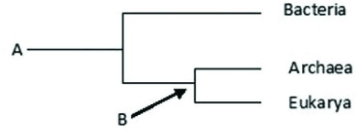 Describe groups labeled A and B.
 (Multiple Choice)
4.7/5 (78)
(78) Which of the following statements about genetic information is correct?
(Multiple Choice)
4.8/5 (79)
(79) Following a scientific method, which of the following is the correct order of steps?
(Multiple Choice)
4.9/5 (74)
(74) Which branch of biology is concerned with the naming and classifying of organisms?
(Multiple Choice)
4.8/5 (81)
(81) Which of these provides evidence of the common ancestry of all life?
(Multiple Choice)
4.7/5 (68)
(68) A double-stranded DNA molecule with three guanine and five thiamine nucleotides (in 5 3 strand) has how many nucleotides in total?
(Multiple Choice)
4.9/5 (79)
(79) Two organisms are ________ if they share more classification levels.
(Multiple Choice)
4.8/5 (75)
(75) Three important research developments that have made the genomic and proteomic approaches possible are ________.
(Multiple Choice)
4.9/5 (79)
(79) Which of the following statements best distinguishes hypotheses from theories in science?
(Multiple Choice)
4.8/5 (83)
(83) Which of the following is the quality of a good scientific hypothesis?
(Multiple Choice)
4.7/5 (79)
(79) Use the following information when answering the following question.
In 1668, Francesco Redi performed a series of experiments on spontaneous generation. He began by putting similar pieces of meat into eight identical jars. Four jars were left open to the air, and four were sealed. He then did the same experiment with one variation: Instead of sealing four of the jars completely, he covered them with gauze (the gauze excluded the flies while allowing the meat to be exposed to air). In both experiments, he monitored the jars and recorded whether or not maggots (young flies) appeared in the meat.
In both experiments, flies appeared in all of the open jars and only in the open jars. Which one of the following statements is correct?
(Multiple Choice)
4.9/5 (79)
(79) Why is a scientific topic best discussed by people of varying points of view, from different subdisciplines, and representing diverse cultures?
(Multiple Choice)
4.8/5 (79)
(79) Which of the following best describes a controlled experiment?
(Multiple Choice)
4.8/5 (88)
(88) Use the information in the graph to answer the following question. 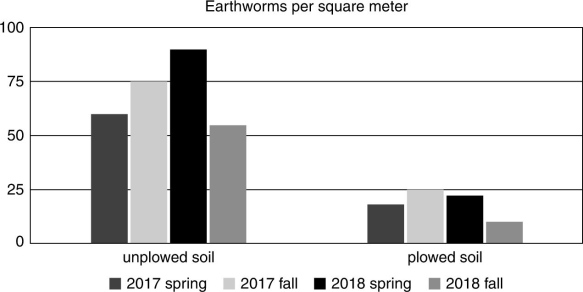 The data can best be used to address which of the following questions?
 (Multiple Choice)
4.9/5 (80)
(80) To understand the chemical basis of inheritance, we must understand the molecular structure of DNA. This is an example of the application of which concept to the study of biology?
(Multiple Choice)
4.9/5 (59)
(59) 
Filters
- Essay(0)
- Multiple Choice(0)
- Short Answer(0)
- True False(0)
- Matching(0)