



 Chat with AI
Exam 20: The Evolution of Genomes

Exam 1: Biology and Its Themes46 Questions
Exam 2: Atoms and Molecules61 Questions
Exam 3: The Chemistry of Water55 Questions
Exam 4: Carbon: the Basis of Molecular Diversity52 Questions
Exam 5: Biological Macromolecules and Lipids71 Questions
Exam 6: Energy and Life65 Questions
Exam 7: Cell Structure and Function66 Questions
Exam 8: Cell Membranes67 Questions
Exam 9: Cellular Signaling62 Questions
Exam 10: Cell Respiration68 Questions
Exam 11: Photosynthetic Processes64 Questions
Exam 12: Mitosis63 Questions
Exam 13: Sexual Life Cycles and Meiosis64 Questions
Exam 14: Mendelian Genetics65 Questions
Exam 15: Linkage and Chromosomes54 Questions
Exam 16: Nucleic Acids and Inheritance65 Questions
Exam 17: Expression of Genes70 Questions
Exam 18: Control of Gene Expression66 Questions
Exam 19: Dna Technology56 Questions
Exam 20: The Evolution of Genomes47 Questions
Exam 21: How Evolution Works60 Questions
Exam 22: Phylogenetic Reconstruction66 Questions
Exam 23: Microevolution65 Questions
Exam 24: Species and Speciation65 Questions
Exam 25: Macroevolution58 Questions
Exam 26: Introduction to Viruses54 Questions
Exam 27: Prokaryotes61 Questions
Exam 28: The Origin and Evolution of Eukaryotes66 Questions
Exam 29: Nonvascular and Seedless Vascular Plants72 Questions
Exam 30: Seed Plants64 Questions
Exam 31: Introduction to Fungi56 Questions
Exam 32: An Introduction to Animal Diversity58 Questions
Exam 33: Invertebrates58 Questions
Exam 34: Vertebrates66 Questions
Exam 35: Plant Structure and Growth68 Questions
Exam 36: Transport in Vascular Plants73 Questions
Exam 37: Plant Nutrition51 Questions
Exam 38: Reproduction of Flowering Plants59 Questions
Exam 39: Plant Signals and Behavior60 Questions
Exam 40: The Animal Body58 Questions
Exam 41: Chemical Signals in Animals62 Questions
Exam 42: Animal Digestive Systems58 Questions
Exam 43: Animal Transport Systems58 Questions
Exam 44: Animal Excretory Systems49 Questions
Exam 45: Animal Reproductive Systems64 Questions
Exam 46: Development in Animals68 Questions
Exam 47: Animal Defenses Against Infection65 Questions
Exam 48: Electrical Signals in Animals62 Questions
Exam 49: Neural Regulation in Animals69 Questions
Exam 50: Sensation and Movement in Animals68 Questions
Exam 51: An Overview of Ecology71 Questions
Exam 52: Behavioral Ecology64 Questions
Exam 53: Populations and Life History Traits73 Questions
Exam 54: Biodiversity and Communities71 Questions
Exam 55: Energy Flow and Chemical Cycling in Ecosystems80 Questions
Exam 56: Conservation and Global Ecology75 Questions
Select questions type


Which of the following statements explains how errors during meiosis that result in an extra copy of a chromosome can facilitate evolution?
(Multiple Choice)
4.8/5  (72)
(72) Which of the following processes is most likely responsible for the variable number of repeated units found at a specific STR locus?
(Multiple Choice)
4.8/5 (96)
(96) Which of the following characteristics is unique to multigene families?
(Multiple Choice)
4.9/5 (71)
(71) Which of the following describes an error in a cellular process that results in DNA duplications?
(Multiple Choice)
4.9/5 (68)
(68) Which of the following statements distinguishes between the way transposons and retrotransposons move around in a genome?
(Multiple Choice)
4.9/5 (81)
(81) Comparisons of DNA sequences within the human species have revealed many variations. Which of the following variations involves duplication of relatively long stretches of DNA?
(Multiple Choice)
4.7/5 (83)
(83) A long region of genomic DNA is compared with a cDNA. The cDNA sequence is identical to segments, but not all, of the genomic DNA sequence. According to these data which of the following statements best describes the genomic DNA?
(Multiple Choice)
5.0/5 (66)
(66) In a eukaryote, which of the following describes the most likely outcome when gene duplication occurs in one member of a gene pair?
(Multiple Choice)
4.9/5 (79)
(79) Which of the following statements explains how hemoglobin in a human embryo has a higher affinity for oxygen than hemoglobin in the adult?
(Multiple Choice)
5.0/5 (80)
(80) Which of the following techniques would be most appropriate to test the hypothesis that humans and chimps differ in the expression of a large set of shared genes?
(Multiple Choice)
4.9/5 (78)
(78) Using modern techniques of sequencing by synthesis and the shotgun approach, the sequences of entire chromosomes are determined by ________.
(Multiple Choice)
4.8/5 (83)
(83) Human genomes contain several globin genes that are expressed at distinct times in development. Which of the mechanisms listed best explains this developmental pattern?
(Multiple Choice)
4.9/5 (80)
(80) Two eukaryotic proteins have one domain in common but are otherwise very different. Which of the following processes is most likely to have contributed to this similarity?
(Multiple Choice)
4.7/5 (83)
(83) Exon shuffling occurs during which of the following processes?
(Multiple Choice)
4.8/5 (94)
(94) A microarray is a tool used in genetic research to determine the relative level of expression of mRNAs in a particular tissue. One use of the technology is in cancer diagnosis and treatment. Which of the following pieces of evidence would support diagnosis of a cancer due to a mutation in a tumor-suppressor gene?
(Multiple Choice)
4.8/5 (67)
(67) Use the following information to answer the question. 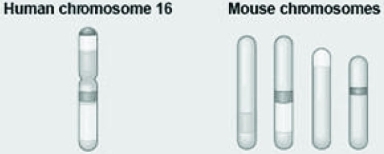 The figure shows a diagram of blocks of genes on human chromosome 16 and the locations of blocks of similar genes as they are found on four different mouse chromosomes.
Which of the following statements best explains the different arrangements of these blocks in the genomes of these two species?
The figure shows a diagram of blocks of genes on human chromosome 16 and the locations of blocks of similar genes as they are found on four different mouse chromosomes.
Which of the following statements best explains the different arrangements of these blocks in the genomes of these two species? (Multiple Choice)
4.8/5 (82)
(82) Which of the following statements best describes multi gene families?
(Multiple Choice)
4.8/5 (78)
(78) Which of the following describes an advantage of establishing and using a human reference genome in a bioinformatics investigation?
(Multiple Choice)
4.7/5 (86)
(86) Fragments of DNA extracted from the remnants of an extinct vertebrate, the woolly mammoth, have been amplified and sequenced. Currently, the most efficient and ethical use of these products is ________.
(Multiple Choice)
4.7/5 (78)
(78) 
Filters
- Essay(0)
- Multiple Choice(0)
- Short Answer(0)
- True False(0)
- Matching(0)