



 Chat with AI
Exam 30: Seed Plants

Exam 1: Biology and Its Themes46 Questions
Exam 2: Atoms and Molecules61 Questions
Exam 3: The Chemistry of Water55 Questions
Exam 4: Carbon: the Basis of Molecular Diversity52 Questions
Exam 5: Biological Macromolecules and Lipids71 Questions
Exam 6: Energy and Life65 Questions
Exam 7: Cell Structure and Function66 Questions
Exam 8: Cell Membranes67 Questions
Exam 9: Cellular Signaling62 Questions
Exam 10: Cell Respiration68 Questions
Exam 11: Photosynthetic Processes64 Questions
Exam 12: Mitosis63 Questions
Exam 13: Sexual Life Cycles and Meiosis64 Questions
Exam 14: Mendelian Genetics65 Questions
Exam 15: Linkage and Chromosomes54 Questions
Exam 16: Nucleic Acids and Inheritance65 Questions
Exam 17: Expression of Genes70 Questions
Exam 18: Control of Gene Expression66 Questions
Exam 19: Dna Technology56 Questions
Exam 20: The Evolution of Genomes47 Questions
Exam 21: How Evolution Works60 Questions
Exam 22: Phylogenetic Reconstruction66 Questions
Exam 23: Microevolution65 Questions
Exam 24: Species and Speciation65 Questions
Exam 25: Macroevolution58 Questions
Exam 26: Introduction to Viruses54 Questions
Exam 27: Prokaryotes61 Questions
Exam 28: The Origin and Evolution of Eukaryotes66 Questions
Exam 29: Nonvascular and Seedless Vascular Plants72 Questions
Exam 30: Seed Plants64 Questions
Exam 31: Introduction to Fungi56 Questions
Exam 32: An Introduction to Animal Diversity58 Questions
Exam 33: Invertebrates58 Questions
Exam 34: Vertebrates66 Questions
Exam 35: Plant Structure and Growth68 Questions
Exam 36: Transport in Vascular Plants73 Questions
Exam 37: Plant Nutrition51 Questions
Exam 38: Reproduction of Flowering Plants59 Questions
Exam 39: Plant Signals and Behavior60 Questions
Exam 40: The Animal Body58 Questions
Exam 41: Chemical Signals in Animals62 Questions
Exam 42: Animal Digestive Systems58 Questions
Exam 43: Animal Transport Systems58 Questions
Exam 44: Animal Excretory Systems49 Questions
Exam 45: Animal Reproductive Systems64 Questions
Exam 46: Development in Animals68 Questions
Exam 47: Animal Defenses Against Infection65 Questions
Exam 48: Electrical Signals in Animals62 Questions
Exam 49: Neural Regulation in Animals69 Questions
Exam 50: Sensation and Movement in Animals68 Questions
Exam 51: An Overview of Ecology71 Questions
Exam 52: Behavioral Ecology64 Questions
Exam 53: Populations and Life History Traits73 Questions
Exam 54: Biodiversity and Communities71 Questions
Exam 55: Energy Flow and Chemical Cycling in Ecosystems80 Questions
Exam 56: Conservation and Global Ecology75 Questions
Select questions type


Use the information to answer the following question.
Scarlet gilia (Ipomopsis aggregata) usually has red flowers. In certain populations in the Arizona mountains, however, the flowers range from red to pink to white. In early summer, most (but not all) of the flowers were red. In late summer, the same individual plants were still present; the flowers ranged from pink to white, and few red flowers were present. The table below describes the pollination process in these plants.
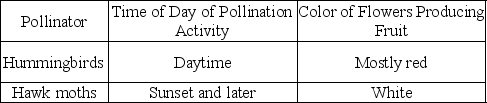 Late in the season, when only hawk moths were present, researchers painted the red flowers white. Which of the following results is most likely in this situation?
 (Multiple Choice)
5.0/5  (92)
(92) Which of the following problems will likely increase if the human population continues to increase?
(Multiple Choice)
4.9/5 (66)
(66) Use the information to answer the following question.
Scarlet gilia (Ipomopsis aggregata) usually has red flowers. In certain populations in the Arizona mountains, however, the flowers range from red to pink to white. In early summer, most (but not all) of the flowers were red. In late summer, the same individual plants were still present; the flowers ranged from pink to white, and few red flowers were present. The table below describes the pollination process in these plants.
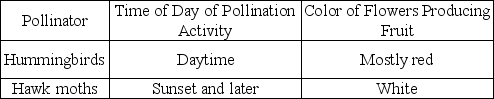 Some plants continued to produce only dark (red) flowers whereas others produced lighter colored flowers later in the season. Which plants do you expect produced more fruit over the entire season?
 (Multiple Choice)
5.0/5 (77)
(77) In onions (Allium), cells of the sporophyte have 16 chromosomes within each nucleus. How many chromosomes should be in an endosperm nucleus?
(Multiple Choice)
4.7/5 (90)
(90) Among plants known as legumes (beans, peas, alfalfa, clover, for example) the seeds are contained in a fruit that is itself called a legume, better known as a pod. Upon opening such pods, it is commonly observed that some ovules have become mature seeds, whereas other ovules have not. Which of the following statements best explains this observation?
(Multiple Choice)
4.9/5 (85)
(85) The Brazil nut tree, Bertholletia excels, is native to tropical rain forests of South America. Scientists have discovered that the pale yellow flowers of Brazil nut trees cannot fertilize themselves and admit only female orchid bees as pollinators. If a female orchid bee has just left a Brazil nut tree with nectar in her stomach, and if she visits another flower on a different Brazil nut tree, what is the sequence in which the following events should occur?
(Multiple Choice)
4.8/5 (79)
(79) In onions (Allium), cells of the sporophyte have 16 chromosomes within each nucleus. How many chromosomes should be in a megasporangium nucleus?
(Multiple Choice)
4.9/5 (78)
(78) Which of the following statements about the pine life cycle is correct?
(Multiple Choice)
4.9/5 (78)
(78) Which of the following is the most beneficial adaptation of the seed coats in angiosperm species whose seeds are dispersed by fruit-eating animals, as opposed to angiosperm species whose seeds are dispersed by other means?
(Multiple Choice)
5.0/5 (84)
(84) Which of the following is a characteristic of all angiosperms?
(Multiple Choice)
5.0/5 (78)
(78) In onions (Allium), cells of the sporophyte have 16 chromosomes within each nucleus. How many chromosomes should be in a tube cell nucleus?
(Multiple Choice)
4.8/5 (89)
(89) Which of the following describes a difference between wind-pollinated angiosperms compared with animal pollinated plants? Wind pollenated plants ________.
(Multiple Choice)
4.8/5 (82)
(82) In spruces and pines, which of the following is an advantage of having needlelike leaves?
(Multiple Choice)
4.8/5 (82)
(82) The internal parts of the pollen grains of seed-producing plants are most similar to which of the following structures in seedless plants?
(Multiple Choice)
4.9/5 (84)
(84) Which of the following organisms are the closest relatives of pine and spruce trees?
(Multiple Choice)
4.8/5 (74)
(74) Immature seed cones of conifers are usually green before pollination, and flowers of grasses are inconspicuously colored. What does this indicate about how they are pollinated?
(Multiple Choice)
4.8/5 (85)
(85) Which of the following is a characteristic that distinguishes gymnosperms and angiosperms from other plants?
(Multiple Choice)
4.7/5 (92)
(92) The Brazil nut tree, Bertholletia excels, is native to tropical rain forests of South America. The agouti (Dasyprocta spp.), a cat-sized rodent, is the only animal with teeth strong enough to crack the hard wall of Brazil nut fruits. It typically eats some of the seeds, buries others, and leaves still others inside the fruit into which moisture can then enter and allow the remaining seeds to germinate. The agouti is most directly involved in dispersal of which of the following structures?
(Multiple Choice)
4.7/5 (87)
(87) The Brazil nut tree, Bertholletia excels, is native to tropical rain forests of South America and produces large nuts. The large white part of a Brazil nut that people eat serves which of the following functions in nature?
(Multiple Choice)
4.9/5 (83)
(83) 
Filters
- Essay(0)
- Multiple Choice(0)
- Short Answer(0)
- True False(0)
- Matching(0)