



 Chat with AI
Exam 33: Invertebrates

Exam 1: Biology and Its Themes46 Questions
Exam 2: Atoms and Molecules61 Questions
Exam 3: The Chemistry of Water55 Questions
Exam 4: Carbon: the Basis of Molecular Diversity52 Questions
Exam 5: Biological Macromolecules and Lipids71 Questions
Exam 6: Energy and Life65 Questions
Exam 7: Cell Structure and Function66 Questions
Exam 8: Cell Membranes67 Questions
Exam 9: Cellular Signaling62 Questions
Exam 10: Cell Respiration68 Questions
Exam 11: Photosynthetic Processes64 Questions
Exam 12: Mitosis63 Questions
Exam 13: Sexual Life Cycles and Meiosis64 Questions
Exam 14: Mendelian Genetics65 Questions
Exam 15: Linkage and Chromosomes54 Questions
Exam 16: Nucleic Acids and Inheritance65 Questions
Exam 17: Expression of Genes70 Questions
Exam 18: Control of Gene Expression66 Questions
Exam 19: Dna Technology56 Questions
Exam 20: The Evolution of Genomes47 Questions
Exam 21: How Evolution Works60 Questions
Exam 22: Phylogenetic Reconstruction66 Questions
Exam 23: Microevolution65 Questions
Exam 24: Species and Speciation65 Questions
Exam 25: Macroevolution58 Questions
Exam 26: Introduction to Viruses54 Questions
Exam 27: Prokaryotes61 Questions
Exam 28: The Origin and Evolution of Eukaryotes66 Questions
Exam 29: Nonvascular and Seedless Vascular Plants72 Questions
Exam 30: Seed Plants64 Questions
Exam 31: Introduction to Fungi56 Questions
Exam 32: An Introduction to Animal Diversity58 Questions
Exam 33: Invertebrates58 Questions
Exam 34: Vertebrates66 Questions
Exam 35: Plant Structure and Growth68 Questions
Exam 36: Transport in Vascular Plants73 Questions
Exam 37: Plant Nutrition51 Questions
Exam 38: Reproduction of Flowering Plants59 Questions
Exam 39: Plant Signals and Behavior60 Questions
Exam 40: The Animal Body58 Questions
Exam 41: Chemical Signals in Animals62 Questions
Exam 42: Animal Digestive Systems58 Questions
Exam 43: Animal Transport Systems58 Questions
Exam 44: Animal Excretory Systems49 Questions
Exam 45: Animal Reproductive Systems64 Questions
Exam 46: Development in Animals68 Questions
Exam 47: Animal Defenses Against Infection65 Questions
Exam 48: Electrical Signals in Animals62 Questions
Exam 49: Neural Regulation in Animals69 Questions
Exam 50: Sensation and Movement in Animals68 Questions
Exam 51: An Overview of Ecology71 Questions
Exam 52: Behavioral Ecology64 Questions
Exam 53: Populations and Life History Traits73 Questions
Exam 54: Biodiversity and Communities71 Questions
Exam 55: Energy Flow and Chemical Cycling in Ecosystems80 Questions
Exam 56: Conservation and Global Ecology75 Questions
Select questions type


What would the presence of a lophophore in a newly discovered species suggest about that organism?
(Multiple Choice)
4.8/5  (85)
(85) You find a multi-legged animal in your garden and want to determine if it is a centipede or a millipede. Which of the following characteristics would allow you to make this distinction?
(Multiple Choice)
4.8/5 (87)
(87) Which of the following structures in insects functions in gas exchange?
(Multiple Choice)
4.9/5 (84)
(84) Which of the following statements about bryozoans (ectoprocts) is correct?
(Multiple Choice)
4.9/5 (92)
(92) The heartworms that can accumulate within the hearts of dogs and other mammals have a hemocoel, an alimentary canal, and an outer covering that is occasionally shed. To which phylum does the heartworm belong?
(Multiple Choice)
4.8/5 (79)
(79) What would be the most effective method of reducing the incidence of blood flukes in a human population?
(Multiple Choice)
4.8/5 (76)
(76) As you are walking along a beach, you find an animal and believe that it belongs to the class Asteroidea. Which of the following characteristics would support your hypothesis that the animal is a sea star and not another type of echinoderm?
(Multiple Choice)
4.9/5 (77)
(77) You find what you believe is a new species of animal. Which of the following characteristics would enable you to argue that it is more closely related to a nematode than it is to an annelid?
(Multiple Choice)
4.8/5 (84)
(84) Which of the following groups of organisms has flagella associated with its method of feeding?
(Multiple Choice)
4.9/5 (80)
(80) Which of the following statements is correct with respect to the evolutionary relationship between chordates and invertebrates?
(Multiple Choice)
4.8/5 (75)
(75) The sharp, inch-long thorns of the crown-of-thorns sea star are its spines. These spines, unlike those of most other sea stars, contain a potent toxin. If it were discovered that crown-of-thorns sea stars do not make this toxin themselves, then what is the most likely alternative source for the toxin?
(Multiple Choice)
4.9/5 (93)
(93) Why do large animals need specialized organs for gas exchange?
(Multiple Choice)
4.8/5 (85)
(85) 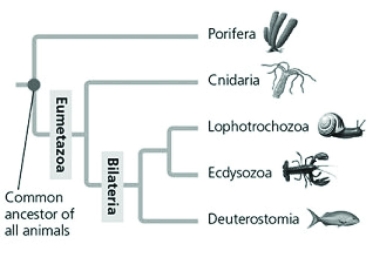
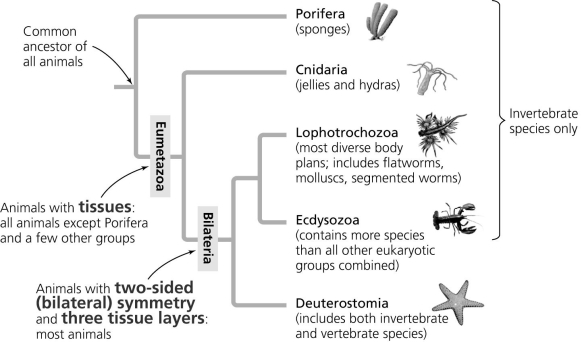 In these figures, which two main clades branch from the most recent common ancestor of the eumetazoans?
 (Multiple Choice)
4.9/5 (78)
(78) Use the following information and figure to answer the question.
Aphids are hemipterans that suck phloem liquid from plants. Ants are often seen collecting the liquid off the posterior end of the aphid and collecting the liquid that is released from the aphid's digestive system. In an effort to understand this interaction, several researchers measure the survival rates of aphid populations when ants were present and when they were excluded. Their results are shown. 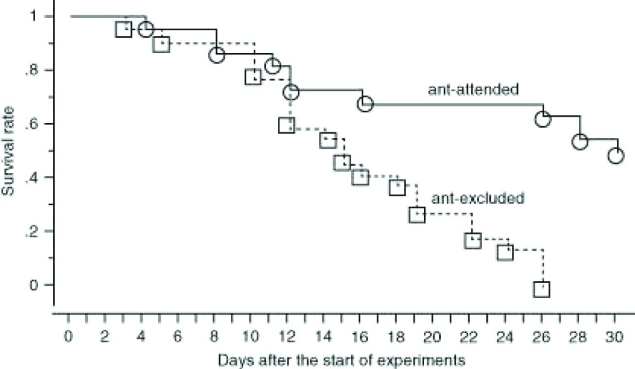 Which of the following conclusions is most consistent with the data?
 (Multiple Choice)
4.9/5 (80)
(80) The phylum Cycliophora includes tiny organisms that live in large numbers on the outsides of the mouthparts and appendages of lobsters. The feeding stage permanently attaches to the lobster and collects scraps of food from its host's feeding by capturing the scraps in a current created by a ring of cilia.
The feeding stage of cycliophorans is best described as ________.
(Multiple Choice)
4.7/5 (89)
(89) Which of the following characteristics of their exoskeletons is exhibited by both arthropods and molluscs?
(Multiple Choice)
4.8/5 (80)
(80) Which of the following statements best explains how planarians can survive and thrive without respiratory or circulatory systems?
(Multiple Choice)
4.9/5 (67)
(67) 
Filters
- Essay(0)
- Multiple Choice(0)
- Short Answer(0)
- True False(0)
- Matching(0)