



 Chat with AI
Exam 53: Populations and Life History Traits

Exam 1: Biology and Its Themes46 Questions
Exam 2: Atoms and Molecules61 Questions
Exam 3: The Chemistry of Water55 Questions
Exam 4: Carbon: the Basis of Molecular Diversity52 Questions
Exam 5: Biological Macromolecules and Lipids71 Questions
Exam 6: Energy and Life65 Questions
Exam 7: Cell Structure and Function66 Questions
Exam 8: Cell Membranes67 Questions
Exam 9: Cellular Signaling62 Questions
Exam 10: Cell Respiration68 Questions
Exam 11: Photosynthetic Processes64 Questions
Exam 12: Mitosis63 Questions
Exam 13: Sexual Life Cycles and Meiosis64 Questions
Exam 14: Mendelian Genetics65 Questions
Exam 15: Linkage and Chromosomes54 Questions
Exam 16: Nucleic Acids and Inheritance65 Questions
Exam 17: Expression of Genes70 Questions
Exam 18: Control of Gene Expression66 Questions
Exam 19: Dna Technology56 Questions
Exam 20: The Evolution of Genomes47 Questions
Exam 21: How Evolution Works60 Questions
Exam 22: Phylogenetic Reconstruction66 Questions
Exam 23: Microevolution65 Questions
Exam 24: Species and Speciation65 Questions
Exam 25: Macroevolution58 Questions
Exam 26: Introduction to Viruses54 Questions
Exam 27: Prokaryotes61 Questions
Exam 28: The Origin and Evolution of Eukaryotes66 Questions
Exam 29: Nonvascular and Seedless Vascular Plants72 Questions
Exam 30: Seed Plants64 Questions
Exam 31: Introduction to Fungi56 Questions
Exam 32: An Introduction to Animal Diversity58 Questions
Exam 33: Invertebrates58 Questions
Exam 34: Vertebrates66 Questions
Exam 35: Plant Structure and Growth68 Questions
Exam 36: Transport in Vascular Plants73 Questions
Exam 37: Plant Nutrition51 Questions
Exam 38: Reproduction of Flowering Plants59 Questions
Exam 39: Plant Signals and Behavior60 Questions
Exam 40: The Animal Body58 Questions
Exam 41: Chemical Signals in Animals62 Questions
Exam 42: Animal Digestive Systems58 Questions
Exam 43: Animal Transport Systems58 Questions
Exam 44: Animal Excretory Systems49 Questions
Exam 45: Animal Reproductive Systems64 Questions
Exam 46: Development in Animals68 Questions
Exam 47: Animal Defenses Against Infection65 Questions
Exam 48: Electrical Signals in Animals62 Questions
Exam 49: Neural Regulation in Animals69 Questions
Exam 50: Sensation and Movement in Animals68 Questions
Exam 51: An Overview of Ecology71 Questions
Exam 52: Behavioral Ecology64 Questions
Exam 53: Populations and Life History Traits73 Questions
Exam 54: Biodiversity and Communities71 Questions
Exam 55: Energy Flow and Chemical Cycling in Ecosystems80 Questions
Exam 56: Conservation and Global Ecology75 Questions
Select questions type


A species population's size (N) may vary depending on a number of factors including crowding and resource limitation. As N approaches K (carrying capacity) for a certain population, which of the following outcomes is predicted by the logistic growth model?
(Multiple Choice)
4.9/5  (69)
(69) To measure the population of lake trout in a 250-hectare lake, 500 individual trout were captured using nets and marked with a fin clip, then returned to the lake. The next week, the trout capture was repeated, and out of the 200 lake trout that were caught, 50 had fin clips. Using the mark-recapture estimate, the lake trout population size is predicted to be closest to which of the following?
(Multiple Choice)
4.9/5 (89)
(89) Use the figure to answer the following question. 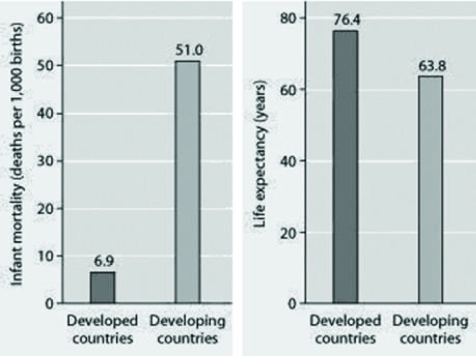 Infant mortality and life expectancy at birth in developed and
Developing countries (data as of 2005).
What is a logical conclusion that can be drawn from the graphs about developed countries?
Infant mortality and life expectancy at birth in developed and
Developing countries (data as of 2005).
What is a logical conclusion that can be drawn from the graphs about developed countries? (Multiple Choice)
4.8/5 (76)
(76) Which of the following is accurate about a population exhibiting exponential growth?
(Multiple Choice)
4.7/5 (92)
(92) Which of the following techniques would most accurately measure the dispersion pattern of the population being studied?
(Multiple Choice)
4.9/5 (70)
(70) Use the graph to answer the following question. 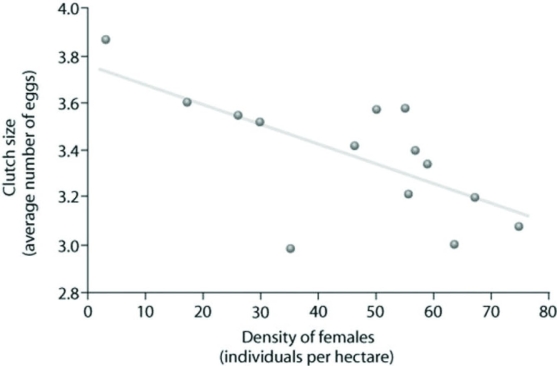 Which of the following claims can be best supported using the data?
 (Multiple Choice)
4.8/5 (82)
(82) Two breeding female fish of the same species successfully reproduce, and one female lays 100 eggs, while the other female lays 1,000 eggs. Which one of the following outcomes is most likely, given the limits of fitness trade-offs?
(Multiple Choice)
4.7/5 (92)
(92) In which of the following situations would you expect to find the largest number of r-selected individuals?
(Multiple Choice)
4.9/5 (66)
(66) An undergraduate student is working in a research lab, and starting with a single bacterium, she cultures it in a flask of ideal nutrient broth at an optimum temperature over a two-hour period? Assume resources do not become limiting over this time frame.
(Multiple Choice)
4.9/5 (71)
(71) Use the graph to answer the following question. 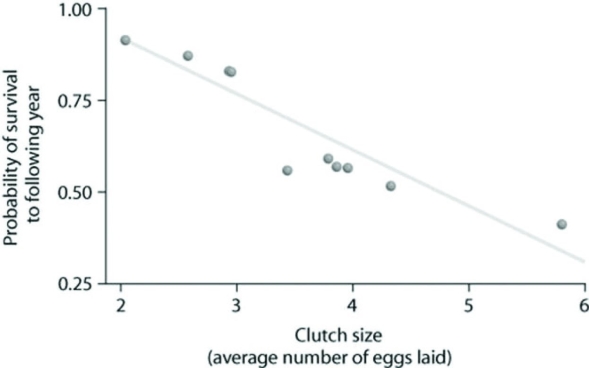 Based on the data graphed here, which size clutch would likely result in the highest estimated overall reproductive success (fecundity) after one year?
 (Multiple Choice)
4.9/5 (89)
(89) Use the graph to answer the following question. 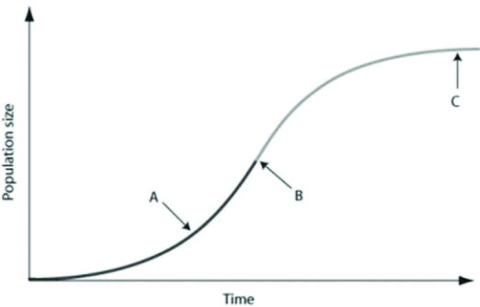 In the figure, which of the arrows represents the carrying capacity?
 (Multiple Choice)
4.9/5 (85)
(85) Starting from a single individual, which estimate best predicts the size of a population of bacteria at the end of a 2-hour time period if they reproduce by binary fission every 20 minutes? (Assume unlimited resources and no mortality.)
(Multiple Choice)
4.8/5 (66)
(66) Based on current growth rates, Earth's human population in 2019 will be closest to ________.
(Multiple Choice)
4.9/5 (84)
(84) 
Filters
- Essay(0)
- Multiple Choice(0)
- Short Answer(0)
- True False(0)
- Matching(0)