



 Chat with AI
Exam 57: Ecosystems

Exam 1: Studying Life246 Questions
Exam 2: Small Molecules and the Chemistry of Life246 Questions
Exam 3: Proteins, Carbohydrates, and Lipids246 Questions
Exam 4: Nucleic Acids and the Origin of Life246 Questions
Exam 5: Cells: the Working Units of Life248 Questions
Exam 6: Cell Membranes246 Questions
Exam 7: Cell Communication and Multicellularity246 Questions
Exam 8: Energy, Enzymes, and Metabolism246 Questions
Exam 9: Pathways That Harvest Chemical Energy246 Questions
Exam 10: Photosynthesis: Energy From Sunlight242 Questions
Exam 11: The Cell Cycle and Cell Division260 Questions
Exam 12: Inheritance, Genes, and Chromosomes250 Questions
Exam 13: Dna and Its Role in Heredity257 Questions
Exam 14: From Dna to Protein: Gene Expression252 Questions
Exam 15: Gene Mutation and Molecular Medicine251 Questions
Exam 16: Regulation of Gene Expression245 Questions
Exam 17: Genomes249 Questions
Exam 18: Recombinant Dna and Biotechnology243 Questions
Exam 20: Mechanisms of Evolution243 Questions
Exam 21: Reconstructing and Using Phylogenies246 Questions
Exam 22: Speciation247 Questions
Exam 23: Evolution of Genes and Genomes252 Questions
Exam 24: The History of Life on Earth246 Questions
Exam 25: Bacteria, Archaea, and Viruses262 Questions
Exam 26: The Origin and Diversification of Eukaryotes252 Questions
Exam 27: Plants Without Seeds: From Water to Land251 Questions
Exam 28: The Evolution of Seed Plants259 Questions
Exam 29: The Evolution and Diversity of Fungi261 Questions
Exam 30: Animal Origins and the Evolution of Body Plans248 Questions
Exam 31: Protostome Animals244 Questions
Exam 32: Deuterostome Animals246 Questions
Exam 33: The Plant Body243 Questions
Exam 34: Transport in Plants248 Questions
Exam 35: Plant Nutrition247 Questions
Exam 36: Regulation of Plant Growth246 Questions
Exam 37: Reproduction in Flowering Plants247 Questions
Exam 38: Plant Responses to Environmental Challenges246 Questions
Exam 39: Physiology, Homeostasis, and Temperature Regulation258 Questions
Exam 40: Animal Hormones249 Questions
Exam 41: Immunology: Animal Defense Systems265 Questions
Exam 42: Animal Reproduction261 Questions
Exam 43: Animal Development261 Questions
Exam 44: Neurons, Glia, and Nervous Systems250 Questions
Exam 45: Sensory Systems249 Questions
Exam 46: The Mammalian Nervous System: Structure and Higher Functions254 Questions
Exam 47: Musculoskeletal Systems259 Questions
Exam 48: Gas Exchange247 Questions
Exam 49: Circulatory Systems252 Questions
Exam 50: Nutrition, Digestion, and Absorption259 Questions
Exam 51: Salt and Water Balance and Nitrogen Excretion251 Questions
Exam 52: Animal Behavior249 Questions
Exam 53: The Physical Environment and Biogeography of Life248 Questions
Exam 54: Populations259 Questions
Exam 55: Species Interactions254 Questions
Exam 56: Communities247 Questions
Exam 57: Ecosystems238 Questions
Exam 58: A Changing Biosphere222 Questions
Select questions type


Relationships between temperature and rainfall are important in determining levels of primary production.In region A, both temperature and rainfall remain high throughout the year.In region B, temperature is high but rainfall remains low.What latitudes and biomes are represented by these relationships?
(Multiple Choice)
4.8/5  (73)
(73) Some people have suggested that fertilizing the oceans with iron would help combat the effects of global warming on oceans.However, it is unlikely that this method will be used extensively, because iron fertilization
(Multiple Choice)
4.9/5 (70)
(70) At the surface of the oceans, NPP is most often limited by nutrients, particularly nitrogen and iron.Moving downward through the ocean, the major limiting factor is usually
(Multiple Choice)
4.9/5 (79)
(79) Compare and contrast, with examples, the production efficiencies of ectotherms and endotherms.How does size affect production efficiency?
(Essay)
4.9/5 (70)
(70) The overharvesting of cod on Georges Bank, which resulted in the collapse of the cod fishery there, is an example of _______ use of an ecosystem.
(Short Answer)
4.9/5 (68)
(68) In an ocean ecosystem that has bottom-up control and occurs in an upwelling area, the amount of NPP in the system is likely controlled by the amount of _______.
(Short Answer)
4.8/5 (77)
(77) About half of the excess CO2 released into the atmosphere is dissolved into the oceans.What effect(s) does this added CO2 have on the oceans?
(Multiple Choice)
4.8/5 (73)
(73) An upwelling zone off the coast of Peru, in South America, has a very high net productivity.The factor that probably contributes most to the region's high NPP is its
(Multiple Choice)
4.7/5 (81)
(81) In the ocean, why would there be a smaller biomass of large predators (for example, sharks and tuna) than of herbivorous animals (for example, some small fish and zooplankton)?
(Multiple Choice)
4.9/5 (76)
(76) In the 1990s, oceanographic researchers added iron sulfite to the surface waters around the Galápagos Islands.The result of this experiment showed that iron
(Multiple Choice)
4.9/5 (81)
(81) Humans make many alterations to natural ecosystems.They turn natural areas into agricultural areas, build canals to transport offshore oil, cut down forests for lumber, build cities and highways, and more.How do these changes affect human societies?
(Multiple Choice)
4.9/5 (86)
(86) A soil ecosystem has very low plant growth and is found to be deficient in nitrogen.To obtain the nitrogen it needs using natural processes (as opposed to fertilizers added by humans), this ecosystem would need more _______ bacteria.
(Multiple Choice)
4.9/5 (88)
(88) The FACE experiments were designed to determine whether primary production could offset rising atmospheric CO2 levels caused by the burning of _______.
(Short Answer)
4.9/5 (84)
(84) As a result of human agriculture and urbanization, and more recently large-scale phosphorus mining, the amount of phosphorus in Earth's freshwater and terrestrial ecosystems has nearly quadrupled.This suggests that recent increases in algal blooms in many lakes might be occurring because phosphorus
(Multiple Choice)
5.0/5 (99)
(99) Which of these animals would likely have the highest production efficiency?
(Multiple Choice)
4.8/5 (66)
(66) Refer to the figure.  In an ecosystem, nutrients are highly limiting and prevent NPP from increasing above a certain level.This represents which type of control of energy flow?
 (Multiple Choice)
4.8/5 (87)
(87) Addition of artificial nitrogen fertilizers to agricultural lands causes an increase in nitrification and denitrification by bacteria.These processes in turn release nitrous oxide (N2O) into the atmosphere.What are the implications of additional nitrous oxide in the atmosphere?
(Multiple Choice)
4.7/5 (85)
(85) Bacteria, fungi, and larger organisms attack dead leaves, breaking them into smaller fragments.Soil and fecal material of larger organisms, such as earthworms, contain bacteria that continue the decomposition.Bacteria ultimately mineralize the leaf material into inorganic substances that are used by primary producers and bacteria.These activities describe the process of decomposition as it relates to
(Multiple Choice)
4.8/5 (77)
(77) Refer to the graph. 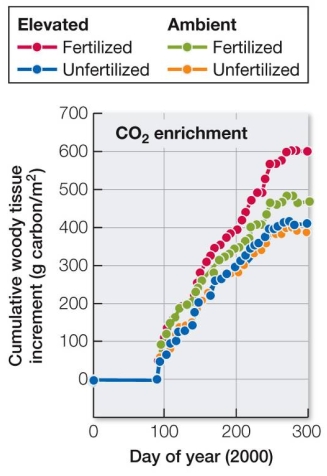 The FACE experiment conducted in a North Carolina pine forest analyzed the effects of two factors on forest NPP.These two factors were
 (Multiple Choice)
4.7/5 (73)
(73) 
Filters
- Essay(0)
- Multiple Choice(0)
- Short Answer(0)
- True False(0)
- Matching(0)