



 Chat with AI
Exam 4: Surgery

Exam 1: Medicine2 k Questions
Exam 2: Pediatric723 Questions
Exam 3: Psychiatry336 Questions
Exam 4: Surgery563 Questions
Exam 5: Obstetrics & Gynecology469 Questions
Select questions type


A 58-year-old man is evaluated for hypertension in the postanesthesia care unit 3 hours after undergoing open left inguinal hernia repair with placement of mesh. The surgery, which lasted approximately 1 hour, was performed using both general anesthesia and local anesthetic. Medical history is significant for obesity and prior surgical hemorrhoidectomy. The patient is alert and reports vague lower abdominal discomfort. Blood pressure is 150/92 mm Hg and pulse is 104/min. A surgical dressing on the left groin is intact with a small amount of serosanguinous drainage. There is mild distension in the central part of the lower abdomen, where palpation increases the patient's discomfort. The rest of the abdomen is soft and nontender. Postoperative telemetry reveals sinus tachycardia. Which of the following is the best next step in management of this patient?
(Multiple Choice)
4.8/5  (79)
(79) A 21-year-old man sustained a fall, hitting the left side of his head on a rock. He did not lose consciousness, but during the next 30 minutes, he developed a headache and vomited twice. The patient has no chronic medical conditions and takes no medication. Blood pressure is 136/90 mm Hg and pulse is 68/min. On examination, he is drowsy but otherwise well oriented. Swelling and tenderness are noted over the left frontoparietal region. CT scan of the head will most likely reveal which of the following?
(Multiple Choice)
4.8/5 (93)
(93) A 54-year-old man comes to the office due to intermittent episodes of blood in the stool over the past several weeks. The blood is mixed in the stool, and he has also noticed bright red blood on the toilet paper. The patient reports no prior medical conditions but has not seen a physician in many years. Family history includes colon cancer in his paternal uncle. Vital signs are within normal limits. Physical examination shows a nondistended, soft, and nontender abdomen with no hepatosplenomegaly. A palpable mass is present on digital rectal examination. Flexible sigmoidoscopy confirms a fungating mass in the upper rectum; biopsy is consistent with adenocarcinoma. Staging CT scans reveal no lung, liver, or bony metastases. Which of the following is most appropriate prior to surgical treatment of this patient's condition?
(Multiple Choice)
4.8/5 (68)
(68) A 15-year-old boy comes to the office with worsening right foot pain. The pain is described as a burning sensation that extends from the medial heel to the toes, accompanied by cramps in the pedal arch. He joined the track team at school about 3 months ago and has since developed this pain. In the last 2 weeks, he has had to stop track practice completely because of the pain. The patient is otherwise healthy and does not take medications. He is up to date on immunizations and eats a balanced diet. On examination, there is bilateral pes planus. The arches reform with tip-toe standing. The right ankle has full range of motion. The pain is reproduced by percussing the posterior medial malleolar area and by dorsiflexion-eversion and plantar flexion-inversion of the ankle. Squeezing the medial and lateral calcaneus and dorsiflexing the toes against resistance do not reproduce the pain. Which of the following is the most likely diagnosis of this patient?
(Multiple Choice)
4.9/5 (73)
(73) A 56-year-old woman comes to the office due to abdominal pain and nausea. The patient has had 2 days of dull, persistent pain in the left lower abdomen that has progressively worsened. She has had no appetite and vomited once today. In addition, the patient has had mild urinary urgency with no dysuria or hematuria. She has not had a bowel movement during this period but is passing flatus. Medical history includes hypertension, type 2 diabetes mellitus, and an ovarian cyst. Temperature is 38 C (100.4 F), blood pressure is 134/82 mm Hg, and pulse is 94/min. BMI is 33 kg/m2. Physical examination shows left lower quadrant abdominal tenderness with no rebound tenderness or guarding. No palpable abdominal mass or organomegaly is present. Bowel sounds are normoactive in all quadrants. The remainder of the examination shows no abnormalities. Urine dipstick is positive for leukocyte esterase and negative for nitrite. Which of the following is the most likely diagnosis?
(Multiple Choice)
4.8/5 (87)
(87) A 64-year-old woman undergoes elective inguinal hernia repair. The patient has had a left inguinal hernia for the past several years, but it recently increased in size, became more uncomfortable, and began affecting her daily activities. Medical history includes hypertension, hyperlipidemia, and a previous cesarean delivery. The patient does not use tobacco, alcohol, or illicit drugs. Vital signs are within normal limits, and physical examination is unremarkable except for a reducible left inguinal hernia. After consideration of the surgical options, the patient undergoes a nonmesh open hernia repair with no intraoperative complications. At discharge, the patient is advised to limit strenuous physical activity to prevent wound disruption. Which of the following will provide the maximum tensile strength to this patient's wound?
(Multiple Choice)
4.8/5 (63)
(63) A 30-year-old man comes to the emergency department due to scrotal pain. The patient initially felt a sharp pain along his right groin yesterday morning after lifting weights. He tried resting and taking a warm bath, which initially improved his symptoms, but as the day progressed, the pain returned and was accompanied by nausea. The patient took a few doses of ibuprofen, but it did not help. The pain progressively worsened overnight; when the patient woke up this morning, he had difficulty walking and has vomited twice. Medical history includes an umbilical hernia that was surgically repaired at age 2. The patient takes no daily medications. Temperature is 37.7 C (99.9 F), blood pressure is 142/90 mm Hg, pulse is 110/min, and respirations are 20/min. Physical examination shows marked swelling, induration, and erythema of the right hemiscrotum. Ultrasound reveals that the right testicle is twice as large as the left. The right testicle is heterogeneous in echotexture and has a small hydrocele. Which of the following is the most likely cause of this patient's presentation?
(Multiple Choice)
4.7/5 (90)
(90) A 22-year-old previously healthy man is brought to the emergency department by ambulance after a motor vehicle collision. The patient was unrestrained, and his vehicle sustained significant damage. The patient has anterior chest wall pain and painful respirations. Blood pressure is 110/70 mm Hg, pulse is 110/min, respirations are 18/min, and oxygen saturation is 98% on room air. He is alert and oriented to time, place, and person. Jugular venous pressure is normal. Anterior chest wall bruising is present. Bilateral breath sounds are normal and equal; heart sounds are normal. Examination of the abdomen and upper and lower extremities shows no abnormalities. Extended Focused Assessment with Sonography for Trauma (eFAST) reveals no pericardial or pleural effusion, or intrabdominal bleeding; chest x-ray and CT scan of the cervical spine are normal. The patient's pain improves with pain medication. Which of the following is the best next step in management of this patient?
(Multiple Choice)
4.8/5 (77)
(77) A 54-year-old man comes to the emergency department due to shortness of breath. Over the past 2 weeks he has had progressively labored breathing that now occurs even at rest. He has had no chest pain, cough, fevers, night sweats, nausea, vomiting, or weight changes. The patient does note frequent "attacks" of epigastric pain for the past 10 years, which occur twice a month and last a few days at a time. Medical history is significant for alcohol withdrawal seizures; the patient has consumed 7 or 8 beers a day for the past 20 years. Temperature is 37.7 C (98.8 F), heart rate is 95/min, and respirations are 23/min; oxygen saturation is 92% on 4 L oxygen by nasal cannula. Physical examination shows decreased breath sounds on the left side along with dullness to percussion. The abdomen is tender to palpation in the epigastrium without rebound or guarding. Extremities are warm and well perfused without edema or clubbing. Chest x-ray reveals a large, left-sided pleural effusion. Thoracentesis results in removal of 1.5 L of fluid. A sample is sent for analysis, revealing the following:  What is the most likely diagnosis in this patient?
 (Multiple Choice)
5.0/5 (83)
(83) A 65-year-old woman comes to the emergency department due to a 24-hour history of chest pain. She describes substernal chest pain accompanied by diaphoresis that began yesterday, persisted all night long, and started to clear only in the morning. Her son insisted that she go to the emergency department despite the fact that the pain is now "almost gone." The patient has a history of hypertension and diet-controlled diabetes mellitus. She is poorly compliant with her antihypertensive regimen. In the emergency department, her ECG shows sinus rhythm with ST-segment elevation in leads II, III, and aVF. Cardiac catheterization shows total occlusion of the proximal right coronary artery; intervention is deferred due to the patient's delayed presentation. On the third day of hospitalization, she suddenly develops severe shortness of breath and hypotension. On examination, she is diaphoretic and tachypneic. Bibasilar crackles are present. A short, soft systolic murmur is heard at the apex. Which of the following is the most likely cause of this patient's current symptoms?
(Multiple Choice)
4.9/5 (85)
(85) A 23-year-old man is brought to the emergency department after a motor vehicle collision. He is in distress and has severe abdominal pain and distension. The patient undergoes urgent laparotomy, which reveals a splenic laceration with significant bleeding. Splenectomy is performed, and the patient does well postoperatively. He has no significant medical history. The patient drinks alcohol occasionally but does not use tobacco or illicit drugs. He received all childhood vaccinations but has not had any vaccines in the past 10 years. Which of the following vaccinations is recommended for this patient?
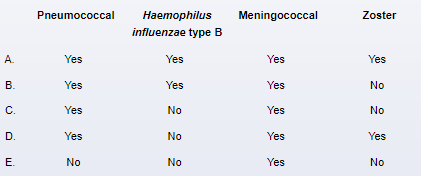
(Multiple Choice)
4.9/5 (82)
(82) A 45-year-old woman is evaluated on postoperative day 3 due to nausea and vomiting. The patient underwent a total abdominal hysterectomy for symptomatic uterine fibroids, and the surgery was complicated by ureter injury and stent placement. She was placed on a clear liquid diet on postoperative day 2, when she began to have some nausea. Since then, the patient has had multiple episodes of vomiting but no hematemesis. She has not passed flatus or had a bowel movement since the surgery. Temperature is 37.2 C (99 F), blood pressure is 130/80 mm Hg, and pulse is 80/min. The abdomen is mildly distended and has decreased bowel sounds. The incision is tender to palpation but has no surrounding erythema or discharge. Laboratory results are as follows: 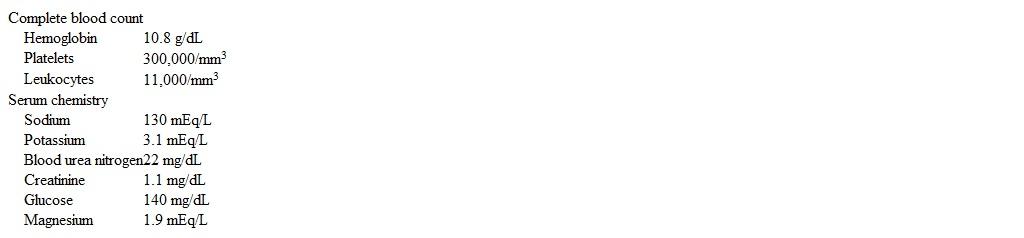 Abdominal x-ray is shown in the exhibit.
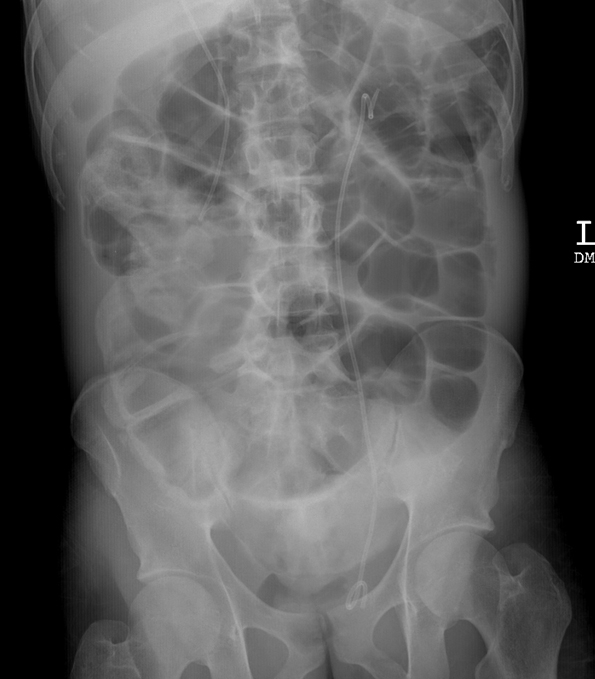 In addition to intravenous fluid administration, which of the following is the best next step in the management of this patient?
Abdominal x-ray is shown in the exhibit. In addition to intravenous fluid administration, which of the following is the best next step in the management of this patient? (Multiple Choice)
4.9/5 (76)
(76) A 73-year-old man is seen in the hospital due to severe left facial pain and inability to fully open his mouth. These symptoms began earlier today. Eight days ago, the patient underwent a laparotomy for intestinal obstruction. The procedure went well, and he has had several bowel movements since the operation. Medical history is significant for dementia and colon cancer, which was diagnosed 5 years ago and is currently in remission. The patient resides in a nursing home. Temperature is 38.9 C (102 F), blood pressure is 150/80 mm Hg, pulse is 90/min, and respirations are 16/min. Examination shows swelling, erythema, and severe tenderness in the left preauricular area. Laboratory studies reveal a white blood cell count of 15,600/mm3. Which of the following would most likely have prevented this complication?
(Multiple Choice)
4.7/5 (84)
(84) A 38-year-old woman comes to the office due to increasing episodes of nausea and substernal discomfort over the past several months. The episodes frequently occur after eating, and the patient occasionally self-induces vomiting to relieve the symptoms. Two weeks ago, she also had difficulty swallowing while experiencing a sensation of food getting stuck in her chest. She has had no anorexia, weight loss, hematemesis, or melena. The patient had gastroesophageal reflux during pregnancy 10 years ago but no other medical conditions. She takes no medications, does not smoke cigarettes, and drinks alcohol occasionally. Vital signs are within normal limits. BMI is 32.5 kg/m2. Physical examination shows a normal oropharynx and a nontender abdomen. Chest imaging reveals a retrocardiac air-fluid level. Which of the following is the most likely underlying cause of this patient's current symptoms?
(Multiple Choice)
4.8/5 (75)
(75) A 37-year-old woman is brought to the emergency department by her boyfriend for severe abdominal pain that started several hours ago. The pain started diffusely in the periumbilical area but is now mostly localized to the lower abdomen. The patient has persistent nausea but no vomiting. Her last menstrual period was 25 days ago, but she has irregular periods. She is sexually active with her boyfriend. Her temperature is 36.8 C (98.1 F), blood pressure is 130/80 mm Hg, pulse is 110/min, and respirations are 25/min. The abdomen, especially in the lower quadrants, is tender on palpation with mild guarding. There is no shifting dullness. Bowel sounds are diminished. Laboratory results are as follows: 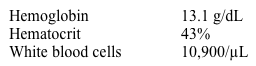 Which of the following is the most appropriate next step in management of this patient?
 (Multiple Choice)
4.8/5 (77)
(77) A 23-year-old man comes to the emergency department after injuring his right shoulder during a basketball game. He was trying to block a shot when his abducted and externally rotated arm was forced backward by an opposing player. The patient immediately felt excruciating pain and fell to the ground holding his right arm. He has no other medical conditions and has never had a similar injury. On examination, there is gross asymmetry of the right shoulder compared to the left, and the right arm is held in slight abduction and external rotation. Distal pulses are full. Plain film x-ray of the right shoulder is shown below. 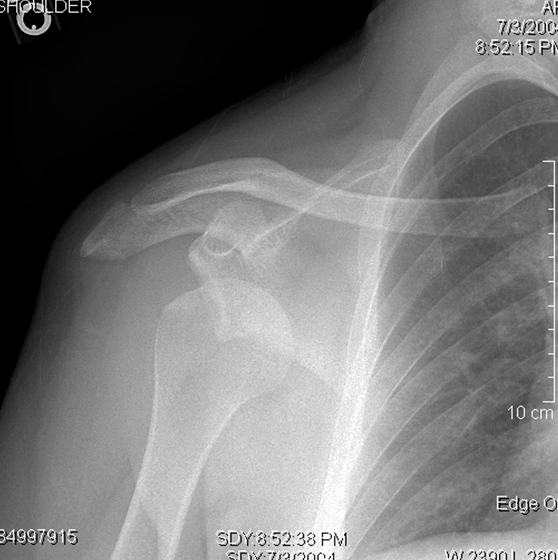 If left untreated, which of the following is the most likely complication of this patient's injury?
 (Multiple Choice)
4.8/5 (77)
(77) A 75-year-old man comes to the office for evaluation of right hip pain. The patient first noticed the pain several months ago and it has become increasingly worse. He now has trouble putting on his shoes and socks. The patient used to walk his dog for 2 miles each night, but he now must use a cane and can only walk a half-mile. The patient has a history of hypertension. BMI is 32 kg/m2. X-ray of the right hip is shown below: 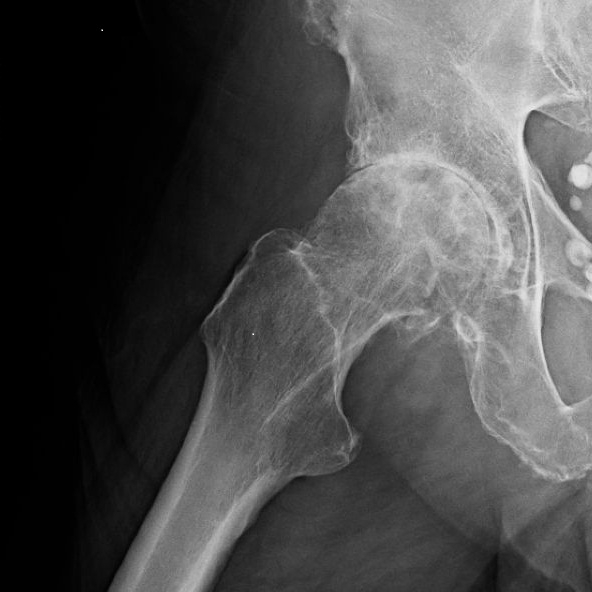 Which of the following is the most likely cause of this patient's hip pain?
 (Multiple Choice)
4.7/5 (71)
(71) A 42-year-old woman is evaluated in the hospital burn unit due to confusion and a change in the appearance of her wounds. Ten days ago, she was hospitalized after sustaining inhalational injury and severe burns to 30% of her total body surface area in a house fire. She has undergone staged excision and grafting of all appropriate areas and is now receiving daily dressing changes. Temperature is 38 C (100.4 F), blood pressure is 110/70 mm Hg, and pulse is 114/min. The patient is alert to person and place but not time. Physical examination shows necrosis and sloughing of skin grafts to the chest that were previously viable and adherent, with erythema of the surrounding skin. Blood cultures are drawn. Which of the following is the most appropriate empiric antibiotic therapy for this patient's condition?
(Multiple Choice)
5.0/5 (91)
(91) A 65-year-old man comes to the office due to a nonhealing ulcer on the left upper extremity. For the last 2 months, he has had an enlarging ulcerated lesion, with intermittent bleeding and itching. In the last 3 weeks, the patient has also noted local numbness, paresthesias, and burning pain. He does not recall any injury prior to the onset of symptoms. He has good appetite and reports no weight loss. There is no fever, dyspnea, or cough. The patient has a history of renal transplantation and takes an appropriate immunosuppressive regimen. He does not use tobacco, alcohol, or illicit drugs. Vital signs are normal. Physical examination of the lesion is shown in the image below. The remainder of the examination is unremarkable. 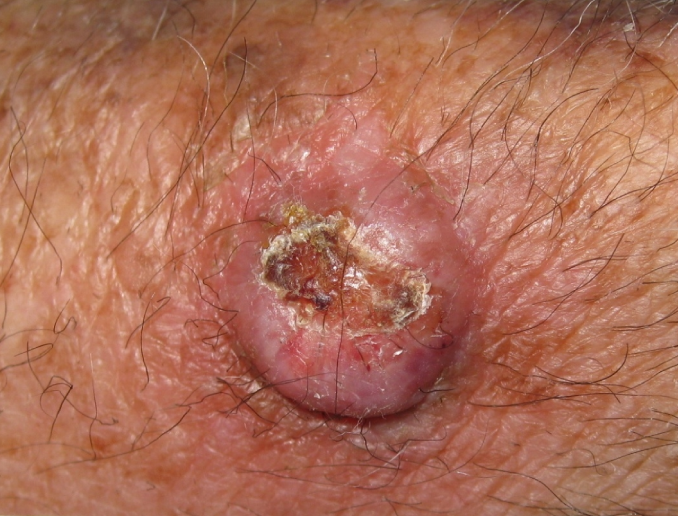 Which of the following is the most likely diagnosis?
 (Multiple Choice)
4.9/5 (68)
(68) A 50-year-old man comes to the physician for a preventive visit. He has no chest pain or shortness of breath but does complain of occasional left posterior calf pain. The pain occurs most often with walking in the course of his job as a postal carrier, but he occasionally has leg cramps at rest. His other medical problems include diet-controlled diabetes mellitus and hypertension, but he does not take any medication regularly. The patient was hospitalized for chest pain 2 years ago. Cardiac stress test at that time was negative and he has had no recurrence. The patient has a 30-pack-year smoking history but does not use alcohol or illicit drugs. His father died suddenly at age 60, and his mother had a stroke in her 70s. His blood pressure is 138/92 mm Hg, pulse is 88/min, and body mass index is 28 kg/m2. Heart and lung examinations show no abnormalities. Popliteal, dorsalis pedis, and posterior tibial pulses are palpable bilaterally. An electrocardiogram shows normal sinus rhythm. His hemoglobin A1c level is 7.2%. Which of the following is the most appropriate next step in management of this patient?
(Multiple Choice)
4.7/5 (89)
(89) 
Filters
- Essay(0)
- Multiple Choice(0)
- Short Answer(0)
- True False(0)
- Matching(0)