



 Chat with AI
Exam 4: Surgery

Exam 1: Medicine2 k Questions
Exam 2: Pediatric723 Questions
Exam 3: Psychiatry336 Questions
Exam 4: Surgery563 Questions
Exam 5: Obstetrics & Gynecology469 Questions
Select questions type


A 46-year-old man is brought to the emergency department after being involved in a motor vehicle collision. He is unresponsive and his injuries include a basilar skull fracture, brain contusion, fractures of ribs 7-10, hemopneumothorax on the right, and a pelvic fracture. After multiple blood product transfusions, placement of a chest tube, and pelvis fixation, his condition stabilizes. On the 5th day of his hospital stay, he is minimally responsive and has spontaneous respirations. Examination shows diminished bowel sounds and facial grimacing with palpation of the right upper quadrant of the abdomen. Rectal examination shows no abnormalities. Nasogastric tube aspiration shows retention of gastric contents. An abdominal CT scan reveals gaseous distension of the small and large bowels without air-fluid levels. The gallbladder is distended with no gallstones; there is small amount of pericholecystic fluid. Which of the following is the most likely cause of this patient's condition?
(Multiple Choice)
4.9/5  (80)
(80) A 55-year-old man comes to the office due to a hard lump on the palm of his right hand that has been present for several months. It is painless and does not affect hand function. Medical history is significant for type 2 diabetes mellitus and hypertension. The patient works as a gardener. Vital signs are normal. On examination, a hard, fibrous, nodular band is present at the base of the ring finger. He has full movement of his fingers. What is the most likely cause of this patient's current condition?
(Multiple Choice)
4.9/5 (82)
(82) A 48-year-old man comes to the emergency department due to pain in his right foot and leg. Yesterday, the patient sailed a friend's boat on the ocean and sustained a small cut to his right foot while jumping onto the dock. He stopped the bleeding using direct pressure and washed the wound with antiseptic. Last night, he awoke with throbbing pain in the right foot. The patient took ibuprofen, but the pain progressively worsened. A few hours later, he developed fever with rigors. The patient was recently diagnosed with hereditary hemochromatosis after laboratory studies showed abnormal liver aminotransferases and elevated transferrin saturation. He has not received treatment and has no other medical problems. He does not use tobacco, alcohol, or illicit drugs. Temperature is 39.4 C (103 F), blood pressure is 100/60 mm Hg, and pulse is 120/min. The patient is in moderate distress. Physical examination shows a 1.5-cm laceration on the dorsum of the right foot with extensive surrounding edema, erythema, and several dark-colored bullae. There is streaking erythema extending up the proximal right thigh. Leukocyte count is 21,000/mm3. Which of the following is the most likely causative organism of this patient's current condition?
(Multiple Choice)
4.8/5 (73)
(73) A 42-year-old woman comes to the office for a follow-up visit. She has been following a weight-loss program with dietary modification and exercise for the past several months. The patient weighs 110 kg (242 lb) and is 170 cm (5 ft 7 in) tall. BMI is 38 kg/m2. In the last 6 months, she has lost 3% of her initial body weight on a balanced, low-calorie (1000 kcal/day) diet. The patient has been strictly adhering to dietary recommendations and exercising "as much as possible" but feels she is not making progress. She also feels hungry all the time. The patient says she is motivated to lose weight but is starting to feel discouraged by her results. Medical history includes hypertension, type 2 diabetes mellitus, and obstructive sleep apnea. Blood pressure is 140/80 mm Hg and pulse is 78/min. Physical examination shows an obese habitus but is otherwise normal. Which of the following is the most appropriate next step in management of this patient?
(Multiple Choice)
4.9/5 (85)
(85) A 55-year-old electrician comes to the emergency department due to a wound to his right leg that started 3 days ago. After crawling through an attic laying electrical wire, he developed a stabbing pain and burning sensation in his right thigh. The patient noticed a small, red area on his posterior right thigh, with 2 small dots in the middle. He thinks he was bitten by one of the small, brown spiders he saw in the attic. The pain lasted a few hours and then subsided. Several hours later a blister formed. Over the next 2 days, a black area appeared in place of the blister and has expanded toward his feet. Temperature is 36.7 C (98.1 F), blood pressure is 140/80 mm Hg, pulse is 76/min, and respirations are 16/min. On examination, the patient is awake and alert, and nontoxic in appearance. He has a 2-cm, dry eschar on his posterior right thigh. There is a surrounding outer ring of erythema. No significant swelling or fluctuance is present. He has normal pulses distal to the wound. Which of the following is the best next step in management of this patient?
(Multiple Choice)
4.8/5 (89)
(89) A 54-year-old woman is brought to the emergency department due to fever. The patient has a history of end-stage kidney disease due to chronic glomerulonephritis and undergoes intermittent hemodialysis. Yesterday, after a dialysis session, she began experiencing malaise and chills. Overnight, she had high fever, chills, and rigors and became increasingly lethargic. There is no history of sore throat, cough, abdominal pain, or diarrhea. The patient's other medical conditions include sigmoid diverticulosis and asymptomatic gallstones. Temperature is 39 C (102.2 F), blood pressure is 84/52 mm Hg, pulse is 118/min, and respirations are 20/min. There is no erythema, purulence, or tenderness at the tunneled dialysis catheter insertion site. The lungs are clear on auscultation, and heart sounds are normal. The abdomen is soft and nontender. There is no extremity edema or skin rash. Laboratory studies reveal neutrophilic leukocytosis and elevated lactic acid level. Blood is drawn for culture; intravenous fluids and empiric broad-spectrum antibiotics are started via peripheral intravenous catheter. Chest x-ray shows no infiltrates. Which of the following additional interventions is most appropriate at this time?
(Multiple Choice)
4.9/5 (73)
(73) A 28-year-old woman comes to the office due to a painful breast mass. She first noticed the mass during her last menstrual period, and its size has not changed since. The patient has no chronic medical conditions, and her only medication is a daily combined oral contraceptive. On breast examination, there are no skin changes or nipple discharge. A palpable, 3-cm mass is present in the right breast at the 5-o'clock position. The mass is soft, mobile, and tender to palpation. Breast ultrasound shows a single, thin-walled, fluid-filled cyst. Fine-needle aspiration is performed and evacuates all the cystic fluid, which is clear and light yellow. However, after aspiration, the mass is still visible on ultrasound and palpable on examination. Which of the following is the best next step in management of this patient?
(Multiple Choice)
4.9/5 (73)
(73) A 29-year-old woman comes to the office due to worsening pain in her right knee. The patient has had increasing knee pain and swelling for the last 3 months, which has prevented her from going to her weekly yoga class and running on the weekends. She has tried taking ibuprofen and putting ice on her knee, but these interventions have provided little relief. The patient has no chronic medical conditions and does not use tobacco, alcohol, or illicit drugs. Temperature is 37.2 C (99 F). On examination, the right knee has mild soft-tissue swelling with no effusion but with decreased range of motion. X-ray shows an expansile lytic lesion at the epiphysis of the distal femur, as shown in the exhibit. 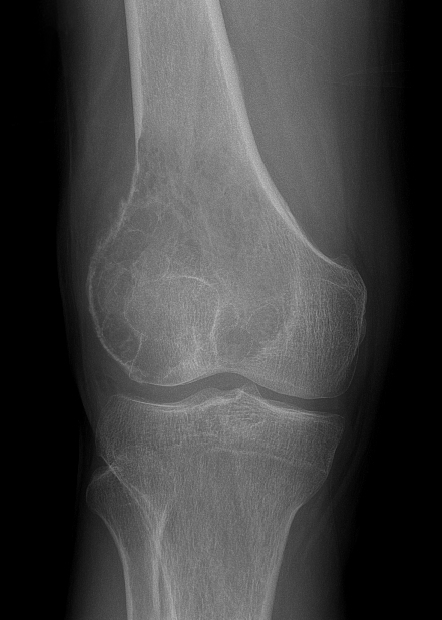 Complete blood count and serum chemistries are normal. Which of the following is the most likely diagnosis in this patient?
 (Multiple Choice)
5.0/5 (89)
(89) A 55-year-old man comes to the office for follow-up due to recurrent episodes of jaw pain. The patient's most recent episode was a week ago. He had pain that worsened with eating, accompanied by a tender mass under the left jaw and fever. All symptoms resolved within a few days with oral antibiotic treatment. This was the third episode in the past year. Which of the following is the most likely underlying reason for this patient's recurrent episodes of jaw pain?
(Multiple Choice)
4.9/5 (84)
(84) A 12-year-old girl is brought to the clinic by her mother for evaluation of leg pain. The patient first noticed a dull ache in her left thigh a month ago. The pain is intermittent, worse after skipping rope with friends, and typically resolves after rest or ibuprofen. She does not recall any inciting injury to the leg. Prior to last month, the patient had never experienced any similar pain. Medical history is unremarkable. She takes no medications. Family history is notable for sickle cell disease. Temperature is 37.5 C (99.5 F). BMI is at the 97th percentile for age. The abdomen is soft with no hepatosplenomegaly. A few soft, nontender, mobile, 1-cm inguinal lymph nodes are palpable bilaterally. Skin examination reveals a few small, healing abrasions over the bilateral anterior knees. The left hip demonstrates decreased range of motion with internal rotation. There is no increased warmth over the joint. The left foot points laterally during ambulation. Which of the following is the most likely underlying cause of this patient's symptoms?
(Multiple Choice)
4.8/5 (76)
(76) A 69-year-old woman comes to the emergency department due to increasing abdominal pain for the past several hours that is worsened by cough or movement. She has had no nausea, vomiting, or diarrhea. For the past 2 days, the patient has had cough and wheezing due to an asthma exacerbation, for which she has been taking an oral glucocorticoid and using inhaled bronchodilators. Other medical conditions include hypertension and atrial fibrillation, for which she takes lisinopril, diltiazem, and apixaban. Surgical history includes abdominal hysterectomy 15 years ago. Temperature is 37 C (98.6 F), blood pressure is 110/60 mm Hg, pulse is 92/min, and respirations are 16/min. BMI is 29 kg/m2. There is mild expiratory wheezing bilaterally. Heart sounds are normal. Abdominal examination reveals localized fullness with tenderness and guarding just lateral to the umbilicus on the left side. Bowel sounds are normal in all quadrants. Leukocyte count is 12,000/mm3 and hemoglobin is 10.8 g/dL. Which of the following is the most likely underlying cause of this patient's abdominal symptoms?
(Multiple Choice)
5.0/5 (81)
(81) A 2-year-old girl is brought to the office for follow-up after recent hospitalization. Two weeks ago, she had abrupt onset of dysphagia, drooling, and vomiting after eating sausage. She underwent urgent esophagoscopy, which showed complete occlusion of the esophageal lumen with impacted food. Impaction was removed and there were no mucosal lesions or strictures at the site of the impaction. Follow-up barium esophagography reveals a deep impression on the posterior aspect of the esophagus at about the level of T4. Recovery was uneventful. The parents report that this is her second episode of food impaction. The patient drinks liquids well but has always had frequent choking with solid foods. Medical history also includes frequent respiratory tract infections, including 2 episodes of middle lobe pneumonia in the last year. Her weight was advancing along the 50th percentile until approximately age 9 months, when her growth began to slow; weight is now at the 15th percentile. On examination, the child appears small for her age. The oral cavity and oropharynx are clear, the lungs are clear, and heart rate is regular with no murmurs. Which of the following is the most likely etiology of this patient's condition?
(Multiple Choice)
4.9/5 (86)
(86) A 52-year-old woman comes to the office due to intermittent right upper-quadrant pain and nausea. The patient has a history of obesity and gallstones, for which she underwent elective cholecystectomy a year ago. The pain is located in the right subcostal area and generally lasts 30-60 minutes. The patient recalls that she had similar pain episodes before the surgery. Laboratory results after one of the episodes are as follows: 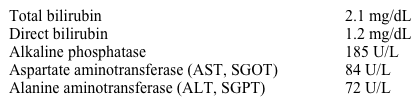 An ultrasound of the abdomen reveals mild dilation of the common bile duct. The pancreas is visualized and appears normal. Which of the following is the best next step in management of this patient?
 (Multiple Choice)
4.9/5 (80)
(80) A 42-year-old woman comes to the office for evaluation of a mass at her right wrist. The patient first noticed swelling in her wrist a few months ago after spending a week knitting blankets for her family. The mass has not caused any pain or stopped her from participating in daily activities, but it continues to slowly increase in size. Medical conditions include hyperlipidemia and rheumatoid arthritis. Medications include methotrexate, a statin, and occasional ibuprofen. Vital signs are normal. BMI is 28 kg/m2. There is slight ulnar deviation at both wrists, with a 2-cm mass on the extensor surface of the right wrist and no overlying skin discoloration. The mass is firm, mobile, and nontender to palpation, and it transilluminates on penlight examination. Which of the following is the most likely diagnosis in this patient?
(Multiple Choice)
4.8/5 (77)
(77) A 25-year-old man comes to the emergency department due to abdominal pain, nausea, and vomiting. The symptoms began 2 months ago, at which time the pain was intermittent and located in the right lower quadrant. Since then, it has progressed and is now diffuse, severe, and unremitting. The patient started vomiting bilious fluid 2 days ago but has not had hematemesis, melena, hematochezia, diarrhea, or unexpected weight loss. In addition, he has not moved his bowels in 2 days, although he frequently passes flatus. Medical history is significant for Crohn disease with ileal involvement, which is currently managed with infliximab and has never required surgery. The patient has used acetaminophen and ibuprofen to relieve his pain and has not used narcotics. He smokes 3-4 cigarettes a day but does not use alcohol or illicit drugs. Temperature is 37.5 C (99.5 F), blood pressure is 134/78, pulse is 95/min, and respirations are 18/min. On physical examination, the patient is awake and cooperative. Chest examination is unremarkable. The abdomen is distended, tympanic, and tender to palpation; there is no rebound tenderness or guarding. Which of the following most likely explains this patient's presentation?
(Multiple Choice)
4.7/5 (84)
(84) A 34-year-old man comes to the emergency department due to acute-onset central chest and epigastric pain radiating to the mid-lower back. The pain started an hour ago while at rest. The patient also reports mild shortness of breath and diaphoresis. He has not seen a physician in 10 years. The patient drinks 3 or 4 beers most days and occasionally uses cocaine. His last use of cocaine was a day ago. On examination, the patient is in severe distress due to pain. Skin is cool and clammy. Blood pressure is 210/120 mm Hg and equal in both arms. Pulse is 110/min and regular, and respirations are 22/min. Pulse oximetry shows 95% on room air. BMI is 34 kg/m2. There is no pulse asymmetry. Jugular venous pressure is normal. Breath sounds are decreased at the left lower base, and percussion is dull in the same area. Heart sounds are normal with no murmurs or extra sounds. Abdominal and neurologic examinations show no abnormalities. Extremities have no cyanosis, clubbing, or edema. ECG reveals sinus tachycardia with nonspecific T-wave changes. Serum troponin is normal. D-dimer is elevated. Serum lipase is normal. Chest x-ray shows a moderate-sized left pleural effusion. Which of the following is the most likely cause of the patient's current condition?
(Multiple Choice)
4.8/5 (82)
(82) A 55-year-old woman is brought to the emergency department due to worsening headaches and right-sided weakness. The patient developed these headaches a month ago and since then has had continuous throbbing pain over the left side of her head that is associated with nausea. More recently, she has noticed increasing difficulty using her right arm and leg. The patient has had no trauma, neck stiffness, fever, double or blurry vision, or photophobia. She recently emigrated from Mexico with her family. She is a retired seamstress and admits to chronic tobacco use for many years. Her temperature is 36.7 C (98 F), blood pressure is 150/90 mm Hg, pulse is 84/min, and respirations are 14/min. Neurologic examination is significant for right-sided pronator drift. A non-contrast head CT scan reveals a partially calcified round extra-axial mass compressing the left frontal lobe, as shown in this exhibit. 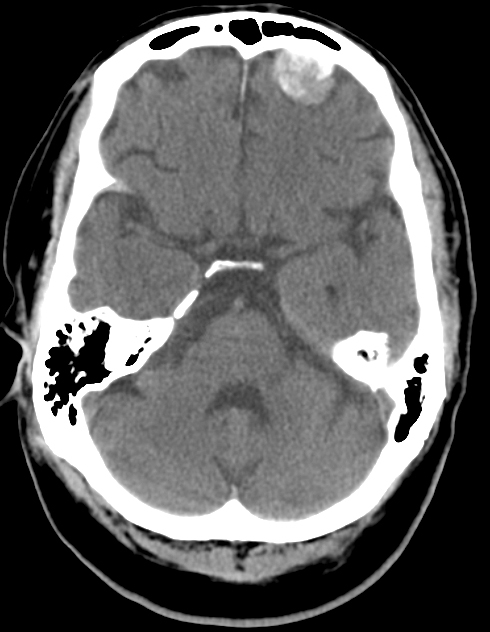 The mass appears dural-based and homogeneously enhances on post-gadolinium MRI. Which of the following is the most appropriate next course of action in management of this patient?
 (Multiple Choice)
5.0/5 (76)
(76) A 22-year-old woman comes to the emergency department due to severe chest pain that she rates as 9/10. The pain started suddenly an hour ago and is constant. The patient also reports neck discomfort and right arm tingling. She has never experienced similar symptoms before. The patient has a history of short stature, scoliosis, and heart murmur. The patient does not use tobacco or illicit drugs. ECG shows sinus tachycardia without any significant ST segment changes. Urine pregnancy test is positive, and ultrasound shows a 12-week intrauterine pregnancy. Which of the following is the most likely cause of this patient's acute presentation?
(Multiple Choice)
4.9/5 (77)
(77) A 56-year-old man is evaluated for fever on postoperative day 3. He had undergone coronary artery bypass surgery for multivessel coronary artery disease, requiring 4 grafts. The patient is still intubated and is receiving mechanical ventilation. He has a history of type 2 diabetes mellitus, hypercholesterolemia, and hypertension. Temperature is 38.9 C (102 F), blood pressure is 130/80 mm Hg, and pulse is 90/min. BMI is 28 kg/m2. Examination reveals coarse breath sounds bilaterally. Heart sounds are normal. The patient grimaces during palpation of the right upper quadrant. Bowel sounds are decreased. Laboratory results are as follows:  Chest x-ray reveals postoperative changes but no new infiltrate. Which of the following is the most likely diagnosis in this patient?
 (Multiple Choice)
4.8/5 (83)
(83) A 60-year-old man undergoes a laparotomy for intestinal obstruction secondary to postoperative adhesions from a cholecystectomy 2 years ago. His other medical problems include type 2 diabetes mellitus, hypothyroidism, and hypertension. On postoperative day 3, he complains of intense pain around his laparotomy wound. His temperature is 38.3 C (101 F), blood pressure is 121/76 mm Hg, pulse is 100/min, and respirations are 16/min. Examination of the wound shows abundant cloudy-gray discharge and dusky, friable subcutaneous tissue. Sensation is decreased at the wound edges. His serum glucose level is 312 mg/dL. Which of the following is the most appropriate next step in management of this patient?
(Multiple Choice)
4.9/5 (64)
(64) 
Filters
- Essay(0)
- Multiple Choice(0)
- Short Answer(0)
- True False(0)
- Matching(0)