



 Chat with AI
Exam 4: Surgery

Exam 1: Medicine2 k Questions
Exam 2: Pediatric723 Questions
Exam 3: Psychiatry336 Questions
Exam 4: Surgery563 Questions
Exam 5: Obstetrics & Gynecology469 Questions
Select questions type


A 28-year-old woman comes to the office due to painful nodular lesions under her arms for the past month. She has also noticed a foul odor. The patient had similar lesions 4 months ago. Other medical conditions include recurrent urinary tract infections. She takes postcoital nitrofurantoin prophylaxis and uses combined oral contraceptives for birth control. The patient smokes a pack of cigarettes daily. Temperature is 36.1 C (97 F), blood pressure is 111/77 mm Hg, and pulse is 78/min. Skin examination shows tender, fluctuant nodules with thick bands of scar tissue at the axillae bilaterally, as shown in the exhibit. 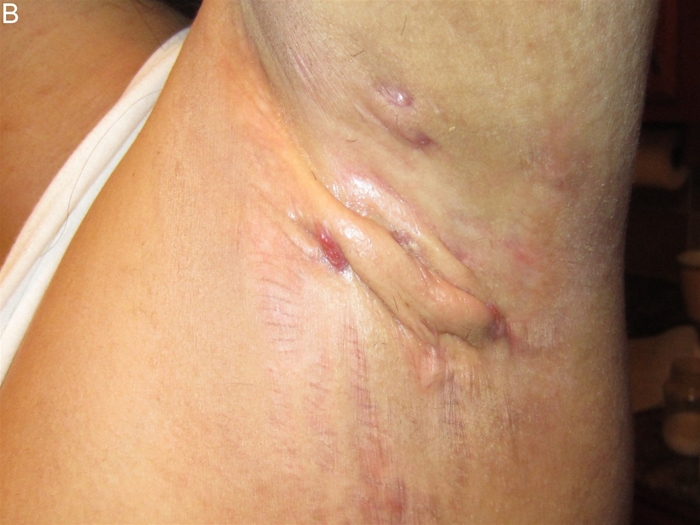 Which of the following is the greatest risk factor for this patient's skin condition?
 (Multiple Choice)
4.8/5  (77)
(77) A 76-year-old man with multi-infarct dementia comes to the emergency department due to cough and low-grade fever. He was treated for pneumonia twice in the last year. For the past 6 months, he has had difficulty swallowing and has occasionally regurgitated undigested food. The patient has a lengthy history of hypertension and chronic atrial fibrillation. BMI is 22 kg/m2. Temperature is 38.5 C (101.3 F), blood pressure is 150/95 mm Hg, pulse is 102/min, and respirations are 16/min. Physical examination is notable for foul-smelling breath and a fluctuant mass in the left neck. Auscultation shows crackles in the right lung base. Chest x-ray shows an infiltrate without cavitation in the right lower lung field. The patient is admitted to the hospital, sputum and blood cultures are sent to the laboratory, and antibiotics are started. A few days later, the patient's condition is markedly improved. Which of the following is the most appropriate next step in management of this patient?
(Multiple Choice)
4.8/5 (70)
(70) A 64-year-old man comes to the office for evaluation of leg pain. The patient underwent a below-the-knee amputation 3 months ago due to a nonhealing plantar ulcer associated with osteomyelitis. He has been trying to be fitted for a walking prosthesis but bearing weight on the stump has caused significant pain. The patient describes the pain as an intermittent burning sensation that has not improved with pain medication. Medical history is notable for type 2 diabetes mellitus, hypertension, and peripheral vascular disease. The patient smokes a pack of cigarettes a day and has 1-2 drinks every night. On physical examination, the amputation incision is well healed, and the distal flap has no areas of blanching. There is slight bogginess over the end of the skin flap. Gentle pressure over the flap reproduces the pain, which radiates up the leg. Which of the following is the most likely cause of this patient's leg pain?
(Multiple Choice)
4.8/5 (88)
(88) A 9-year-old girl is brought to the emergency department due to chest pain. The patient was eating dinner with her family an hour ago when she accidentally swallowed a fish bone. She initially had sharp pain but now has only dull pain in the lower part of her chest. The patient can still drink liquids and appears comfortable. Vital signs are normal. There is no neck swelling, tenderness, or crepitus. The lungs are clear to auscultation. The abdomen is soft, nontender, and nondistended. The remainder of the physical examination is unremarkable. Chest radiograph reveals no objects in the esophagus. CT scan shows a 2-cm, linear hyperdensity in the distal esophagus near the lower esophageal sphincter but no subcutaneous emphysema or free air within the mediastinum. Which of the following is the best next step in management of this patient?
(Multiple Choice)
4.9/5 (96)
(96) A 27-year-old woman is brought to the emergency department with severe epigastric pain, nausea, and vomiting. The pain radiates to her back and is exacerbated by eating. The patient was recently diagnosed with functional biliary sphincter of Oddi dysfunction for which she underwent an endoscopic retrograde cholangiopancreatography (ERCP) with sphincterotomy 24 hours ago. She has no other chronic medical conditions. She does not drink alcohol. Temperature is 38.7 C (101.7 F), blood pressure is 124/82 mm Hg, pulse is 95/min, and respirations are 19/min. There is no scleral icterus. Cardiopulmonary examination shows no abnormalities. The abdomen is tender to palpation in the epigastrium, soft, and without rebound or guarding. Which of the following is the most appropriate next step in management of this patient?
(Multiple Choice)
4.8/5 (80)
(80) A 67-year-old man is brought to the emergency department due to nausea, vomiting, and increasing abdominal pain over the last 3 hours. Four weeks ago he was discharged from the hospital following an inpatient admission for acute myocardial infarction. His other medical problems include type 2 diabetes mellitus, hypertension, hypercholesterolemia, and peptic ulcer disease. The patient quit smoking 2 years ago and does not use alcohol or illicit drugs. His temperature is 37.8 C (100 F), blood pressure is 150/90 mm Hg, pulse is 110/min and irregular, and respirations are 22/min. The patient appears to be in severe distress due to pain. The chest is clear to auscultation. Bowel sounds are decreased. There is diffuse abdominal tenderness, but it is more pronounced over the lower right quadrant. There is no peripheral edema. Initial laboratory results are as follows: 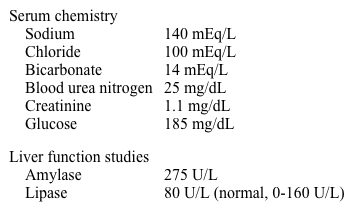 Urinalysis is within normal limits. Which of the following is the most likely diagnosis in this patient?
 (Multiple Choice)
5.0/5 (82)
(82) A 47-year-old woman comes to the office due to knee pain. The patient slipped on an icy step 2 weeks ago and fell on her knee. Since that time, she has had severe knee pain and a large overlying bruise, which has failed to heal. The patient underwent a Roux-en-Y gastric bypass 6 months ago for morbid obesity and has lost 20 kg (44.1 lb) since then. She does not use tobacco or alcohol. Vital signs are normal. On examination, a large ecchymosis is present over the left knee. The knee is swollen, painful to palpation, and has a limited range of motion. There are several smaller ecchymoses and petechiae located on all four extremities. Laboratory results are as follows: 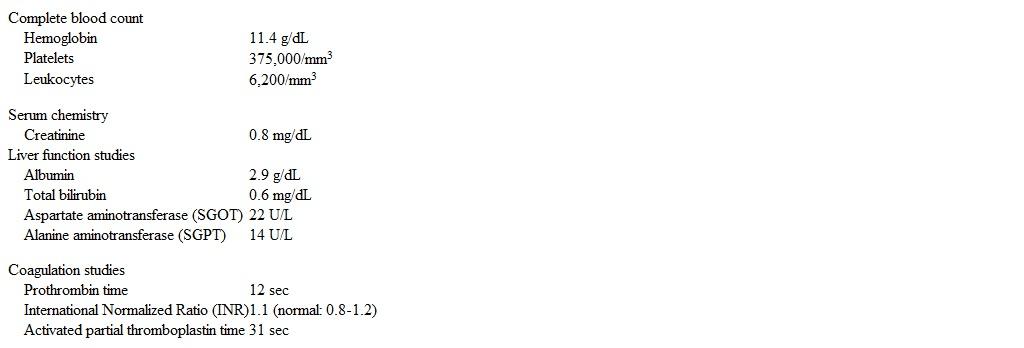 Left knee x-ray reveals a large effusion but no fracture. Arthrocentesis yields brown fluid positive for xanthochromia. Which of the following best explains this patient's manifestations?
 (Multiple Choice)
4.7/5 (91)
(91) A 36-year-old woman comes to the emergency department after having severe epigastric and right shoulder pain for 2 hours. The patient also had an episode of emesis. When asked about her diet, she explains that she unintentionally fasted all day and had a cheeseburger 2 hours ago. The patient had a similar episode last month but did not seek medical attention as it was less severe and resolved spontaneously in a few hours. Her past medical history is significant for heartburn, and she takes ranitidine. On examination, the patient's abdomen is soft and nontender. About 4 hours after the pain began, it resolves completely. Which of the following best explains this episode?
(Multiple Choice)
4.8/5 (78)
(78) A 35-year-old man is evaluated in the hospital burn unit due to abdominal distension and intolerance of enteral feedings. The patient was admitted 6 days ago after an electrical flash injury that caused burns to 40% of his total body surface area. He has undergone 2 of 3 planned surgeries for burn excision and grafting and remains intubated and on mechanical ventilation. He was doing well with enteral feedings until the past 24 hours, when he developed high gastric residual volumes and progressive abdominal distension. Temperature is 39.1 C (102.4 F). Blood pressure is 112/60 mm Hg and pulse is 110/min. Oxygen saturation is 97% on minimal ventilator settings, including a fraction of inspired oxygen (FiO2) of 35%. On examination, all surgical dressings are clean and dry. Heart and lung sounds are normal. The abdomen is distended, soft, and tympanitic to percussion. Bowel sounds are decreased. Which of the following is the best next step in management of this patient?
(Multiple Choice)
4.7/5 (81)
(81) A 50-year-old man comes to the emergency department due to 2 days of malaise, decreased appetite, abdominal discomfort, and bloody stools. The patient had end-stage renal disease and underwent kidney transplantation 4 months ago. He had no major postoperative issues and currently takes mycophenolate, tacrolimus, and prednisone. The patient has a 15 pack-year smoking history but quit several years ago. Temperature is 37 C (98.6 F), blood pressure is 110/70 mm Hg, pulse is 104/min, and respirations are 22/min. Physical examination shows mild abdominal tenderness in the left lower quadrant. Rectal examination is normal. Stool is guaiac positive. Laboratory results are as follows:  Atypical lymphocytes are seen on peripheral blood smear. A colonoscopy reveals multiple ulcerations throughout the colon. Which of the following is the most likely diagnosis for this patient?
 (Multiple Choice)
4.9/5 (72)
(72) A 58-year-old, previously healthy man is evaluated due to a 2-month history of early satiety, postprandial epigastric pain and vomiting, and unintended weight loss. Physical examination shows cachexia and a palpable epigastric mass. Upper gastrointestinal endoscopy reveals a large prepyloric mass causing gastric outlet obstruction; biopsy of the mass is consistent with poorly differentiated adenocarcinoma. Abdominal CT scan reveals thickening of the gastric wall with adjacent fat infiltration, enlarged lymph nodes, and multiple hepatic metastatic lesions. The disease is considered unresectable, and the patient undergoes laparoscopic gastrojejunostomy for palliation of gastric outlet obstruction. Postoperatively, he tolerates tube feeding but experiences worsening weakness. The patient also has frequent episodes of nonsustained ventricular tachycardia. Laboratory results are as follows:  Which of the following is the most likely cause of this patient's worsening condition?
 (Multiple Choice)
4.8/5 (91)
(91) A 36-year-old woman comes to the urgent care clinic due to worsening right lower extremity pain and swelling for the past several days. The patient has a history of injection drug use. She also exchanges sex for drugs and is inconsistent with condom use. Temperature is 37.1 C (98.8 F), blood pressure is 126/76 mm Hg, pulse is 86/min, and respirations are 13/min. Oxygen saturation is 98% on room air. On physical examination, edema, erythema, and warmth of the right leg are noted with increased calf and thigh diameters. There are injection marks in the right groin. Which of the following is the most likely diagnosis?
(Multiple Choice)
4.9/5 (57)
(57) A 78-year-old woman comes to the office due to an enlarging growth on the right wrist for the past year. The growth does not bother the patient. Examination findings are shown in the exhibit. 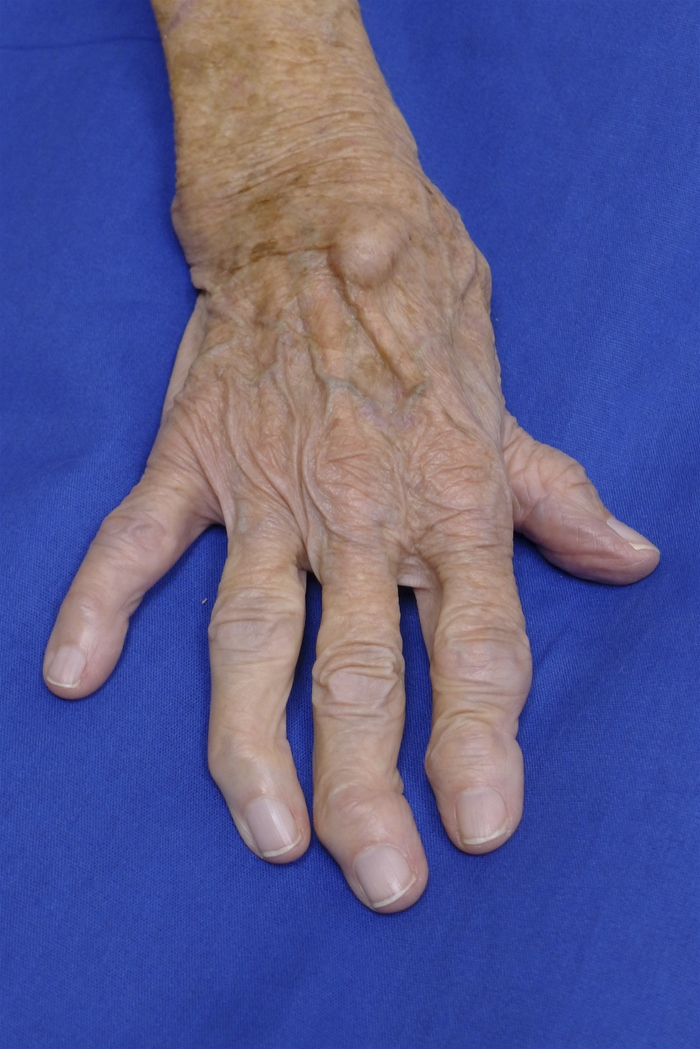 The lesion is round, rubbery, mobile, and nontender; it transilluminates on penlight examination. There is no overlying skin change. Grip strength and sensation in the hand are intact. Which of the following is the most appropriate initial management for this patient's condition?
 (Multiple Choice)
4.7/5 (83)
(83) A 45-year-old man comes to the office with a 6-month history of recurrent, burning epigastric pain and diarrhea. His stools are frothy and unusually foul smelling and they float. The patient's clothes fit loosely, and he believes that he may have lost some weight. He has tried several over-the-counter medications, including antacids, H-2 blockers, and proton pump inhibitors, with moderate success. Vital signs are normal. Examination shows no abnormalities except for midepigastric tenderness to deep palpation. Test of the stool for occult blood is positive, and stool fat is also positive. Gastrointestinal endoscopy reveals two duodenal ulcers and a jejunal ulcer. Which of the following is the best explanation for this patient's impaired fat absorption?
(Multiple Choice)
4.9/5 (83)
(83) A 62-year-old woman is brought to the emergency department by her family due to dizziness. She was unable to get out of bed and go to the bathroom this morning and has had headache and nausea. The patient has a history of migraine headaches and hypertension. Six months ago, she had an episode of transient right-sided vision loss and was prescribed aspirin. Other medications include amlodipine and hydrochlorothiazide. Temperature is 36.7 C (98.1 F), blood pressure is 156/72 mm Hg, and pulse is 88/min. BMI is 33 kg/m2. On physical examination, the patient moves all extremities, and deep tendon reflexes are symmetric. CT scan of the head is shown in the image. The patient is admitted to the hospital. An hour after admission, she appears lethargic but follows simple commands. She had a single episode of vomiting in the emergency department. Which of the following is the best next step in management of this patient?
(Multiple Choice)
4.8/5 (79)
(79) An 18-month-old boy is admitted to the pediatric intensive care unit after undergoing cardiac surgery. At age 16 months, his parents brought him to a pediatrician due to intermittent episodes of cyanosis when he became upset. At that time, a cardiac murmur was noted, and echocardiogram revealed tetralogy of Fallot with moderate pulmonary stenosis. The patient's initial postoperative period is unremarkable, but on postoperative day 4 he develops tachypnea with an increasing oxygen requirement. Chest x-ray reveals significant pleural fluid in the right hemithorax. Analyses of serum and pleural fluid obtained by thoracentesis are as follows: 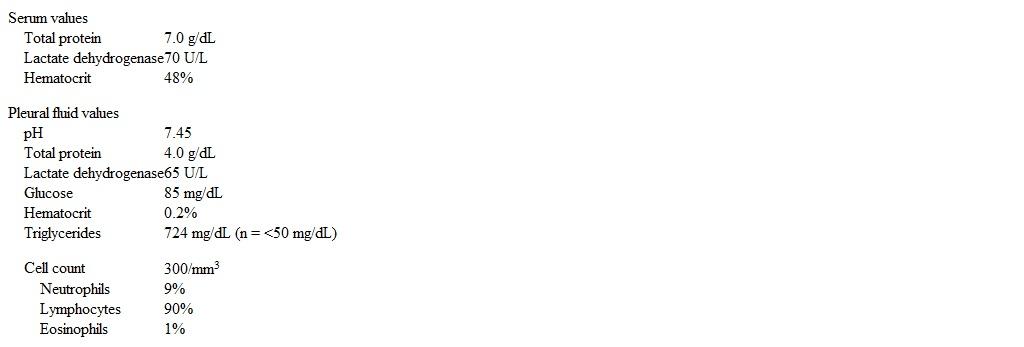 Which of the following is the most likely mechanism causing this patient's pleural effusion?
 (Multiple Choice)
4.9/5 (83)
(83) A 16-year-old boy is brought to the emergency department with abdominal pain. Two hours ago, the patient was playing in a lacrosse match when he suddenly developed severe, persistent pain in his right lower quadrant with associated nausea. He experienced no trauma to the abdomen and has had no fever, vomiting, or diarrhea. The patient has had similar episodes over the past 3 weeks following lacrosse matches, but these episodes resolved shortly afterward with rest. He has no history of groin or scrotal swelling. The patient has no chronic medical conditions and takes no medications. He is sexually active with 1 partner and uses condoms inconsistently. Temperature is 37.7 C (99.9 F). The abdomen is soft, nontender, and nondistended. There is scrotal erythema and edema; the right hemiscrotum is tender to palpation. The pain is worsened when the scrotum is elevated, and the scrotum does not transilluminate. Which of the following is the most likely cause of this patient's symptoms?
(Multiple Choice)
4.9/5 (86)
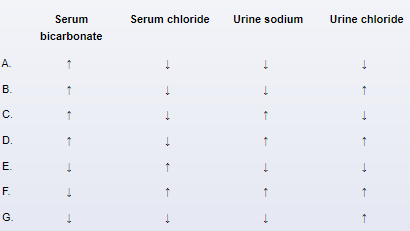
(86) A 37-year-old man comes to the emergency department due to progressive weakness. He has been vomiting everything he eats for the past 4 days. The patient's medical history is significant for Helicobacter pylori infection, but he never completed pharmacotherapy. He smokes 1 pack of cigarettes daily and drinks 3-4 beers every day. Blood pressure is 100/70 mm Hg, pulse is 104/min, and respirations are 12/min. Oxygen saturation is 95% on room air. Mucous membranes are dry, and the physical examination is otherwise unremarkable. Which of the following changes are most likely in this patient?
(Multiple Choice)
4.8/5 (75)
(75) A 56-year-old man comes to the emergency department due to worsening abdominal discomfort and distension. The discomfort is diffuse and began 1 day prior, after the patient woke up from a night of heavy drinking that included a fall in which he struck his lower abdomen. He has also had increasing abdominal girth over the past day. Medical history includes alcohol use disorder and hypertension; there is a remote history of appendectomy. Review of systems is negative for fever or vomiting but positive for inability to void. Temperature is 36.7 C (98.1 F), blood pressure is 158/90 mm Hg, and pulse is 90/min. Heart and lung sounds are normal. The abdomen is distended, mildly tender to palpation diffusely, and dull to percussion with a positive fluid wave. Laboratory results are as follows: 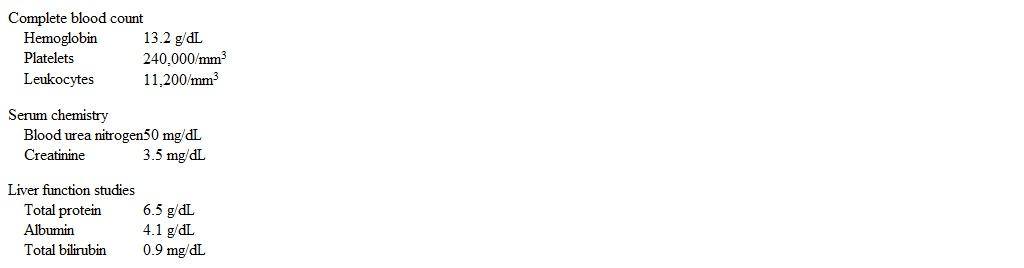 Which of the following is the most likely diagnosis in this patient?
 (Multiple Choice)
4.9/5 (72)
(72) A 26-year-old man comes to the office for evaluation of left knee pain and swelling. The patient first noticed the pain 3 months ago after going on a short run. His knee has progressively become more painful, and he is now unable to run short distances without significant pain. The patient has tried ice and ibuprofen with no relief, and compression wraps have only made the pain worse. He has no chronic medical conditions, and his only surgery is an enucleation for retinoblastoma when he was an infant. Temperature is 37.2 C (99 F), blood pressure is 130/80 mm Hg, and pulse is 84/min. BMI is 22 kg/m2. The left knee appears swollen, but there is no overlying rash or skin lesion. The left knee has full range of motion with no crepitus, but deep palpation over the distal thigh is associated with pain. X-ray of the knee shows a lytic lesion that has ill-defined margins on the femoral condyle and is surrounded by concentric layers of reactive bone. Which of the following is the most likely diagnosis in this patient?
(Multiple Choice)
4.9/5 (102)
(102) 
Filters
- Essay(0)
- Multiple Choice(0)
- Short Answer(0)
- True False(0)
- Matching(0)