



 Chat with AI
Exam 4: Surgery

Exam 1: Medicine2 k Questions
Exam 2: Pediatric723 Questions
Exam 3: Psychiatry336 Questions
Exam 4: Surgery563 Questions
Exam 5: Obstetrics & Gynecology469 Questions
Select questions type


A 62-year-old woman on the postoperative floor is evaluated due to increasing confusion. The patient is unable to answer questions, keeps trying to get out of bed, and continues to pull on her intravenous lines. Six hours ago, she underwent a total abdominal hysterectomy, bilateral salpingo-oophorectomy, staging, and debulking procedure for primary peritoneal cancer. After the procedure, the patient was placed on a continuous hydromorphone infusion for pain control. She was stable in the postanesthesia care unit and was moved to the postoperative floor 2 hours ago. Her medical conditions include type 2 diabetes mellitus, for which she takes insulin, and chronic hypertension. Temperature is 36.7 C (98.1 F), blood pressure is 90/50 mm Hg, pulse is 116/min, and respirations are 22/min. Cardiac examination shows sinus tachycardia with no rubs or murmurs. The lungs are clear to auscultation. The abdominal dressing is soaked with blood, and there is blood leaking between the staples at the incision site. Finger-stick blood glucose level is 150 mg/dL. Which of the following is the best next step in management of this patient?
(Multiple Choice)
5.0/5  (76)
(76) A 72-year-old man undergoes coronary artery bypass graft (CABG) for severe coronary artery disease. He is extubated on the second postoperative day. His temperature is 36.6° C (97.9° F), blood pressure is 120/70 mm Hg, pulse is 80/min, and respirations are 12/min. On the third postoperative day, he complains of dyspnea and worsening retrosternal pain despite continuous analgesia with morphine. His temperature is 38.6° C (101.5° F), blood pressure is 112/52 mm Hg, pulse is 125/min and irregularly irregular, and respirations are 28/min. Examination shows normal heart sounds. A small amount of cloudy fluid is present in the sternal wound drain. His ECG shows atrial fibrillation with rapid ventricular response. An x-ray film of the chest shows widening of the mediastinum. Echocardiography reveals a small amount of pericardial fluid. Laboratory studies show: 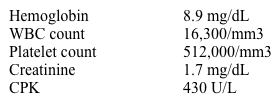 Which of the following will this patient most likely require?
 (Multiple Choice)
4.7/5 (74)
(74) A 37-year-old man comes to the office due to a 2-month history of left-sided groin pain. The patient has a progressive, achy pain that is present at rest and worse with ambulation and weight bearing. He was treated for poison ivy dermatitis with a 5-day course of oral prednisone a year ago but has had no other medical conditions and takes no medications. The patient drinks 5 or 6 alcoholic beverages a day. He works as a gardener for a landscaping service and plays soccer twice a week. Vital signs are normal. BMI is 24 kg/m2. On examination, the patient appears mildly uncomfortable and anxious. Examination of the hip and groin shows no erythema, warmth, or swelling. Active and passive range of motion at the left hip is decreased in extension, abduction, and internal and external rotation. X-ray of the hip is shown in the exhibit. 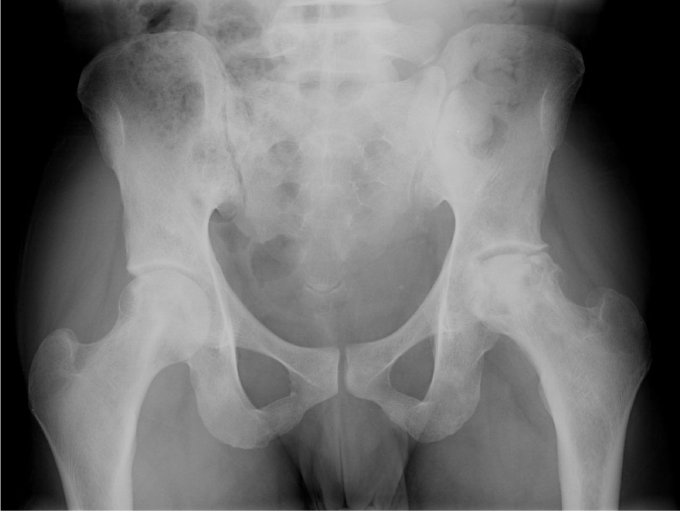 Which of the following is most likely contributing to this patient's condition?
 (Multiple Choice)
4.9/5 (78)
(78) A 72-year-old woman comes to the office due to intermittent lower abdominal discomfort for the past several months. The patient also reports frequent urges for bowel movements every day producing small-volume stools or just mucus and are often followed by a sensation of incomplete evacuation. Physical examination shows a nondistended and nontender abdomen. Digital rectal examination reveals normal rectal tone and an empty rectal vault. When the patient is instructed to bear down, an erythematous mass with concentric rings protrudes through the anus and spontaneously retracts. Which of the following is the strongest risk factor for this patient's current condition?
(Multiple Choice)
4.8/5 (78)
(78) A previously healthy, 25-year-old man is brought to the emergency department after falling approximately 3 m (10 ft) from a treehouse, landing on his left side. There was no loss of consciousness. The patient has left shoulder and left-sided chest pain, as well as abdominal pain. Blood pressure is 114/72 mm Hg and pulse is 116/min. Physical examination shows bruising to the left side of the chest wall and abdomen. Heart sounds are normal. There is sharp, left-sided chest pain with deep inspiration but equal breath sounds on both sides. The left costal margin and the left upper quadrant of the abdomen are tender to palpation. Range of motion of the left shoulder is normal. Portable chest x-ray is normal. Focused Assessment with Sonography for Trauma shows no pericardial effusion or significant intraperitoneal free fluid. Which of the following is the best next step in management of this patient?
(Multiple Choice)
4.7/5 (76)
(76) A 17-year-old girl is brought to the emergency department due to severe right shoulder pain. She was playing basketball when her shoulder popped out of place. Her coach placed her arm in a sling, gave her an ice pack, and drove her to the emergency department. The patient has no numbness or tingling in the arm. She takes no medications. Vital signs are normal. On examination, the range of motion in the right shoulder is limited, with anterior and lateral tenderness to palpation. The neurovascular examination is normal. X-ray of the right shoulder is shown in the exhibit. 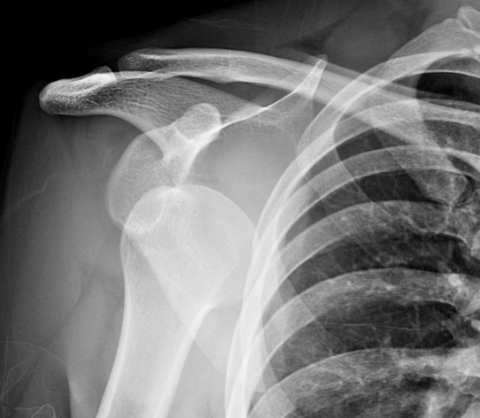 The condition is treated successfully without complications. This patient is at greatest risk for which of the following conditions?
 (Multiple Choice)
4.9/5 (86)
(86) A 56-year-old woman comes to the office due to skin lesions on her right arm that she noticed 4 weeks ago. The patient has no fever or chills. The lesions do not itch. She underwent a right mastectomy for breast cancer 7 years ago and was treated with radiation and chemotherapy. Since her treatment, the patient has had swelling of the right arm. Vital signs are normal. There is nonpitting edema of the right upper extremity. On the inner surface of the right upper arm is a red plaque with no distinct borders, studded with 3 purple papules. The right breast has a well-healed scar, and the left breast is normal. Which of the following is the best next step in management of this patient?
(Multiple Choice)
4.9/5 (102)
(102) A 15-month-old boy is brought to the emergency department due to refusal to stand. Earlier today, the patient fell from a standing height after tripping on toys. The event was witnessed by several employees at the day care that he has been attending for a week. He cried initially but was consoled and continued playing. At home, however, he was unwilling to walk or bear weight on his right leg. The patient has met appropriate growth parameters and developmental milestones. Weight and height are at the 75th percentile. Temperature is 37.7 C (99.9 F). The patient is sitting comfortably in his mother's lap. The abdomen is soft with no organomegaly. The right distal tibia is slightly edematous compared with the left. Palpation over the right distal tibia elicits crying. Skin examination shows scattered bruises on the bilateral knees and lower legs. The radiograph is shown in the image below: 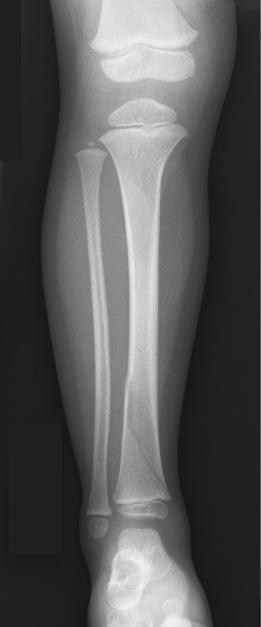 In addition to leg immobilization, which of the following is the best next step in evaluation of this patient?
 (Multiple Choice)
4.9/5 (98)
(98) A 65-year-old man comes to the emergency department due to severe right leg pain and is found to have an acute thrombotic occlusion of the right popliteal artery. He has a history of hypertension, type 2 diabetes mellitus, and hyperlipidemia. The patient is admitted to the surgical floor and initiated on intravenous unfractionated heparin. The following morning, he undergoes surgical revascularization of the right leg. The patient's hospital course progresses well, but 5 days postoperatively his platelet count decreases from 240,000/mm3 on admission to 65,000/mm3. His vital signs are stable. The surgical wound is healing well. There are no rashes or pitting edema. Which of the following is the most appropriate next step in management of this patient?
(Multiple Choice)
4.9/5 (75)
(75) A 50-year-old man comes to the office due to a persistent ulcer on his left leg for the past 2 months. Ten years ago, he sustained full-thickness burns to the left pretibial and ankle areas that required extensive wound care and skin autografting and resulted in significant scarring. The patient had been doing well until 2 months ago, when he developed an ulcer associated with pain and bloody drainage within the region of the prior skin graft. He has tried local wound care with antibiotic ointment, but the lesion has not healed. On physical examination, there is a 3-cm, irregularly shaped ulcer on the left lower leg just proximal to the medial malleolus. The ulcer has red granulation tissue at the base that bleeds easily when touched. Pedal pulses are 2+ bilaterally. The legs are symmetric in girth; there is no edema in the legs or feet. Which of the following is the most likely diagnosis?
(Multiple Choice)
4.9/5 (82)
(82) A 45-year-old man comes to the emergency department due to a 2-day history of progressively increasing epigastric pain that radiates to the back. He also has had nausea, an episode of vomiting, and anorexia. The patient has no chronic medical conditions and takes no medications. Temperature is 38.3 C (101 F), blood pressure is 116/78 mm Hg, pulse is 104/min, and respirations are 22/min. BMI is 27 kg/m2. Mucous membranes are moist. Breath sounds are decreased at both lung bases. The abdomen is mildly distended, and bowel sounds are decreased; there is epigastric tenderness with voluntary guarding. No rebound tenderness or rigidity is noted. Laboratory results are as follows:  Which of the following findings in this patient is associated with the worst prognosis?
 (Multiple Choice)
4.9/5 (80)
(80) A 50-year-old woman comes to the emergency department due to abdominal pain. For 3 days, she had lower abdominal cramping and frequent watery diarrhea, but over the past 24 hours, the pain has progressively worsened; she has also had a fever. The patient has no chronic medical conditions but recently finished a course of ciprofloxacin for pyelonephritis. Temperature is 38.9 C (102 F), blood pressure is 110/68 mm Hg, and pulse is 118/min. Abdominal examination shows lower abdominal tenderness without guarding or rigidity. Abdominal CT scan reveals colonic wall edema without perforation. The patient is admitted to the hospital and treated with intravenous fluids and oral vancomycin. Stool toxin assay is positive for Clostridioides (formerly Clostridium) difficile. Two days later, the diarrhea has decreased, but the abdominal pain is worsening. Examination shows an absence of bowel sounds; the abdomen is distended and diffusely tender to both palpation and release of palpation pressure. Abdominal x-ray reveals dilation of the transverse and descending colon to 10 cm. Serum lactate is 6 mmol/L (normal: <2). Which of the following is the best next step in management?
(Multiple Choice)
4.9/5 (89)
(89) A 46-year-old woman comes to the office due to tingling, numbness, and weakness of the left upper extremity. The patient experienced left shoulder and subscapular pain during a vacation 1 month ago, which she attributed to sleeping on a new bed. She saw a chiropractor upon returning and has taken ibuprofen as needed. Over the past 3 weeks, she has also experienced tingling and numbness in her left hand and has had mild left arm weakness. The patient spends prolonged time answering the phone at work and has noticed the symptoms worsen after cradling the phone between the head and the left shoulder. She has a history of hypothyroidism and takes levothyroxine. Vital signs are within normal limits. Physical examination shows loss of pinprick sensation in the left thumb and index finger. There is mild weakness of the elbow flexion and biceps reflex is decreased on the left side. Which of the following is the most likely cause of this patient's symptoms?
(Multiple Choice)
4.8/5 (90)
(90) A 22-year-old man comes to the emergency department with a persistent, painful erection he has had for the past 6 hours. The patient has had similar episodes that lasted 1-2 hours but resolved spontaneously. He says his symptoms started this morning without provocation when he woke up. The patient recently started a summer job working outside pouring concrete. Medical history includes sickle cell disease; he has not taken any medications other than his usual folic acid. The patient does not use alcohol or illicit drugs. On examination, the penis is rigid, and the glans is soft. The scrotum is normal. Which of the following is the most appropriate next step in management?
(Multiple Choice)
4.7/5 (91)
(91) A 55-year-old man is evaluated for new-onset shortness of breath after a right hemicolectomy 3 days ago. He has no chest pain, cough, or hemoptysis. The patient came to the hospital 4 days ago with a history of constipation, weight loss, and abdominal distension. He was found to have an obstructing cecal mass and underwent right hemicolectomy with ileocolic anastomosis. The patient has no significant medical history other than a 35-pack-year smoking history. Temperature is 37.2 C (99 F), blood pressure is 120/80 mm Hg, pulse is 98/min, and respirations are 22/min. Pulse oximetry shows 88% on room air. Lung examination reveals dullness to percussion and absence of breath sounds on the left. Chest x-ray is shown below. 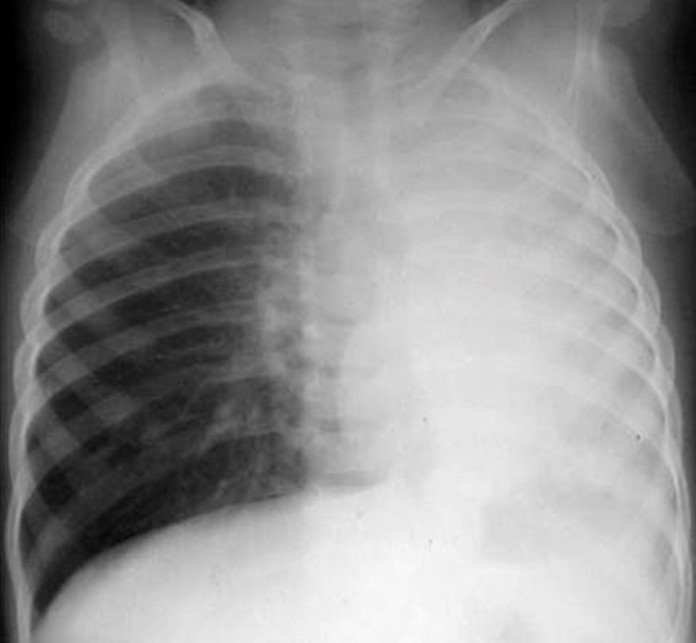 Chest x-ray at the time of admission was normal. Which of the following is the most likely cause of this patient's pulmonary findings?
 (Multiple Choice)
4.8/5 (82)
(82) A 56-year-old man comes to the emergency department with left hand pain that started 2 hours ago. He was reaching into some grass to move a large pipe on his ranch when he felt a sharp bite to his left hand. He did not see what bit him. Medical history includes hypertension. Upon arrival, his blood pressure is 88/60 mm Hg, pulse is 118/min, and respirations are 22/min. Examination of the left hand reveals 2 puncture wounds just distal to his left wrist. Persistent oozing is noted from the wound. There is pronounced swelling and ecchymosis present to the middle of his upper arm. There is significant pain with passive movement of the left wrist and elbow. Sensation is intact in the left arm. Capillary refill is decreased in all 4 extremities equally. Which of the following is the best initial treatment for this patient?
(Multiple Choice)
4.7/5 (76)
(76) A 57-year-old man comes to the office for follow-up after recent thyroid surgery. A month ago, he was found to have a solitary thyroid nodule, and a fine-needle aspiration biopsy of the mass revealed a neoplasm arising from parafollicular cells. He underwent an uncomplicated total thyroidectomy and removal of surrounding lymph nodes. He feels well and is taking levothyroxine as prescribed. Medical history is otherwise significant for well-controlled hypertension. The patient has no family history of thyroid cancers, and germline RET mutation testing was negative. Vital signs are within normal limits. On examination, there is a well-healing incision on his lower anterior neck with no surrounding erythema or edema. There are no enlarged cervical lymph nodes. The remainder of the examination shows no abnormalities. Blood cell counts and serum chemistry studies are within normal limits. Periodic surveillance with which of the following is most appropriate in this patient?
(Multiple Choice)
4.8/5 (92)
(92) A 26-year-old man in the burn unit is being evaluated for nutritional needs. The patient was admitted 12 hours ago after the trash he was burning exploded, causing partial- and full-thickness burns to the face, the anterior chest and abdomen, and both upper extremities. He has been receiving IV crystalloid resuscitation titrated to an adequate urine output, and his burns have undergone initial debridement and dressing with topical antimicrobial ointment. Temperature is 37.6 C (99.7 F), blood pressure is 132/86 mm Hg, and pulse is 100/min. The patient is mildly sedated but arousable. Burn dressings are intact, with some serous drainage, and the abdomen is soft and nondistended. Which of the following is the most appropriate management of this patient's nutrition?
(Multiple Choice)
4.8/5 (88)
(88) A 55-year-old man is brought to the emergency department after falling from a 20-ft (6.2-m) height. The patient was leaning over a second-story roof to hang Christmas lights when he lost his footing and fell forward. Although he partially braced his fall with outstretched arms and legs, his body hit the pavement with full force. The patient has severe chest and back pain. Blood pressure is 162/90 mm Hg in the left arm, pulse is 118/min, and respirations are 24/min. On physical examination, the patient is alert but appears scared. His voice is hoarse when he tries to speak. The pupils are symmetric and reactive to light, and the trachea is midline. There is bruising over the sternum, which is tender to palpation. Breath sounds are symmetric bilaterally, and heart sounds are normal with no murmurs. The abdomen is soft and nontender. There are superficial abrasions on the patient's palms and knees. The lower extremities are cool to touch with diminished femoral pulses bilaterally. Which of the following is most likely to confirm the diagnosis in this patient?
(Multiple Choice)
4.9/5 (100)
(100) Which of the following is the best next step in management of this patient's breast mass?
(Multiple Choice)
4.9/5 (82)
(82) 
Filters
- Essay(0)
- Multiple Choice(0)
- Short Answer(0)
- True False(0)
- Matching(0)