



 Chat with AI
Exam 4: Surgery

Exam 1: Medicine2 k Questions
Exam 2: Pediatric723 Questions
Exam 3: Psychiatry336 Questions
Exam 4: Surgery563 Questions
Exam 5: Obstetrics & Gynecology469 Questions
Select questions type


A 40-year-old woman comes to the office for evaluation of a sore throat. It began 2 months ago, worsens with swallowing, and is making it difficult for her to swallow solid foods. She has also noticed worsening bad breath. Medical history is unremarkable. She has never smoked and uses alcohol rarely. The patient is currently in a long-term monogamous relationship and has had multiple sexual partners over her lifetime. Temperature is 37 C (98.6 F), blood pressure is 118/76 mm Hg, and pulse is 82/min. Ear examination reveals a clear external ear canal with an intact tympanic membrane with no middle ear fluid. The nasal mucosa is pink with no nasal drainage. Oral cavity examination shows mild dental disease but no mucosal lesions. Oropharyngeal examination reveals an enlarged, firm right tonsil with a 2-cm ulceration. There are also 2 enlarged, firm, fixed, nontender lymph nodes in the right side of her neck. Which of the following is most likely responsible for this patient's condition?
(Multiple Choice)
4.9/5  (66)
(66) A 54-year-old woman is brought to the emergency department after sustaining severe burns from a deep fryer explosion that occurred when she attempted to deep fry a frozen turkey. Temperature is 36 C (96.8 F). Blood pressure is 102/64 mm Hg and pulse is 110/min. The patient is alert but in severe pain. Examination reveals partial- to full-thickness burns of the face, neck, anterior chest and abdomen, and all 4 extremities. Intravenous access is obtained, and crystalloid resuscitation is administered, along with analgesia. The patient is brought to the burn unit, where her wounds are cleansed and dressed using topical antimicrobial ointment. During the subsequent treatment of this patient's burn injuries, which of the following is most likely to decrease the patient's risk for developing infection?
(Multiple Choice)
4.7/5 (71)
(71) A 48-year-old man comes to the emergency department due to fever and malaise for the past 2 days. He also complains of fatigue and lethargy but not nausea, vomiting, diarrhea, or dysuria. Medical history is significant for alcoholic cirrhosis, which was treated with an orthotopic liver transplant 10 weeks ago. Current medications include tacrolimus, mycophenolate mofetil, and low-dose prednisone. Temperature is 38.1 C (100.6 F), blood pressure is 125/82, pulse is 80/min, and respirations are 12/min. The patient is awake and oriented to person, place, and time. Scleral icterus is present. Cardiopulmonary examination is unremarkable. There is a well-healed surgical scar on the abdomen but no tenderness or distension. Laboratory results are as follows:  A liver biopsy shows inflammatory infiltration of the portal tracts consisting of lymphocytes, eosinophils, and neutrophils. Interlobular bile duct destruction and prominent endotheliitis are both present. Which of the following is the best next step in management?
 (Multiple Choice)
4.7/5 (91)
(91) A 24-year-old woman is brought to the emergency department (ED) after a motor vehicle collision. She was the passenger in a vehicle that collided with an 18-wheeler. Paramedics state that the patient was ejected from the vehicle and found on the side of the road. They placed 2 large-bore intravenous lines, infused 1 L of crystalloid, and transported her to the ED. Blood pressure is 80/50 mm Hg, pulse is 138/min, and respirations are 24/min. On examination, the eyes are closed, and the patient is moaning. Auscultation of the lungs reveals decreased breath sounds on the right. The abdomen is tender in the right and left upper quadrants. The patient has an obvious deformity of the left thigh. The extremities are cold and clammy. Chest x-ray reveals a right hemothorax. Focused assessment with sonography for trauma examination shows evidence of free fluid in the right and left upper quadrants. A right chest tube is placed, and 1.5 L of blood is returned. Which of the following is the best next step in management?
(Multiple Choice)
4.9/5 (72)
(72) A 59-year-old man comes to the emergency department due to a sore throat. He says that he was assaulted during an altercation in a bar 7 days ago. The following day, the patient noticed some neck pain and stiffness, followed by a sore throat. Today, he has severe throat pain, which has spread to his left shoulder and radiates down his left arm. The patient drinks 6-12 beers daily and has a 50-pack-year smoking history. Medical history includes type 2 diabetes mellitus and hypertension. Temperature is 38.6 C (101.5 F), blood pressure is 108/70 mm Hg, pulse is 106/min, and respirations are 16/min. On examination, the patient is awake and alert. Abrasions are present on the head, neck, and face. Mild swelling and ecchymosis are noted on the forehead and around the right eye. The posterior pharynx is normal; there is no trismus or drooling. Right upper extremity strength is 5/5, and left upper extremity strength is 4/5. Cervical spine tenderness is present at the C5 and C6 level. Laboratory results are as follows:  What is the best next step in management of this patient?
 (Multiple Choice)
4.9/5 (104)
(104) A 15-year-old boy is brought to the emergency department due to abdominal pain that started approximately 24 hours ago and is described as diffuse, severe, and stabbing. The pain is associated with frequent bilious emesis, and he is unable to tolerate any oral intake. The patient's last bowel movement was over 24 hours ago, and he is passing minimal flatus. He has had nausea, anorexia, and intermittent abdominal pain for the last 6 months. The patient has never required surgery. His family emigrated from Indonesia 4 weeks ago. Temperature is 37.6 C (99.7 F), blood pressure is 112/78 mm Hg, pulse is 110/min, and respirations are 12/min. Mucous membranes are pale and dry. Heart and lung sounds are unremarkable aside from tachycardia. The abdomen is diffusely tender and distended without rebound or involuntary guarding. Bowel sounds are high-pitched and loud. Laboratory results are as follows: 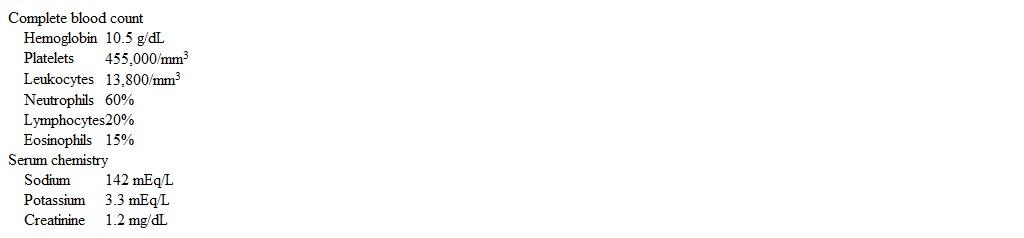 An abdominal x-ray shows small bowel dilation and air-fluid levels without pneumobilia. Which of the following is the most likely etiology of this patient's presentation?
 (Multiple Choice)
4.8/5 (84)
(84) A 46-year-old woman comes to the office due to worsening lower extremity tingling and numbness. She has also had difficulty walking, especially at night. Review of systems is positive for hair loss. The patient had gastric bypass surgery 5 years ago and has lost 30 kg (66 lb). She was originally prescribed multivitamin and mineral supplements but now takes only zinc. Physical examination shows gait ataxia with loss of vibration and position sensation in the feet. There is mild lower extremity edema and scattered areas of skin depigmentation. Laboratory studies reveal hypochromic microcytic anemia. Deficiency of which of the following is the most likely cause of this patient's current condition?
(Multiple Choice)
4.9/5 (65)
(65) A 65-year-old man comes to the office due to 4 months of abdominal pain, nausea, and occasional emesis. The pain is deep, mid-epigastric, persistent, and non-radiating. There is no consistent relationship between the pain and food intake. He has no difficulty swallowing, hematemesis, black stools, blood in the stool, or diarrhea. The patient thinks he may have lost weight recently. He emigrated to the United States from China 20 years ago but frequently travels to China to visit family. He has no significant medical or surgical history. The patient does not use tobacco, alcohol, or illicit drugs. Temperature is 36.9 C (98.4 F), blood pressure is 110/78 mm Hg, pulse is 78/min, and respirations are 16/min. BMI is 20 kg/m2. Heart and lung sounds are normal. The upper abdomen is mildly tender to palpation but nondistended. Hepatomegaly is present. Bowel sounds are normoactive. Laboratory results are as follows: 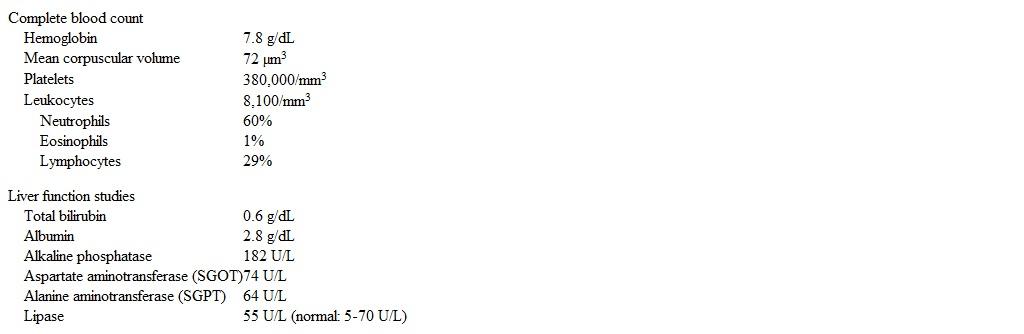 Laboratory testing last year was normal. Which of the following is most likely causing this patient's symptoms?
 (Multiple Choice)
4.8/5 (79)
(79) A 1-year-old girl is brought to the emergency department because she is not moving her right arm. Her father says that the girl acted normally when she awoke this morning. He was swinging her by the forearms when she suddenly started crying and refused to use her right arm. He has swung her by the arms previously and it usually makes her laugh. The girl lives with her father and her mother, who is currently out of town. Physical examination shows a well-nourished child who holds her right arm in pronation against the chest. She avoids any movement of her right arm. There is no bony tenderness to palpation. No bruises or other abnormalities are seen. Which of the following is the most appropriate next step in management of this patient?
(Multiple Choice)
4.9/5 (67)
(67) A 5-year-old boy is brought to the emergency department due to right-sided hemiplegia. His parents say that he has been having increasing difficulty moving his right arm and leg over the past 3 hours. This morning, approximately 10 hours prior, the child tripped on a toy while brushing his teeth and fell forward with the toothbrush in his mouth. He cried immediately, but his parents did not note any oral bleeding. The boy did say, "My throat hurts" throughout the day but was able to eat his lunch. The child has a history of attention deficit hyperactivity disorder for which he takes methylphenidate. The boy's mother has a history of migraines, and his grandfather had a stroke at age 62. Neurologic examination shows right hemiplegia, right hemianesthesia, and mild motor aphasia. Which of the following is the most likely cause of this patient's condition?
(Multiple Choice)
5.0/5 (89)
(89) A 36-year-old woman is undergoing upper and lower gastrointestinal endoscopy due to abdominal pain, anorexia, and nausea, with intermittent vomiting and diarrhea for the past several months. She also has had fatigue and a 10-kg (22-lb) unintended weight loss during this time. Abdominal imaging studies have been unrevealing. The patient has no other medical conditions and takes no medications. She does not use tobacco, alcohol, or illicit drugs and has no known drug allergies. Physical examination in the endoscopy unit shows normal heart and lung sounds, mild diffuse abdominal tenderness, and no lower extremity edema. Propofol is administered in preparation for the endoscopy. Several minutes later, the patient suddenly becomes hypotensive. Temperature is 37.8 C (100 F), blood pressure is 66/40 mm Hg, pulse is 108/min, and respirations are 20/min. Oxygen saturation is 95% on room air. There is no wheezing or skin rash. Heart and lung sounds are normal. The hypotension fails to improve despite intravenous fluid boluses and epinephrine. Urgent laboratory results are as follows: 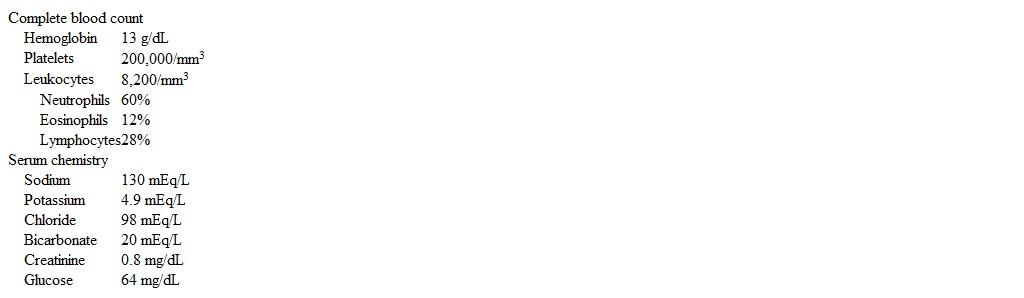 Which of the following is the most likely underlying cause of this patient's cardiovascular collapse?
 (Multiple Choice)
5.0/5 (91)
(91) A 58-year-old man comes to the office due to an ulcer on the sole of the right foot. The patient noticed the wound 4 weeks ago. He has no history of trauma to the area. The ulcer has failed to heal despite wound care with moisture-retentive dressings and pressure offloading with orthotic devices. The patient has had no right foot pain, redness, swelling, fever, or chills. He has a 10-year history of diabetes mellitus complicated by diabetic neuropathy and nephropathy. He also has hypertension and hyperlipidemia. The patient does not use tobacco, alcohol, or illicit drugs. Vital signs are within normal limits. Physical examination shows a 3-cm ulcer under the first metatarsal head of the right foot; the wound has a clean base and no significant discharge. There is no surrounding erythema or areas of fluctuance or tenderness. Which of the following is the best next step in management of this patient's foot ulcer?
(Multiple Choice)
4.9/5 (81)
(81) A 35-year-old woman comes to the office due to blood in her urine. She has been working in her yard for 2 days creating a new garden. Review of systems is positive for recurrent bilateral flank discomfort. The patient has no fever, chills, vomiting, dysuria, or urinary frequency. She has never had blood in her urine before. She is sexually active with a male partner and uses condoms for contraception. The patient does not use tobacco, alcohol, or illicit drugs. Her father died from kidney disease at age 40. Temperature is 37 C (98.6 F), blood pressure is 180/120 mm Hg in both arms, and pulse is 82/min and regular. BMI is 40 kg/m2. Cardiopulmonary examination shows no abnormalities. The abdomen is soft and without bruits. Laboratory results are as follows: 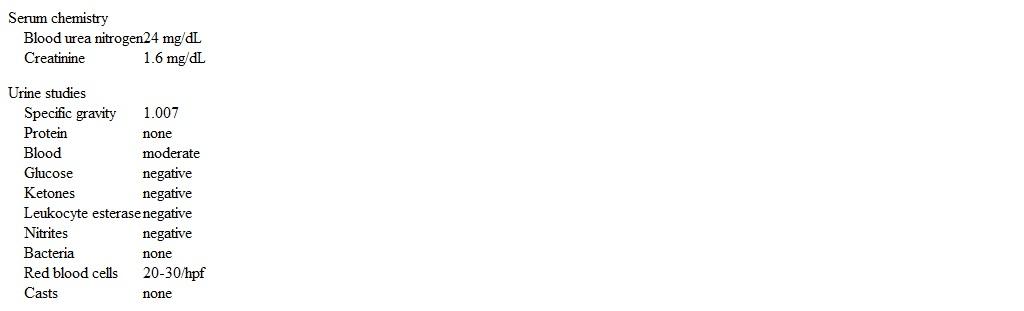 Which of the following is the most likely diagnosis?
 (Multiple Choice)
4.7/5 (94)
(94) A 43-year-old man is found wandering in the street in winter and is brought to the emergency department by a passing motorist. The patient is confused and unable to provide any history. He has no previous hospital records. On examination, there is mild hypothermia (temperature 35 C [95 F]), but vital signs are otherwise normal. The patient appears disheveled and lethargic but follows commands. The oral mucosa is moist, and there are extensive dental caries. The patient has no cervical lymphadenopathy, but there is bilateral, nontender swelling of the cheeks consistent with salivary gland enlargement. Which of the following is the most likely cause of this latter finding?
(Multiple Choice)
4.8/5 (76)
(76) A 70-year-old woman comes to the emergency department at 10 PM after falling in her kitchen 30 minutes ago. She has severe left wrist pain. The patient did not hit her head and reports no other injuries. Medical history is significant for hypertension and osteoporosis. Vital signs are within normal limits. On examination, the left wrist is bruised and swollen and diffusely tender to palpation, but the skin overlying the wrist is intact. The radial pulse is absent, and capillary refill in the fingers is delayed. X-rays of the left wrist are shown in the exhibits.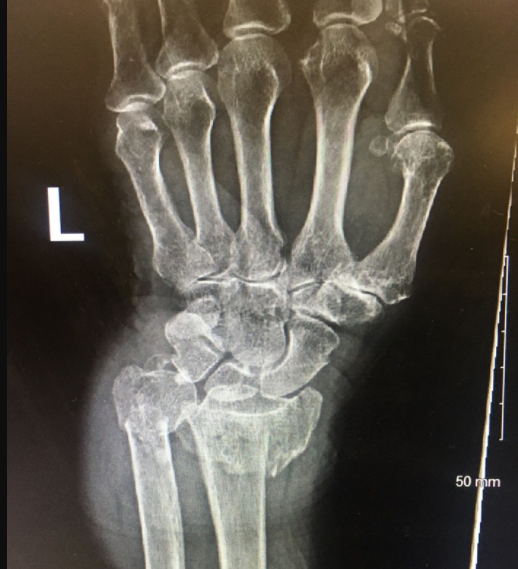
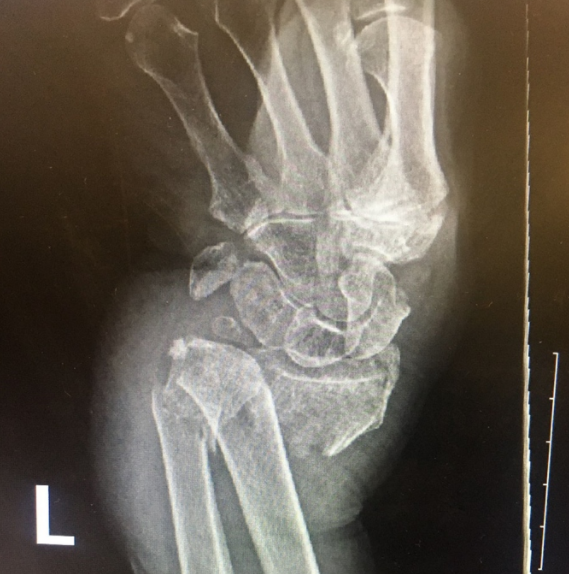 Which of the following is the best next step in management of this patient?
 (Multiple Choice)
4.9/5 (91)
(91) A 36-year-old woman comes to the office for a postoperative visit due to incisional pain. A week ago, the patient had an abdominal hysterectomy for heavy menstrual bleeding, and intraoperative blood loss was 500 mL. After surgery, heparin was administered for venous thromboembolism prophylaxis and discontinued when she started ambulating. Since leaving the hospital, the patient has had incisional pain and light vaginal bleeding. In addition, she has a pulling sensation to the left of her incision that worsens when she bends over and when she strains to have a bowel movement. Temperature is 37.2 C (99 F), blood pressure is 134/78 mm Hg, and pulse is 78/min. BMI is 34 kg/m2. The abdomen is soft and there are normoactive bowel sounds. The low, horizontal abdominal incision is closed with staples, and the skin edges are intact. There is mild incisional induration but no erythema, drainage, or fluctuance. The incision is diffusely tender to deep palpation, and no palpable masses or defects are present. Hemoglobin is 9 g/dL and leukocytes are 10,000/mm3. Which of the following is the best next step in management of this patient?
(Multiple Choice)
5.0/5 (78)
(78) A 64-year-old man is brought to the emergency department by ambulance for right-sided weakness and slurred speech that started 30 minutes ago. The wife reports that her husband said he was dizzy, and shortly after, he developed acute right arm and leg weakness and was unable to speak. Medical history includes hypertension, for which he takes amlodipine. The patient also takes an aspirin daily. Blood pressure is 225/110 mm Hg, pulse is 90/min, and respirations are 20/min. On examination, the patient is alert but aphasic with 0/5 strength in the right upper and lower extremities. Examination of the left upper and lower extremities is normal. A nicardipine infusion is started and CT scan of the head is performed. After returning from the CT scanner, the patient is minimally responsive and has developed hyperextension of all four extremities. CT scan shows a left-sided intracerebral hemorrhage with a 5-mm midline shift to the right. Which of the following is the best next step in management of this patient?
(Multiple Choice)
4.8/5 (79)
(79) An 18-year-old man comes to the office due to 3 days of progressive left testicular pain. The pain began gradually and is dull and achy. The patient has had no trauma to that area and has never had similar symptoms. He has no fever, chills, urinary frequency, dysuria, urethral discharge, or penile ulcerations. The patient is sexually active. Vital signs are normal. The left testicle is lower in the scrotum than the right. The area posterior to the left testis is swollen and very tender. The pain improves with elevation of the testis, and the cremasteric reflex is normal. Urinalysis shows 4-5 white blood cells/hpf. Which of the following is the best next step in management of this patient?
(Multiple Choice)
4.7/5 (87)
(87) A 52-year-old man is found to be tachypneic on the second day after an uncomplicated upper abdominal ventral hernia repair. Until now, his postoperative course had been unremarkable, and he has been treated with low-dose morphine for pain control. The patient says he feels short of breath but has no chest pain. He has an occasional cough with a small amount of early-morning sputum production. Other medical conditions include hypertension and hyperlipidemia. The patient is an active smoker with a 15-pack-year history. Temperature is 36.7 C (98.1 F), blood pressure is 123/79 mm Hg, pulse is 90/min, and respirations are 28/min. BMI is 32 kg/m2. Physical examination shows decreased breath sounds at the right lung base without wheezes or prolonged expiration. Heart sounds are normal. There is abdominal distension and diffuse tenderness without rebound. The surgical incision appears clean and dry. Chest x-ray reveals a dense opacity at the right lung base.
Arterial blood gas analysis done on room air is most likely to show which of the following?
(Multiple Choice)
4.8/5 (85)
(85) A 33-year-old woman comes to the office for follow-up of a thyroid nodule that was discovered incidentally on a routine physical examination 3 weeks ago. The patient feels well and has experienced no weight changes, temperature intolerance, or menstrual irregularities. Medical history is notable for primary hypothyroidism treated with levothyroxine. Family history is notable for hypertension and hypothyroidism in her mother, but the patient has no relatives with a history of thyroid cancer. TSH is normal. Neck ultrasound reveals a 2.0-cm hypoechoic nodule in the right lobe of her thyroid without any enlarged lymph nodes. Fine-needle aspiration biopsy reveals large cells with ground glass cytoplasm, and pale nuclei containing inclusion bodies and central grooving consistent with papillary thyroid cancer. Which of the following is the best next step in management of this patient?
(Multiple Choice)
4.8/5 (86)
(86) 
Filters
- Essay(0)
- Multiple Choice(0)
- Short Answer(0)
- True False(0)
- Matching(0)