



 Chat with AI
Exam 4: Surgery

Exam 1: Medicine2 k Questions
Exam 2: Pediatric723 Questions
Exam 3: Psychiatry336 Questions
Exam 4: Surgery563 Questions
Exam 5: Obstetrics & Gynecology469 Questions
Select questions type


A 48-year-old woman comes to the office due to impaired vision. For the last year, she has had progressive loss of visual acuity. The patient is unable to read her computer screen and has stopped driving at night due to excessive glare from oncoming headlights. History is notable for chronic HIV infection, which has been well controlled with a multidrug antiretroviral regimen. Examination shows opacification of the lenses bilaterally. Which of the following is the most appropriate next step in management of this patient's eye condition?
(Multiple Choice)
4.7/5  (90)
(90) A 68-year-old man with no previous history of renal disease is evaluated in the postoperative unit due to decreased urine output. The patient was admitted due to severe abdominal pain, fever, and vomiting. Evaluation revealed perforated sigmoid diverticulitis, and the patient underwent urgent sigmoid resection. Postoperatively, he has received maintenance intravenous fluids and piperacillin/tazobactam. In the day since surgery, the patient has had 200 mL of urine output. Temperature is 37.1 C (98.8 F), blood pressure is 100/70 mm Hg, and pulse is 96/min. The lungs are clear to auscultation, and heart sounds are normal. The abdomen shows postoperative changes with sluggish bowel sounds. The patient has no skin rash. Laboratory results are as follows:  Urinalysis reveals no sediment, and bladder scanning reveals no urine. Which of the following is the best next step in management of this patient?
 (Multiple Choice)
4.8/5 (67)
(67) A 33-year-old woman comes to the office due to a dull, aching pain in the right upper quadrant of the abdomen for several weeks. Her medical history is unremarkable. She takes no medications except an oral contraceptive, which she has used for the past 12 years. The patient drinks 1 or 2 glasses of wine on social occasions but does not use tobacco or illicit drugs. Temperature is 36.7 C (98 F), blood pressure is 120/80 mm Hg, pulse is 78/min, and respirations are 14/min. BMI is 27 kg/m2. Examination shows hepatomegaly with moderate discomfort on deep palpation in the right upper quadrant. There is no jaundice or ascites. Cardiopulmonary examination shows no abnormalities. Laboratory results are as follows: 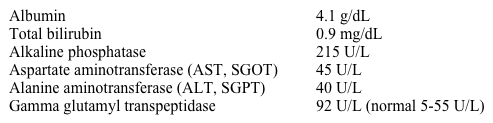 Abdominal ultrasonogram reveals a solitary hyperechoic 7-cm lesion in the right lobe of the liver. Which of the following is the most likely diagnosis in this patient?
 (Multiple Choice)
4.9/5 (71)
(71) A 62-year-old man comes to the office due to anorexia, fatigue, and a 9 kg (20 lb) weight loss over the past 6 months. He rarely drinks alcohol and does not use illicit drugs, although he has smoked one pack of cigarettes daily for the past 40 years. The patient has previously been diagnosed with hypertension, diverticulosis, external hemorrhoids, and osteoarthritis. Current medications are atenolol and aspirin, and he has no known drug allergies. Temperature is 37 C (98.6 F), blood pressure is 132/88 mm Hg, pulse is 70/min, and respirations are 12/min. Physical examination reveals a soft abdomen that is mildly tender to deep palpation in the midepigastric region. The sclerae are icteric, and the skin is jaundiced. Laboratory results show: 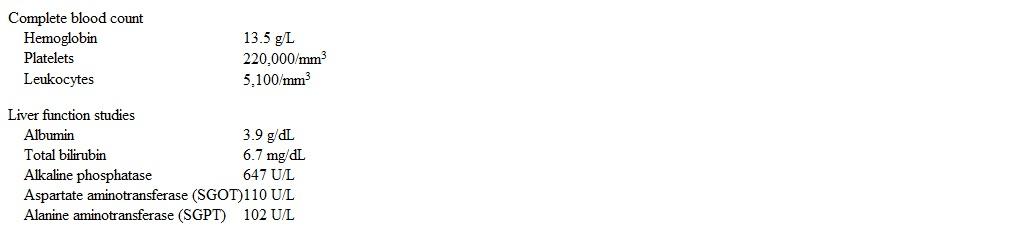 Antimitochondrial antibodies are negative. Abdominal ultrasound demonstrates mild dilation of the common bile duct; there are no stones present in the gallbladder and no evidence of gallbladder wall thickening. Which of the following is the best next step in the management of this patient's condition?
 (Multiple Choice)
4.9/5 (92)
(92) A 42-year-old man comes to the emergency department due to worsening anal pain for the past 2 days. The patient initially had pain only during defecation, but now the pain is constant and severe. He also has anal pruritus but has not had any drainage. The patient reports a history of constipation with hard stools every 3-4 days requiring the frequent use of laxatives. He has had sexual intercourse with men and women and has had anoreceptive intercourse in the past. Temperature is 38 C (100.4 F), blood pressure is 120/80 mm Hg, and pulse is 85/min. Physical examination shows an erythematous and tender 1-cm fluctuant mass near the anal orifice with induration of the overlaying skin. Which of the following is the most likely cause of this patient's current condition?
(Multiple Choice)
4.9/5 (75)
(75) A 34-year-old man comes to the emergency department due to severe, sudden-onset pain in his penis. During sexual intercourse 2 hours ago, he heard a cracking sound followed by pain and rapid loss of erection. When attempting to urinate, the pain is aggravated, and the patient is unable to pass urine. Physical examination shows a swollen and ecchymotic penis. Following adequate analgesia, which of the following is the best next step in management of this patient?
(Multiple Choice)
4.8/5 (74)
(74) A 22-year-old man in the intensive care unit is being evaluated for nutritional needs. Three days ago, the patient was brought to the hospital after a severe motorcycle collision in which he sustained traumatic brain injury as well as splenic rupture with associated vascular injury. The patient required multiple abdominal operations and finally underwent delayed fascial closure this morning. Temperature is 37.1 C (98.8 F), blood pressure is 128/84 mm Hg, and pulse is 90/min. The patient is intubated and receiving mechanical ventilation. The abdomen is mildly distended but soft; the dressing over the incision is clean and dry. Bowel sounds are decreased. Which of the following is the best next step for management of this patient's nutrition?
(Multiple Choice)
4.9/5 (74)
(74) A 2-year-old boy is seen in the emergency department for refusal to walk. His family returned 3 days ago from a weekend camping trip in Arizona. The parents do not recall the boy having any injuries, but he did have a cough and runny nose just before the trip. Since returning home, the parents have noticed the patient limping mildly when running. After day care yesterday, his left knee began hurting. The parents placed a cold compress on the knee last evening, which helped. This morning, the patient refused to walk and cried when the parents took him out of bed. He has no chronic medical conditions and takes no medications. Immunizations are up to date. Temperature is 38.3 C (101 F). The skin over the left knee is warm and edematous. There are no abrasions. The patient resists all attempts at passive range of motion. The knee is aspirated, and synovial fluid reveals a leukocyte count of 53,000/mm3; the joint aspiration specimen is sent for culture. The patient is admitted to receive intravenous vancomycin. After 2 days, he continues to have fever and refuses to walk. Which of the following is the most appropriate to add to this patient's regimen?
(Multiple Choice)
4.8/5 (87)
(87) A 76-year-old man is admitted to the coronary care unit after an episode of substernal chest pain. His other medical problems include hypertension, hyperlipidemia, and type 2 diabetes mellitus. He has a history of a diverticular bleed 2 years ago. After initial workup, cardiac catheterization is performed and shows 70% left main coronary artery stenosis, 90% proximal left anterior descending artery stenosis, and 80% right coronary artery stenosis. Antiplatelet agents are stopped, and the patient is continued on a heparin drip in preparation for coronary artery bypass surgery the next day. Five hours after the catheterization, his blood pressure is 75/60 mm Hg and pulse is 120/min and regular. He complains of some generalized weakness and back pain but denies chest pain, shortness of breath, nausea, and abdominal discomfort. On physical examination, he appears diaphoretic and clammy. Neck veins are flat. Heart sounds are normal, and the chest is clear to auscultation. The right groin arterial puncture site is mildly tender, without any swelling or bruits. He receives 1000 mL of normal saline with symptomatic improvement. His blood pressure is 96/60 mm Hg and pulse is 85/min. His repeat ECG is unchanged from the initial ECG at presentation. Which of the following is the most appropriate next step in managing this patient?
(Multiple Choice)
4.9/5 (77)
(77) A 62-year-old man comes to the office for evaluation of hoarseness. He says that he has always had a deep voice, but over the past 4 months, it has become "rough" and "scratchy" and the hoarseness is constant; it does not change throughout the day. Medical history is significant for chronic obstructive pulmonary disease and gastroesophageal reflux disease. The patient has smoked a pack of cigarettes daily for the past 40 years. He drinks 12 beers weekly. Vital signs are within normal limits. Nasal mucosa is dry, and oral cavity examination shows poor dentition with mild thrush seen on the lateral surfaces of the tongue bilaterally. There is no cervical adenopathy. Flexible laryngoscopy reveals a clear nasal cavity and nasopharynx. The base of tongue has normal mucosa, and the tonsils are small with no lesions. The vocal cords are mobile bilaterally. The right vocal cord is clear with a straight edge. There is a fungating, irregular mass on the left vocal cord that appears white in some areas and red in others with some blood crusting. Which of the following would most likely be seen on biopsy of this vocal cord lesion?
(Multiple Choice)
4.8/5 (89)
(89) A 34-year-old man comes to the office due to erectile dysfunction. For the past 2 months, he has had pain and penile curvature during erections, which has made vaginal penetration difficult and has started to adversely affect his self-esteem. The patient has had no urethral discharge or other symptoms. He smokes a pack of cigarettes daily and does not use alcohol or illicit drugs. The patient has had a total of 5 female sexual partners. Vital signs are within normal limits. Cardiopulmonary examination shows no abnormalities. The abdomen is soft and nontender with no masses. There is no inguinal lymphadenopathy. A palpable plaque is present on the dorsal side of the penis approximately half way between the glans and the pubis. The testes are normal with no scrotal erythema or skin ulceration. Which of the following is the most likely diagnosis?
(Multiple Choice)
4.7/5 (94)
(94) A 76-year-old man is brought to the hospital due to a 2-week history of cough, increasing shortness of breath, right-sided chest pain, and fever. The patient also has lost 3 kg (6.6 lbs) during this time. Medical history includes type 2 diabetes mellitus, hypertension, and Alzheimer dementia. Temperature is 39.1 C (102.4 F), blood pressure is 102/68 mm Hg, pulse is 112/min, and respirations are 24/min. Examination shows decreased respiratory excursion, decreased breath sounds, and dullness to percussion on the right side. Laboratory studies reveal leukocytes 22,000/mm3 with 85% neutrophils and hemoglobin 10.5 g/dL. Chest x-ray reveals a moderate pleural effusion. A right lateral decubitus x-ray shows the effusion to be free flowing, and an underlying right lower lobe infiltrate is noted. Thoracentesis yields 750 mL of foul-smelling turbid fluid. Which of the following organisms is most likely responsible for this patient's current condition?
(Multiple Choice)
4.9/5 (87)
(87) A 67-year-old man comes to the emergency department due to worsening left foot pain. The pain involves the entire left foot and is severe in the forefoot. The pain began a day prior while the patient was lying in bed watching television. He immediately sat up and dangled his foot over the side of the bed, but this did not improve the pain as it had during past episodes. Although the pain was initially mild, it progressively worsened over the course of the day. The patient tried heat packs and over-the-counter pain medication, which he takes intermittently for chronic low back pain, without relief. Medical history includes hypertension and hyperlipidemia. The patient smokes 1-2 packs of cigarettes daily. Temperature is 36.7 C (98 F), blood pressure is 146/90 mm Hg, and pulse is 92/min. On examination, the skin of both lower legs is shiny and hairless, and the left foot is mottled and cooler to the touch than the right foot. Pulses are not palpable in either foot but can be detected with doppler in the right foot. The left foot has capillary refill of 4-5 seconds. The patient has difficulty moving his left foot and toes. Which of the following is the most likely cause of the patient's new symptoms?
(Multiple Choice)
4.9/5 (67)
(67) A 7-year-old girl is brought to the emergency department due to a right arm injury. While jumping on a trampoline, she slipped and fell onto her outstretched right hand. The patient had immediate pain and would not move her arm. She did not hit her head or lose consciousness. On examination, the patient is crying in pain, with significant ecchymosis and swelling just above the elbow. She is holding the right arm in flexion and winces when it is moved. X-ray reveals a supracondylar fracture with posterior displacement of the distal humerus fragment, as shown in the image below. 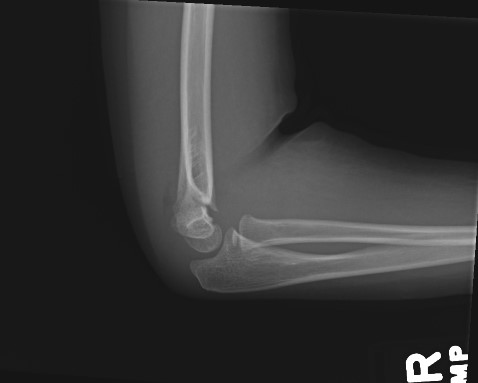 Which of the following is at greatest risk of injury in this patient?
 (Multiple Choice)
4.7/5 (83)
(83) A 7-year-old boy is brought to the emergency department after falling during recess. His teacher saw him jump off a swing and fall onto his outstretched left arm. The patient developed immediate pain in the arm and now refuses to move it at the elbow. On examination, the left arm is grossly deformed, swollen, and slightly pale. The radial pulse is intact. The patient's x-ray is shown below. 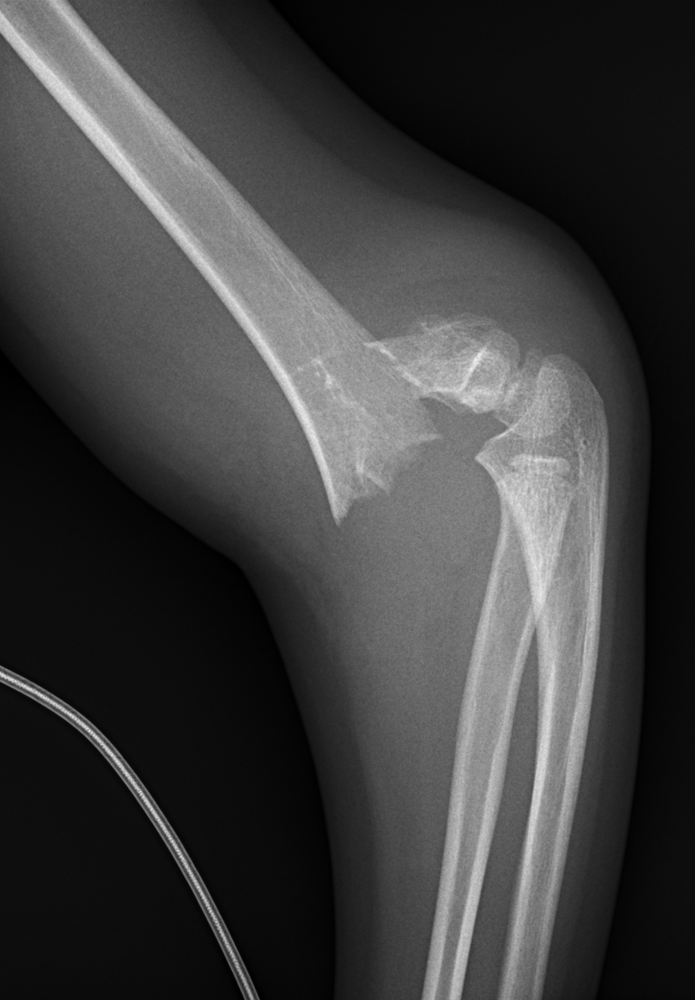 Two hours later, while the patient is awaiting surgery, pain and swelling continue to increase despite administration of nonsteroidal anti-inflammatory drugs and opioid analgesics. Which of the following complications is most likely present in this patient?
 (Multiple Choice)
4.7/5 (74)
(74) A 64-year-old woman comes to the office for evaluation of a painless neck lump. The patient first noticed right-sided neck swelling a month ago. She has not had fevers, chills, cough, or shortness of breath but has had decreased appetite and weight loss. Medical history is significant for obesity, type 2 diabetes mellitus, and nonalcoholic fatty liver disease. The patient has smoked a pack of cigarettes daily for the past 29 years. She drinks alcohol socially. Vital signs are within normal limits. Physical examination reveals a 2-cm, hard, nontender cervical lymph node close to the right submandibular gland. There is no other lymphadenopathy. The lungs are clear to auscultation and heart sounds are normal. The abdomen is soft and nontender; mild hepatomegaly is present. The remainder of the examination is normal. Fine-needle aspiration of the lymph node reveals squamous cell carcinoma. Which of the following would be most helpful to establish the primary source of this patient's malignancy?
(Multiple Choice)
4.9/5 (80)
(80) A 24-year-old man is brought to the emergency department after the all-terrain vehicle he was driving rolled over and landed on him. Blood pressure is 82/50 mm Hg, pulse is 128/min, and respirations are 24/min. The patient is alert but anxious and diaphoretic. He has a scalp laceration that has stopped bleeding. The pupils are equal and reactive to light. The trachea is midline. Bruising is present over the chest wall and abdomen. Breath sounds are present bilaterally. Heart sounds are normal. The abdomen is distended and has diffuse tenderness. Portable chest x-ray shows fracture of multiple ribs, including the right eighth and ninth ribs and the left fourth rib, with no pneumothorax. Focused Assessment with Sonography for Trauma shows no pericardial effusion but a large amount of intraperitoneal free fluid. Pelvic x-ray is negative for fractures. The patient remains hypotensive after the rapid infusion of 2 L of intravenous crystalloid and is taken for emergency exploratory laparotomy. Which of the following injuries is the most likely cause of this patient's persistent hypotension?
(Multiple Choice)
4.8/5 (70)
(70) A 29-year-old man comes to the office due to difficulty swallowing for the past 2 years. Pork, chicken, and steak occasionally "get stuck" in his mid-chest seconds after he swallows. These episodes occur intermittently but with increasing frequency. Drinking water usually alleviates the symptoms, but the patient occasionally induces vomiting to eject the food. He has no trouble swallowing water, broth, or gelatin. The patient has no pain, cough, or nasal regurgitation after swallowing. He frequently plays football and takes ibuprofen to relieve aches and pains. He has seasonal allergies and takes antihistamines during the spring. Temperature is 37.3 C (99.1 F), blood pressure is 125/78 mm Hg, pulse is 76/min, and respirations are 12/min. BMI is 28 kg/m2. Heart and lung sounds are unremarkable. The abdomen is soft, nontender, and nondistended. Which of the following is the most likely explanation for this patient's symptoms?
(Multiple Choice)
4.9/5 (79)
(79) A 15-year-old boy with sickle cell disease is brought to the emergency department due to 2 days of fever and severe pain in the left knee. The patient has been hospitalized previously for acute vasoocclusive crises, which generally occur in his arms. His temperature is 38.2 C (100.8 F). Physical examination shows marked tenderness and swelling over the proximal tibia. Laboratory studies reveal leukocytosis and an elevated C-reactive protein. MRI of the left leg shows marked inflammation of the proximal tibia without joint effusion. Blood culture is obtained. Which of the following is the most appropriate choice of empiric antibiotic therapy?
(Multiple Choice)
4.8/5 (81)
(81) A 28-year-old man in the hospital burn unit has been febrile for the past 48 hours. He was admitted to the hospital 4 days ago after sustaining inhalational injury and burns over 40% of the total body surface area in a methamphetamine laboratory explosion. There were no signs of wound infection 4 hours ago in the operating room, where the patient underwent dressing changes and a second stage of burn excision and skin grafting under general anesthesia. Temperature is 38.5 C (101.3 F), blood pressure is 146/92 mm Hg, and pulse is 118/min. The patient is sedated and intubated and on mechanical ventilation. He arouses to a loud voice and follows simple commands, moving the extremities symmetrically. Telemetry shows sinus tachycardia. Multiple wound and blood cultures taken since admission are negative. Which of the following is the most likely explanation for this patient's condition?
(Multiple Choice)
4.8/5 (92)
(92) 
Filters
- Essay(0)
- Multiple Choice(0)
- Short Answer(0)
- True False(0)
- Matching(0)