



 Chat with AI
Exam 4: Surgery

Exam 1: Medicine2 k Questions
Exam 2: Pediatric723 Questions
Exam 3: Psychiatry336 Questions
Exam 4: Surgery563 Questions
Exam 5: Obstetrics & Gynecology469 Questions
Select questions type


A 39-year-old woman comes to the office for evaluation of breast pain. The patient has had persistent right-sided breast pain for the past 2 months. She has had no breast trauma or changes in activity. The patient has no chronic medical conditions, and her only medication is an oral contraceptive. Her last menstrual period was 2 weeks ago. Family history is significant for a female paternal cousin with breast cancer at age 58. Temperature is 98.8 F (37.1 C), blood pressure is 106/64 mm Hg, and pulse is 88/min. There is dense breast tissue bilaterally. The right breast has localized tenderness immediately lateral to the areola, at the 9 o'clock position. There are no skin changes or axillary lymphadenopathy. The remainder of the physical examination is unremarkable. Urine pregnancy test is negative. Which of the following is the best next step in management of this patient?
(Multiple Choice)
4.8/5  (70)
(70) A 52-year-old man undergoes emergency laparotomy for peritonitis after he was stabbed in the abdomen during a robbery. During the operation, minor spillage of enteric contents is discovered, and a small bowel injury is found and repaired. When the rest of the intraabdominal organs are examined for injury, an approximately 10 cm gastric mass is found that appears most consistent with a gastrointestinal stromal tumor. Resection of the mass would require partial gastrectomy. Which of the following is the most appropriate next step?
(Multiple Choice)
4.8/5 (73)
(73) A 49-year-old woman comes to the emergency department due to 2 weeks of worsening left-sided abdominal pain, fever, and chills. The pain is constant, deep, and radiates to the back. The patient also has had decreased appetite and notes a 2.3-kg (5-lb) weight loss during this period. She has no dysuria, urinary frequency, hematuria, diarrhea, or constipation. The patient underwent laparoscopic cholecystectomy 2 weeks ago for acute calculus cholecystitis. She has a history of type 2 diabetes mellitus, hypertension, and hypothyroidism. Temperature is 39.5 C (103.1 F), blood pressure is 130/80 mm Hg, pulse is 102/min, and respirations are 16/min. Cardiopulmonary examination shows no abnormalities. The spleen is enlarged and tender; there is no hepatomegaly. Bowel sounds are present. The remainder of the examination is normal. Which of the following is the most likely diagnosis?
(Multiple Choice)
4.9/5 (87)
(87) A 62-year-old woman comes to the emergency department due to acute leg pain. The patient, who recently started an exercise program for weight loss, felt pain at the right knee and posterior calf while walking on a treadmill. She subsequently developed swelling at the calf and right ankle. Medical history is notable for type 2 diabetes mellitus, hypertension, and hypercholesterolemia. The patient does not use tobacco or alcohol. Temperature is 36.5 C (97.7 F), blood pressure is 166/88 mm Hg, and pulse is 90/min. BMI is 41 kg/m2. Examination shows tenderness and induration at the medial head of the gastrocnemius. There is moderate pitting edema at the ankle and a crescent-shaped patch of ecchymosis at the medial malleolus. Which of the following is the most likely cause of this patient's symptoms?
(Multiple Choice)
4.9/5 (91)
(91) A 26-year-old man is brought to the hospital after a motor vehicle collision. The patient was found unconscious at the scene and was intubated on the way to the hospital. Initial imaging showed left-sided epidural hematoma, multiple rib fractures, and a pelvic fracture. He was immediately taken to the operating room for epidural hematoma evacuation. During resuscitation and in the postoperative period, the patient received 4 L of intravenous fluids and 3 units of packed red blood cells. Although he was hemodynamically stable on day 1 of hospitalization, the nursing report on day 2 notes reduced urine output. In addition, there is persistent oozing from the patient's venipuncture sites and around the surgical wound. Which of the following is the most likely cause of this patient's bleeding?
(Multiple Choice)
4.9/5 (96)
(96) A 46-year-old man undergoes an elective inguinal hernia repair. After induction of general anesthesia, he is noted to be pale and tachycardic. The patient's medical history is significant for frequent headaches, hypertension, and an anxiety disorder. His outpatient medications include lisinopril, alprazolam, and as-needed naproxen. The patient regularly drinks a 6-pack of beer on weekends but does not use tobacco or illicit drugs. Family history is unremarkable. His temperature is 36.9 C (98.4 F), blood pressure is now 250/140 mm Hg (it was 144/90 mm Hg before induction), and pulse is 125/min. ECG shows sinus tachycardia with no ischemic changes. Which of the following is the most likely diagnosis?
(Multiple Choice)
4.9/5 (81)
(81) A 23-year-old man was extricated from his vehicle following a motor vehicle collision in which he was the unrestrained driver. The patient was found unresponsive at the scene and intubated by paramedics. He received 2.5 L of normal saline over 20 minutes en route to the emergency department. His medical history is not known. At the emergency department, blood pressure is 70/30 mm Hg and pulse is 120/min. The patient responds to strong vocal and tactile stimuli by opening his eyes. Pupils are equal and reactive to light. There are multiple bruises over the anterior chest and upper abdomen. Neck veins are flat, trachea is midline, and extremities are cold. The abdomen is mildly distended. Cardiac monitoring shows sinus tachycardia. Which of the following is most likely to be seen in this patient?
(Multiple Choice)
4.8/5 (61)
(61) A previously healthy, 22-year-old farmer is brought to the emergency department after a tractor ran over his chest. The patient was intubated in the field because of respiratory distress. In the emergency department, blood pressure is 74/40 mm Hg, pulse is 132/min, and pulse oximetry is 84% on 100% FiO2. On examination, the trachea is deviated to the left and breath sounds are absent in the right lung. A right-sided chest tube is placed, after which the patient's blood pressure and pulse oximetry normalize. The rest of the trauma survey is notable for bruising over the anterior chest and crackling of the neck and chest skin on palpation. Heart sounds are normal, and the abdomen is nondistended and soft. Chest x-ray confirms appropriate endotracheal and chest tube placement and reveals multiple rib fractures, right pneumothorax, pneumomediastinum, and subcutaneous emphysema. Two hours later, the chest tube drainage system has a persistent large air leak, despite an adequate seal at the chest wall and all connection points. Which of the following is the best next step in management of this patient?
(Multiple Choice)
4.9/5 (83)
(83) A 25-year-old man comes to the emergency department due to several episodes of hemoptysis over the past 2 hours. The patient has no chronic medical conditions and takes no medication. He has never smoked cigarettes. Vital signs are normal. BMI is 27 kg/m2. Lung examination is normal. CT scan of the chest with contrast reveals a 3.2-cm, avidly enhancing homogenous mass, as seen in the exhibits,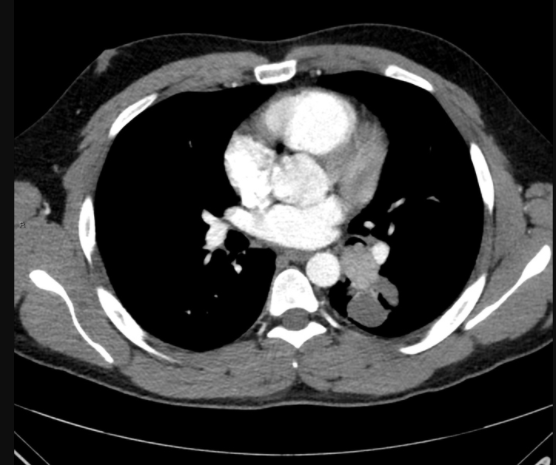
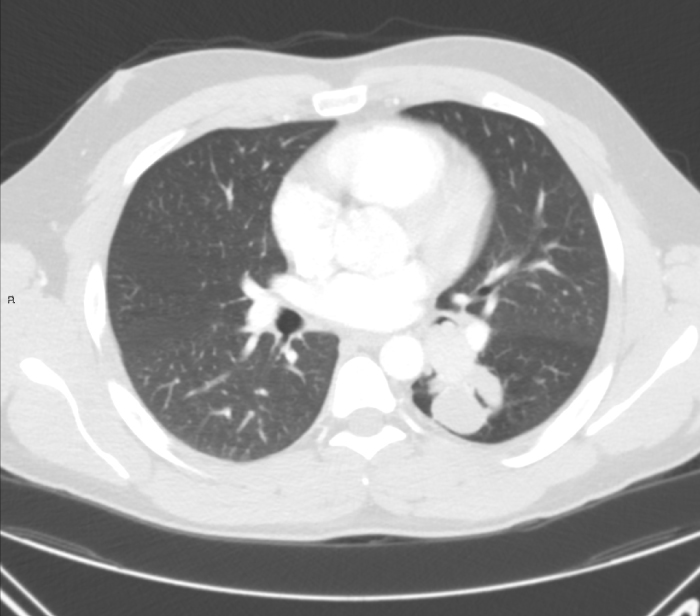 with an endobronchial component at the left hilum. What is the most likely diagnosis in this patient?
 (Multiple Choice)
4.7/5 (78)
(78) A 28-year-old primigravid woman at 40 weeks gestation is hospitalized for induction of labor. She has no chronic medical conditions, and her pregnancy has been uncomplicated. Intravaginal misoprostol is administered for cervical ripening followed by intravenous infusion of oxytocin. Progressive uterine contractions are achieved, and the fetal heart rate tracing is reassuring. Patient-controlled bupivacaine via an epidural catheter is started for pain control. Twenty minutes later, the patient experiences perioral numbness, a metallic taste in her mouth, and tinnitus. She also reports feelings of anxiety and palpitations but has no headache or visual disturbances. Blood pressure is 150/86 mm Hg and pulse is 110/min. Physical examination reveals normal deep tendon reflexes and no clonus. While being examined, the patient has a generalized tonic-clonic seizure. Which of the following is the most likely cause of this patient's seizure?
(Multiple Choice)
4.7/5 (61)
(61) A 62-year-old woman comes to the office due to 6 weeks of malaise and intermittent fever. She has also had decreased appetite and unintentional weight loss but no bowel or bladder symptoms. The patient has a history of type 2 diabetes mellitus and hypertension, and 10 years ago she underwent total hysterectomy and bilateral salpingo-oophorectomy for early stage endometrial cancer. She has smoked a pack of cigarettes daily for 30 years and does not drink alcohol. She works as an accountant. Temperature is 37.9 C (100.2 F), blood pressure is 140/90 mm Hg, pulse is 90/min, and respirations are 16/min. On examination, she appears thin and pale. A hard mass is palpated over the right flank area. There is no abdominal tenderness, and bowel sounds are normal. The liver and spleen are not enlarged. No lymphadenopathy is present. Laboratory results are as follows:  Which of the following is the most likely diagnosis in this patient?
 (Multiple Choice)
4.9/5 (80)
(80) A 23-year-old man is brought to the emergency department after a motor vehicle collision. The patient was found unresponsive at the scene and intubated by the paramedics, who also administered 2 L of normal saline. He was the unrestrained driver. Upon arrival, blood pressure is 72/54 mm Hg, and pulse is 120/min. The patient responds to strong vocal and tactile stimuli by opening his eyes. Pupils are equal and reactive to light. Neck veins are distended. There are multiple bruises involving the anterior chest and upper abdomen. Chest x-ray reveals a small, left-sided pleural effusion and normal cardiac contours. Which of the following is the most likely diagnosis?
(Multiple Choice)
4.8/5 (85)
(85) A 67-year-old male comes to the clinic for medical clearance prior to an elective abdominal aortic aneurysm repair. He denies any cough, shortness of breath or chest pain. He has coronary artery disease, diabetes and hypertension. He does not use tobacco, alcohol or drugs. His blood pressure is 120/76 mm Hg, pulse is 60/min, and respirations are 14/min. Examination shows no abnormalities, except prominent epigastric pulsations. Which of the following interventions would be most helpful in preventing postoperative pneumonia in this patient?
(Multiple Choice)
4.9/5 (78)
(78) A 31-year-old motorcyclist is brought to the emergency department after a collision in which he had a direct blow to his lower abdomen and pelvis. Blood pressure is 110/80 mm Hg, pulse is 102/min, and respirations are 18/min. The airway is intact, and breath and heart sounds are normal. There is suprapubic tenderness to palpation with bruising. Chest x-ray reveals no fractures. Pelvic x-ray shows widening of the pubic symphysis. Focused Assessment with Sonography for Trauma reveals intraperitoneal free fluid. Urine dipstick test is positive for blood. Which of the following is the best next step in management of this patient?
(Multiple Choice)
4.8/5 (69)
(69) A 62-year-old woman comes to the emergency department due to a 2-day history of right knee pain and swelling. In the past, the patient has occasionally had knee pain brought on by physical activity, but the current episode is more severe and persistent. She has had difficulty bending the knee or bearing weight; NSAIDs have provided minimal relief. The patient's other medical conditions include hypertension, type 2 diabetes mellitus, chronic kidney disease, and diabetic foot ulcers. Temperature is 38.4 C (101.1 F), blood pressure is 142/84 mm Hg, and pulse is 104/min. On physical examination, the right knee is swollen, warm, and erythematous with limited active and passive range of motion. The left knee appears normal, but there is mild crepitus on movement. X-rays of the right knee reveal subcutaneous edema, joint effusion, and degenerative changes. Right knee arthrocentesis yields 5 mL of cloudy fluid with a leukocyte count of 55,000/mm3, of which 95% are polymorphonuclear cells. No bacteria or crystals are visualized. Cultures of the synovial fluid are sent, and empiric antibiotics are begun. Which of the following additional interventions are most appropriate in management of this patient?
(Multiple Choice)
4.8/5 (78)
(78) A 65-year-old man with knee osteoarthritis is admitted to a busy hospital due to an elective left knee arthroplasty. The operating room is running behind schedule, and the patient's case is delayed by 2 hours. Because of the delay, the surgeon is assigned a new operating room, circulating nurse, and supporting surgical team. When verifying this patient's planned operation, which of the following practices is most recommended to promote patient safety?
(Multiple Choice)
5.0/5 (67)
(67) A 32-year-old woman comes to the office due to a "mole." The lesion is located on her back, and she believes it has been present for years but does not recall when it first appeared. The patient thinks it might be enlarging and is concerned due to a family history of skin cancer. The lesion is not painful and does not itch or bleed. She has fair skin and a history of severe sunburns in childhood. Medical history is unremarkable, and she does not use tobacco, alcohol, or illicit drugs. Vital signs are normal. Skin examination shows a few scattered benign-appearing nevi and a single prominent lesion at her right scapular area. Which of the following additional skin examination findings would be most concerning for malignancy?
(Multiple Choice)
4.9/5 (77)
(77) A 19-year-old woman comes to the clinic due to recurrent headaches. The patient has had headaches for years but thinks they have recently gotten worse; they last several hours and remit spontaneously or after taking over-the-counter acetaminophen. She has no nausea, vomiting, abdominal pain, sweating, or fever. Six months ago, the patient checked her blood pressure at a local pharmacy and was told it was high. She has no other medical issues and takes no prescription medications. Her family history is significant for hypertension and diabetes. Blood pressure is 175/100 mm Hg on the right arm and 170/102 mm Hg on the left arm, pulse is 80/min, and respirations are 14/min. On examination, she appears comfortable and cooperative. Peripheral pulses are full and symmetric. Chest examination is unremarkable. A systolic bruit is heard under the right ear. Abdominal examination shows no tenderness or masses. Which of the following is the most likely cause of this patient's hypertension?
(Multiple Choice)
4.9/5 (75)
(75) A 44-year-old man who has had an extensive small bowel resection for Crohn disease has been on total parenteral nutrition for two years. He presented to the hospital with epigastric and right upper quadrant pain. His vital signs are within normal limits. Physical examination shows mild right upper quadrant tenderness. An ultrasonogram shows several gallstones; an ultrasonogram performed two years ago did not demonstrate gall stones. Which of the following is the most likely cause of his gallstones?
(Multiple Choice)
4.9/5 (65)
(65) A 22-year-old man comes to the office due to intermittent right knee pain that has been increasing for the past 8 weeks. The pain began after the patient participated in a recreational soccer tournament, but he does not recall any significant injuries. He has intermittent, moderate pain associated with a sensation of "catching" in the knee while walking. At times he is unable to completely extend the knee. The patient also had swelling at the joint several days after the pain began, but the swelling slowly resolved. The symptoms affect his daily routine, especially outdoor activities, which he has not done since the injury. He has taken over-the-counter acetaminophen with inconsistent relief. On examination, his gait is grossly normal. There is full, pain-free range of motion of the knee with no erythema, warmth, or swelling. No ligamentous laxity is found with varus or valgus stress, or with anterior or posterior traction on the lower leg. With the knee held in internal and external rotation, flexion and extension at the knee elicits moderate pain and crepitus. X-ray of the knee is normal. Which of the following is the best next step in management of this patient?
(Multiple Choice)
4.7/5 (97)
(97) 
Filters
- Essay(0)
- Multiple Choice(0)
- Short Answer(0)
- True False(0)
- Matching(0)