



 Chat with AI
Exam 4: Surgery

Exam 1: Medicine2 k Questions
Exam 2: Pediatric723 Questions
Exam 3: Psychiatry336 Questions
Exam 4: Surgery563 Questions
Exam 5: Obstetrics & Gynecology469 Questions
Select questions type


A 50-year-old woman comes to the office for an annual wellness check. The patient is asymptomatic and feels well. She follows a high-fiber diet and eats red meat once a week. The patient drinks at least 3 cups of coffee a day. Medical history is significant for obesity, type 2 diabetes mellitus, osteoarthritis, and cervical intraepithelial neoplasia treated with surgical excision. In addition to insulin, the patient takes ibuprofen every day for knee pain. Family history is unremarkable. She does not use tobacco, alcohol, or illicit drugs. Vital signs are within normal limits. BMI is 35 kg/m2. Cardiopulmonary and abdominal examinations are unremarkable. The patient is referred for a screening colonoscopy, which reveals a large villous adenoma within the ascending colon. Which of the following is the greatest risk factor predisposing this patient to this abnormality?
(Multiple Choice)
4.7/5  (86)
(86) A previously healthy 19-year-old man comes to the emergency department (ED) due to persistent abdominal discomfort. The patient previously came to the ED 3 days ago after he fell while mountain biking. He did not lose consciousness and recalls hitting the handlebars prior to flipping and landing on his back. His trauma workup-which included CT scan of the chest, abdomen, and pelvis-was negative, and he was discharged. Since then, the patient has had persistent upper abdominal discomfort and nausea, along with an episode of nonbilious emesis. Temperature is 38.1 C (100.6 F), blood pressure is 104/62 mm Hg, and pulse is 108/min. The lungs are clear to auscultation, and heart sounds are normal. Ecchymosis is present across the upper abdomen, which is tender to palpation with voluntary guarding. Bowel sounds are decreased. Bedside ultrasonography reveals a large amount of free fluid in the upper abdomen. Which of the following is the most likely cause of this patient's condition?
(Multiple Choice)
5.0/5 (97)
(97) A 53-year-old man comes to the office due to right-sided lateral hip pain that makes it difficult for him to lie on that side while sleeping. He describes the pain as burning and localizes it to the outer surface of his thigh. Because the patient has not been able to sleep well due to the pain, he now feels fatigued. The pain has recently occurred during the day and is worse with activity and prolonged standing. The patient has no other medical conditions and takes no medications. Vital signs are within normal limits. BMI is 37 kg/m2. Physical examination shows tenderness over the lateral aspect of the right hip and buttock with deep palpation. Neurologic examination shows no abnormalities. Which of the following is the most likely cause of this patient's pain?
(Multiple Choice)
4.8/5 (71)
(71) A 62-year-old woman comes to the office for evaluation of a pigmented lesion on her left forearm. She first noticed the lesion 4 months ago and says it occasionally itches but is otherwise asymptomatic. The patient also has numerous "freckles" that she attributes to playing golf during the summer. Medical history includes psoriasis, hypertension, and mild chronic obstructive pulmonary disease. She quit smoking 5 years ago and drinks 2 or 3 glasses of wine a week after golfing. On examination, there is a 5-mm, dark brown lesion at the dorsal surface of her distal left forearm; it has a smooth border and a small, eccentric nodule. In addition, multiple scattered, flat, light brown lesions are present on the nose, cheeks, and dorsal surface of the hands. Which of the following is the most appropriate next step in management of this patient's forearm lesion?
(Multiple Choice)
4.7/5 (86)
(86) A 16-year-old boy comes to the emergency department due to a dirt bike collision. Trauma evaluation reveals a femur fracture, and the patient undergoes open reduction and internal fixation. He receives a packed red blood cell transfusion postoperatively. Five minutes after the transfusion begins, the patient acutely develops chills and severe flank pain. Temperature is 39.1 C (102.4 F), blood pressure is 88/40 mm Hg, pulse is 130/min, and respirations are 30/min. Physical examination shows bleeding around the intravenous catheter site. Breath sounds are normal. Which of the following is the most likely cause of this patient's transfusion reaction?
(Multiple Choice)
4.9/5 (90)
(90) A 26-year-old, previously healthy man is brought to the emergency department after a high-speed motor vehicle collision. He became obtunded in the field and required intubation by the paramedics. The patient also received 2 L of crystalloid on the way to the hospital. On arrival, blood pressure is 88/52 mm Hg and pulse is 128/min. Physical examination shows multiple contusions, including to the left side of the forehead, left arm, chest, abdomen, and pelvis, but there is no external hemorrhage. The trachea is midline. Breath sounds are present bilaterally and heart sounds are normal. The abdomen is nondistended and soft to palpation. Muscle tone is normal. Focused Assessment with Sonography for Trauma shows no pericardial or intraperitoneal free fluid. Which of the following is the most likely cause of this patient's hemodynamic instability?
(Multiple Choice)
4.9/5 (78)
(78) A 22-year-old man involved in a motor vehicle collision undergoes a prolonged surgery to repair a left tibial fracture and popliteal artery injury. The day after surgery he has increasing pain in the left leg and is treated with intravenous fluids and morphine. Two hours later, the patient continues to have pain that worsens with passive leg movement and has a "pins and needles" sensation. Examination shows tense, tender swelling of the left calf. There is sensory loss between the great and second left toes. The lower-extremity pulses are palpable bilaterally. Which of the following is the most important next step in management of this patient?
(Multiple Choice)
4.8/5 (80)
(80) A 25-year-old man comes to the office for evaluation of a painless mass in his mouth. The patient has had the mass for many years and has had no growth or other changes in the mass over that time. He has had occasional sinus infections and was in a motor vehicle accident several years ago in which he sustained a concussion, but he is otherwise healthy. The patient smokes a pack of cigarettes a day and drinks 2 or 3 alcoholic beverages on the weekends. Vital signs are normal. Examination of the mass is seen below: 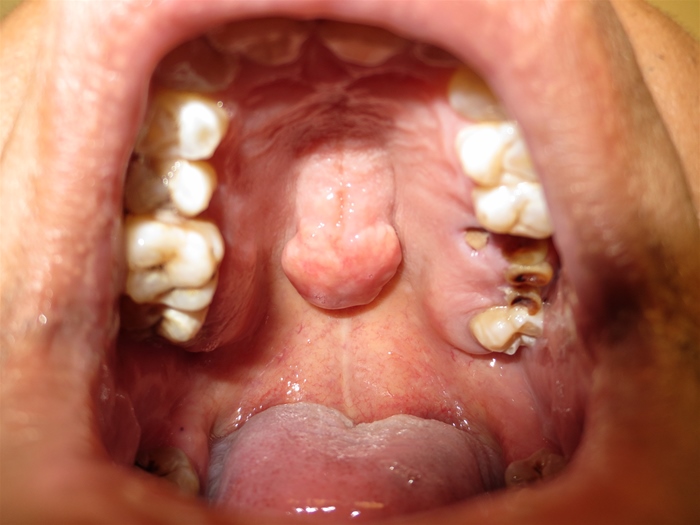 The mass is immobile, nontender, and has a hard consistency. The maxillary and frontal sinuses are nontender, and there is no cervical lymphadenopathy. Which of the following is the most likely cause of this patient's mass?
 (Multiple Choice)
4.7/5 (78)
(78) A 67-year-old man comes to the emergency department due to abdominal discomfort and distension. Five days ago, he began having large-volume watery stools 6-8 times daily after eating at a new restaurant. He also has had associated mild abdominal cramps and nausea but no fever, chills, vomiting, or bloody stools. His wife, who had the same food, also experienced similar symptoms. He self-treated with increased oral fluids and the stool frequency and consistency began to improve. However, his bowel movements abruptly stopped yesterday, and the diffuse abdominal discomfort and distension worsened. Medical history includes hypertension, coronary artery disease, and heart failure treated with diuretics. Temperature is 37 C (98.6 F), blood pressure is 116/72 mm Hg, and pulse is 102/min. Physical examination shows dry mucous membranes. The abdomen is distended, tympanic, and mildly tender to palpation with no guarding or rebound tenderness. Bowel sounds are decreased. Digital rectal examination reveals an empty rectal vault with no evidence of blood or melena. Abdominal CT scan shows diffuse colonic dilation with nondilated small bowels. Leukocyte count is normal and testing for Clostridioides (formerly Clostridium) difficile is negative. Which of the following most likely contributed to this patient's current condition?
(Multiple Choice)
4.8/5 (64)
(64) A 65-year-old man has a cardiac arrest in a shopping mall. Resuscitation is initiated in the field, and the patient is successfully defibrillated. In the emergency department, he is found to have ST segment elevations in the inferior leads and then has an episode of sustained ventricular tachycardia that is treated with intravenous amiodarone. The patient is taken to the cardiac catheterization lab and is found to have a thrombotic occlusion of the right coronary artery, which is successfully treated with percutaneous coronary intervention. On the second day of hospitalization he demonstrates full neurologic recovery and is asymptomatic. Laboratory results are as follows:  The patient's laboratory results were within normal limits 1 week prior to admission. Which of the following is the most likely cause of the new findings?
 (Multiple Choice)
4.9/5 (78)
(78) A 34-year-old man is brought to the emergency department following a high-speed motor vehicle collision. He was found lying outside the car and was intubated by the paramedics. Upon arrival, the patient has absent breath sounds in the right chest, normal breath sounds in the left chest, and hypotension. A right-sided chest tube is placed, resulting in a loud rush of air. Physical examination reveals multiple bruises over the anterior chest wall, with crepitus on palpation. The patient is initially stabilized. Over the next hour, the patient's oxygen saturation progressively declines. Repeat chest x-ray reveals appropriate endotracheal and chest tube placement, reaccumulation of air in the right pleural space, pneumomediastinum, and increased subcutaneous emphysema. Which of the following is the most likely diagnosis?
(Multiple Choice)
4.9/5 (85)
(85) A 34-year-old man is brought to the emergency department after being involved in a motor vehicle collision. He was a restrained driver and used his arm to brace the impact. The patient has severe pain in his right arm. Vital signs are within normal limits. Examination shows a deformed right upper arm that appears shorter than the left. The midportion of the right arm is swollen and tender. He has limited extension at the wrist joint and decreased sensation over the dorsoradial aspect of the right hand. Radial pulse is 1+ on the right and 2+ on the left. An x-ray of the arm shows an oblique fracture of the midshaft of the right humerus. Which of the following is the best next step in management of this patient?
(Multiple Choice)
4.8/5 (75)
(75) A 62-year-old woman comes to the office due to a skin lesion. For the last 6 weeks, she has noticed a slowly enlarging nodule on the back of the neck; it is not associated with pain, itching, or discharge. Medical history is unremarkable. The patient has worked for the last 30 years as a landscape designer. Examination reveals a 7-mm lesion, as shown in the exhibit. 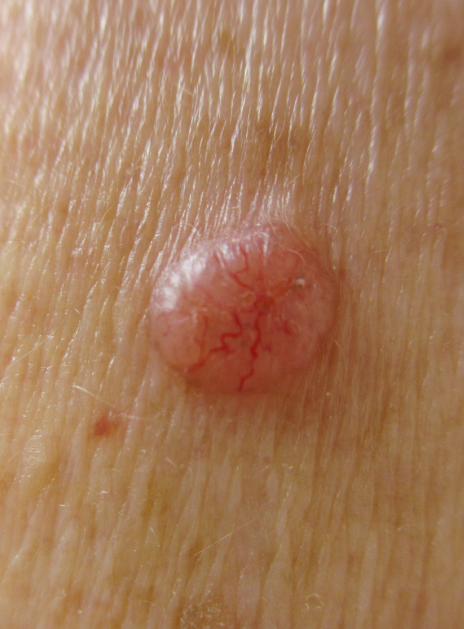 Which of the following is the most appropriate next step in management of this patient's lesion?
 (Multiple Choice)
4.9/5 (81)
(81) A 58-year-old previously healthy woman comes to the emergency department due to wrist pain after a fall. The patient was walking her dog when it suddenly ran toward a squirrel, pulling her to the ground. She tried to brace herself with her outstretched hand and injured the wrist. Physical examination shows a gross deformity of the wrist with extensive swelling and bruising. Distal pulses and testing for capillary refill are normal. The patient had no sensory symptoms initially but developed paresthesia in the affected hand while in the emergency department. X-ray results are shown below: 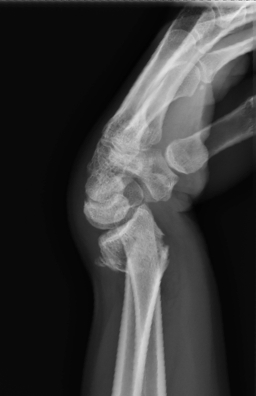 Which of the following is most likely to be abnormal due to associated nerve injury in this patient?
 (Multiple Choice)
5.0/5 (83)
(83) A 34-year-old man comes to the office due to intermittent dizziness over the past 3 months. The patient has had episodes of a sudden spinning sensation, accompanied by nausea, that resolve spontaneously after approximately a minute. Symptoms occur when he is lifting heavy weights, riding on an elevator, or after sneezing. He has had no headache or ear pain but has trouble hearing out of the right ear. The patient had a concussion after a bicycle collision 4 months ago but has no other medical conditions and has had no recent upper respiratory illness. Vital signs are within normal limits. Physical examination shows normal ears, including tympanic membranes. There is no extremity weakness or sensory loss. No nystagmus is present at rest but performing a Valsalva maneuver provokes nystagmus and the other reported symptoms. Which of the following is the most likely diagnosis?
(Multiple Choice)
4.9/5 (81)
(81) A 55-year-old man comes to the hospital due to exertional dyspnea and orthopnea for 24 hours. A week ago, the patient underwent coronary artery bypass surgery for exertional chest pain and was discharged in stable condition. He started physical therapy but had to stop due to dyspnea. He has no cough but is unable to sleep well. Prior to surgery, the patient never had respiratory difficulty. He has a 20-pack-year smoking history but quit just before the surgery. Temperature is 37 C (98.6 F), blood pressure is 120/80 mm Hg, pulse is 88/min, and respirations are 18/min. Oxygen saturation is 95% on room air. Examination shows normal jugular venous pressure, clear lung sounds, and normal heart sounds. The sternal wound is clean and dry. When the patient is placed supine on the examination table, he reports worsening dyspnea and has paradoxical movement of the abdomen during inspiration. There is no peripheral edema. Neurologic examination is normal. What is the most likely cause of this patient's symptoms?
(Multiple Choice)
4.8/5 (76)
(76) A 52-year-old man comes to the clinic for follow-up of a nonhealing wound on his right leg. Eight months ago, the patient had an open fracture of his right tibia due to a motorcycle accident. His injury was surgically treated, and for 2 weeks afterward he had occasional fevers that resolved with a course of antibiotics. For the past month, he has had clear drainage from the wound, which has required daily changing of the dressing. The patient has type 2 diabetes mellitus, which is treated with insulin, and hypertension. On examination, there is a chronic wound, and the overlying dressing contains a scant amount of serosanguinous fluid. There is pain at the fracture site and the patient is unable to bear full weight on the leg. Dorsiflexion of the ankle causes minimal discomfort. Pedal pulses are palpable. X-ray of the leg is shown in the exhibit.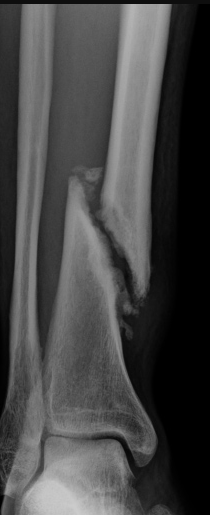 Which of the following is the best next step in the management of this patient's condition?
 (Multiple Choice)
4.8/5 (74)
(74) A 32-year-old man comes to the emergency department with intense, midline chest pain and diaphoresis of 4 hours duration. Prior to the onset of pain, he developed nausea and recurrent vomiting after returning from a party. His medical conditions include HIV infection, alcohol use disorder, and alcoholic hepatitis. The patient uses cocaine regularly and does not take his medications regularly. Temperature is 38.3 C (101 F), blood pressure is 100/60 mm Hg, pulse is 120/min, and respirations are 28/min. Examination shows injected conjunctivae and bilateral dilated pupils. Breath sounds are present on the right but diminished on the left. Heart sounds are normal. Chest x-ray demonstrates a widened mediastinum and moderate left-sided pleural effusion. ECG shows sinus tachycardia. The pleural fluid is found to be a yellow exudate with high amylase content. Which of the following is the most likely diagnosis in this patient?
(Multiple Choice)
4.8/5 (80)
(80) A 59-year-old woman is brought to the emergency department after falling from a standing height. The patient became lightheaded after rising quickly from bed and fell sideways. She struck her left posterior chest against the nightstand but did not hit her head or lose consciousness. The patient now has left-sided chest and shoulder pain, which is worse with deep breathing. Blood pressure is 102/54 mm Hg, pulse is 114/min, and respirations are 20/min. Oxygen saturation is 96% on room air. On examination, the patient is alert and mildly diaphoretic. The trachea is midline and neck veins are flat. Exquisite tenderness and a palpable step-off are present over the left lower ribs posteriorly. Bilateral breath sounds are normal. Heart sounds are unremarkable. The extremities have symmetric strength and no gross deformities. Chest x-ray reveals displaced fractures of the posterior ninth and tenth ribs. Which of the following is the best next step in management of this patient?
(Multiple Choice)
4.9/5 (76)
(76) A 38-year-old man comes to the office with a 6-week history of progressive right hip pain. He localizes the pain to the right groin and says that it is present at rest and worse with weight bearing. The patient has no history of trauma and has not had similar symptoms before. Medical history is notable for sarcoidosis, which has required extended courses of oral glucocorticoids. His temperature is 37.2 C (98.9 F) and blood pressure is 156/86 mm Hg. On examination, the patient's face is round and there is fullness in the supraclavicular area. Forced abduction and internal rotation of the femur aggravate the pain. Muscle power is slightly decreased in the proximal thigh muscles in both legs. Reflexes are 2+ throughout, and there are no sensory deficits. Plain films of the right hip show no significant abnormalities. Which of the following is the most likely cause of this patient's hip pain?
(Multiple Choice)
4.8/5 (90)
(90) 
Filters
- Essay(0)
- Multiple Choice(0)
- Short Answer(0)
- True False(0)
- Matching(0)