



 Chat with AI
Exam 4: Surgery

Exam 1: Medicine2 k Questions
Exam 2: Pediatric723 Questions
Exam 3: Psychiatry336 Questions
Exam 4: Surgery563 Questions
Exam 5: Obstetrics & Gynecology469 Questions
Select questions type


A 43-year-old man comes to the hospital following 24 hours of increasing pain in the lower abdomen, scrotum, and perineum. He also has experienced malaise and nausea. He has had no abdominal surgeries or recent perianal or scrotal trauma. The patient has a history of morbid obesity, hypertension, type 2 diabetes mellitus, hypercholesterolemia, and heart failure with preserved systolic function. Temperature is 39.7 C (103.5 F), blood pressure is 80/60 mm Hg, pulse is 112/min, and respirations are 18/min. Pulse oximetry shows 96% on room air. BMI is 47 kg/m2. The patient appears ill and uncomfortable. There is no jugular venous distension. Lungs are clear to auscultation. Heart sounds are normal. The skin over the lower abdomen, scrotum, and perineum is tense, tender, erythematous, and swollen with evidence of crepitus. Mild, bilateral, lower extremity edema is present. Laboratory results are as follows: 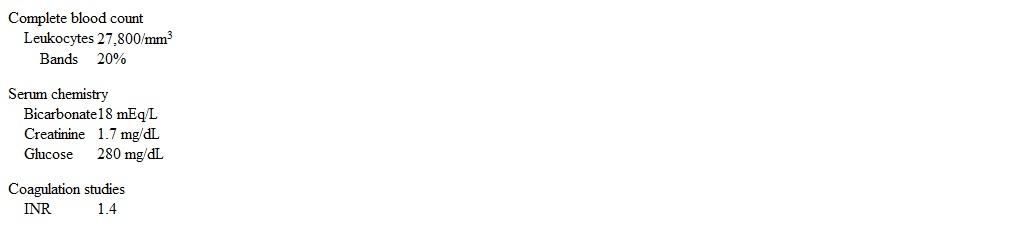 Blood cultures are obtained, and intravenous fluids and antibiotics are initiated. Which of the following is the best next step in management of this patient?
 (Multiple Choice)
4.8/5  (67)
(67) A 46-year-old man is hospitalized after a motorcycle collision. The patient was thrown several feet and was found unconscious by the emergency medical team. On arrival at the emergency department, blood pressure is 160/100 mm Hg, pulse is 58/min, and respirations are 10/min and irregular. The patient does not answer questions or open his eyes to voice or touch. He withdraws all extremities to pain but has no purposeful movements. Pupils are symmetric and sluggish. Bilateral breath sounds are normal. There are abrasions on the face and extremities. Endotracheal intubation is performed for airway protection. Imaging of the head and cervical spine shows no intracranial hematomas, fractures, or dislocations, but diffuse cerebral edema is present. Which of the following is the best initial intervention for reducing intracranial pressure in this patient?
(Multiple Choice)
5.0/5 (66)
(66) A 38-year-old woman comes to the office due to abdominal bloating, excessive flatulence, and diarrhea over the past 3 months. She has 4 or 5 nonbloody, loose stools a day, including at night. The patient has a history of obesity and lost 30 kg (66 lb) after undergoing Roux-en-Y gastric bypass surgery 3 years ago. She takes multiple vitamin supplements daily but has not taken antibiotics recently. The patient has not traveled recently or been exposed to anyone with diarrheal illness. Temperature is 37 C (98.6 F), blood pressure is 130/84 mm Hg, and pulse is 78/min. BMI is 28 kg/m2. Abdominal examination shows no abnormalities. Which of the following is the most likely cause of this patient's symptoms?
(Multiple Choice)
4.7/5 (86)
(86) A 52-year-old woman comes to the office for follow-up a week after undergoing right breast partial mastectomy and right axillary sentinel lymph node biopsy. She was recently diagnosed with invasive ductal carcinoma after mammography detected a hyperdense lesion in the right breast. Vital signs are normal. The right breast and axilla have mild, but appropriate, swelling; incisions are clean and intact, without erythema. Surgical pathology reveals completely excised invasive ductal carcinoma; ductal carcinoma in situ is present at the specimen's lateral margin. The tumor is estrogen receptor-, progesterone receptor-, and HER2-negative. The axillary sentinel lymph node is negative for metastasis. Which of the following is the best next step in management of this patient's breast cancer?
(Multiple Choice)
4.9/5 (82)
(82) A 64-year-old man comes to the emergency department due to 2 days of fevers, chills, and positional chest pain. Medical history is significant for type 2 diabetes mellitus, hypertension, and end-stage kidney disease. The patient undergoes hemodialysis 3 times a week but missed his last session because he did not feel well. Temperature is 39.2 C (102.6 F), blood pressure is 100/60 mm Hg, pulse is 130/min and irregular, and respirations are 20/min. The patient appears unwell and uncomfortable. Examination shows clear lungs, distant heart sounds, no heart murmurs, and minimal lower extremity edema. The dialysis catheter site appears clean without erythema or purulence. The remainder of the examination shows no abnormalities. Blood leukocytes are 25,000/mm3 with 80% neutrophils. ECG shows atrial fibrillation with rapid ventricular response and low-amplitude QRS complexes. Chest x-ray reveals normal lung fields. Bedside echocardiography reveals normal left and right ventricular function, no significant valvular disease, and a moderate pericardial effusion with no evidence of tamponade. Blood cultures are obtained, and broad-spectrum antibiotics are administered. Which of the following is the most appropriate next step in management?
(Multiple Choice)
4.9/5 (87)
(87) A 36-year-old man comes to the office due to pain and drainage under his right arm for the past week. For the past 5 years, the patient has had similar symptoms in both axillae. He initially had painful nodules that regressed spontaneously within 1-2 weeks. However, the lesions eventually progressed to thickened scars and openings that intermittently drained malodorous, seropurulent material. Medical history is unremarkable, and the patient takes no medications. Vital signs are normal. BMI is 36 kg/m2. Examination is shown in the exhibit. 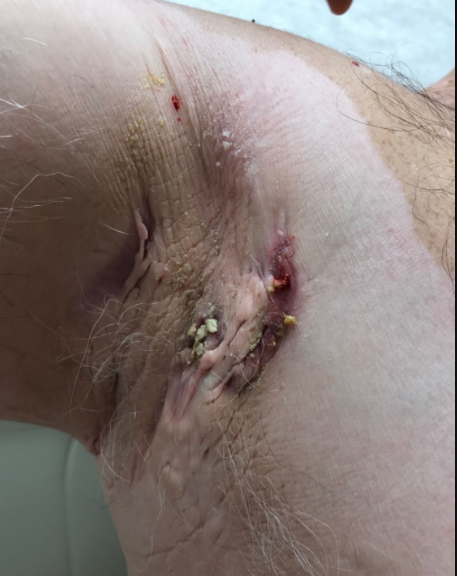 There is no fluctuance or lymphadenopathy to palpation. Which of the following is the most appropriate next step in management of this patient?
 (Multiple Choice)
4.8/5 (96)
(96) A 36-year-old woman comes to the emergency department with worsening fever and sore throat. Four days ago, the patient accidentally swallowed a fish bone that scratched her throat and caused some discomfort. She felt better after some time and did not seek medical attention, but for the past 2 days she has had severe sore throat and difficulty swallowing. The patient also reports neck pain and stiffness. Her temperature is 39 C (102.2 F), blood pressure is 126/80 mm Hg, and pulse is 106/min. Examination shows pooling of saliva in the hypopharynx. The posterior pharyngeal wall is red and bulging. The neck is stiff with reduced passive range of motion. Lung auscultation is normal. Lateral radiographs of the neck reveal increased thickness of the prevertebral soft tissues with an air-fluid level. Due to potential contiguous spread of the disease process, this patient is at greatest risk of developing which of the following?
(Multiple Choice)
4.8/5 (76)
(76) A 72-year-old man underwent surgical repair of an aneurysm of the infrarenal aorta. He received perioperative prophylaxis with a second-generation cephalosporin antibiotic. On the first postoperative day he complains of progressive abdominal pain and bloody diarrhea. His temperature is 38.5° C (101° F), blood pressure is 110/65 mm Hg, pulse is 110/min and respirations are 22/min. His abdomen is mildly distended and tender to palpation. The tenderness is mostly in the left lower quadrant without rebound. Femoral pulses are full and symmetric. His white blood cell count is 12,000/mm3. Which of the following is the most likely diagnosis?
(Multiple Choice)
4.7/5 (79)
(79) A 45-year-old, nulligravid woman comes to the office for intermittent nipple discharge. For the past month, the patient has had spontaneous discharge from her left breast. She has felt no breast masses or breast pain, but she did have trauma to the breast from a skiing accident 3 months ago. Review of systems is otherwise negative. The patient has hypothyroidism for which she takes levothyroxine. Family history is unremarkable. She does not use tobacco, alcohol, or illicit drugs. Blood pressure is 126/82 mm Hg and pulse is 70/min. BMI is 28 kg/m2. Physical examination shows no palpable breast masses. There is dried blood on the left nipple, and a serosanguineous discharge is expressed. Examination of the right breast is unremarkable. There is no axillary lymphadenopathy. Mammography shows no masses or calcifications. Which of the following is the most likely cause of this patient's presentation?
(Multiple Choice)
4.8/5 (80)
(80) A 43-year-old woman comes to the emergency department due to nausea, dizziness, and headache for a day. Her menses began 2 days ago. She has occasionally had fatigue and dizziness during her menstrual periods, but today's symptoms feel different. The patient has a history of von Willebrand disease, causing recurrent, heavy menstrual blood loss, and is scheduled for an endometrial ablation procedure. Her only medication is intranasal desmopressin taken on the first 3 days of her menstrual period. Temperature is 36.9 C (98.4 F), blood pressure is 120/80 mm Hg, pulse is 92/min and regular, and respirations are 18/min. The patient appears restless. Mucous membranes are moist. Deep tendon reflexes are 2+ throughout and Babinski sign is absent. Sensory examination shows no focal deficits. The chest is clear to auscultation. The abdomen is soft and nontender. There is no peripheral edema. The remainder of the examination is unremarkable. Which of the following is the most appropriate next step in management?
(Multiple Choice)
4.8/5 (70)
(70) A 16-year-old girl is brought to clinic for vision follow-up. The patient has myopia that was diagnosed at age 8. She wears corrective lenses, and her prescription has progressed yearly. The patient has no other chronic medical conditions and takes no daily medications. Vital signs are normal. Examination shows equal pupillary reflexes. Visual acuity is 20/50 bilaterally with current lenses. Refraction testing results in a lens prescription of −9 diopters sphere in the right eye and −8.75 diopters sphere in the left eye. This patient is at increased risk for which of the following complications?
(Multiple Choice)
4.8/5 (69)
(69) A 25-year-old man is brought to the emergency department after he fell headfirst down a flight of stairs while intoxicated. According to friends who witnessed the fall, the patient landed on his head but did not lose consciousness. On arrival, blood pressure is 128/78 mm Hg, pulse is 92/min, and respirations are 12/min. The patient smells of alcohol and is somnolent but can follow simple commands. There are facial abrasions. A rigid cervical collar is in place. Bilateral breath sounds are normal with no chest tenderness. Heart sounds are normal. The abdomen is soft and nontender. The patient is moving all extremities spontaneously. He states that he is uncomfortable due to the cervical collar and requests that it be removed. Which of the following is the best immediate step for evaluating and ruling out cervical spine injury in this patient?
(Multiple Choice)
4.8/5 (74)
(74) A 65-year-old man is found to have a lung nodule on chest x-ray performed for evaluation of a dry cough. The cough has since resolved, and he has no other symptoms. The patient has a 30-pack-year smoking history but quit 2 years ago. He has no family history of cancer. CT scan of the chest reveals a 2-cm, peripheral, round lesion in the right lower lung lobe that is surrounded by lung parenchyma. The borders are irregular and no calcification is present. There are no other lung lesions or enlarged lymph nodes. Which of the following is the best next step in management of this patient's lung lesion?
(Multiple Choice)
4.9/5 (86)
(86) A 65-year-old man with exertional chest pain and an abnormal exercise stress test comes to the hospital for elective cardiac catheterization. The patient has no resting chest pain or shortness of breath. He has no known allergies. Temperature is 37 C (98.6 F), blood pressure is 130/78 mm Hg, pulse is 84/min, and respirations are 15/min. Pulse oximetry shows an oxygen saturation of 98% on room air. Examination shows normal jugular venous pressure, clear lungs without crackles, normal heart sounds, no murmurs, and a normal capillary refill time. Ten minutes after the first injection of iodinated contrast during cardiac catheterization, the patient reports chest pain, abdominal pain, and dizziness; then he suddenly becomes obtunded and flushed. Blood pressure is 70/36 mm Hg, pulse is 128/min, and respirations are 32/min. Pulse oximetry shows an oxygen saturation of 90% on 2 L of oxygen via nasal cannula. Which of the following hemodynamic changes are most likely present in this patient at this time?
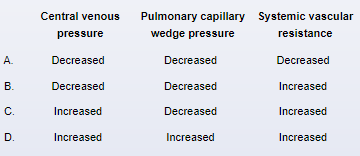
(Multiple Choice)
5.0/5 (91)
(91) A 38-year-old man is evaluated for tachypnea. The patient, a construction worker, fell off a roof while working yesterday. He sustained an open femur fracture, which required urgent operative repair. Medical history includes chronic low back pain for which he has been taking opioids. Temperature is 36.7 C (98.1 F), blood pressure is 130/90 mm Hg, pulse is 110/min, and respirations are 30/min. Pulse oximetry is 99%. On physical examination, the lungs are clear to auscultation. Heart sounds are regular. The abdomen is soft and nontender to palpation. Arterial blood gas while the patient is breathing room air shows the following:  Which of the following best explains the laboratory findings in this patient?
 (Multiple Choice)
4.9/5 (91)
(91) A 55-year-old man comes to the office due to progressive abdominal distension for the past 2 months. He reports that his abdomen has become so large that his clothes no longer fit. Temperature is 37.5 C (99.5 F), blood pressure is 152/87 mm Hg, pulse is 80/min, and respirations are 18/min. The abdomen is grossly enlarged and nontender. Shifting dullness is present. Trace pitting edema is identified in the bilateral lower extremities. Paracentesis reveals bloody ascitic fluid. Repeat paracentesis from another site yields similar bloody fluid. Which of the following is most likely responsible for this patient's presentation?
(Multiple Choice)
4.9/5 (74)
(74) A 75-year-old man comes to the office due to right-sided abdominal pain. He has also experienced progressive fatigue and an unintentional weight loss of 7 kg (15.4 lb) in the past 2 months. He previously refused to undergo colon cancer screening. Medical and family history are unremarkable. Temperature is 37.4 C (99.3 F), blood pressure is 140/80 mm Hg, and pulse is 80/min. Mucosal pallor is present. There is no palpable lymphadenopathy, and cardiopulmonary examination is unremarkable. The abdomen is soft and mildly tender in the right flank area. Abdominal CT scan reveals a large tumor in the right colon with near obstruction of the colonic lumen as well as a 2.1-cm mass in the right hepatic lobe. Liver biopsy of the mass confirms metastatic colon adenocarcinoma. There is no evidence of other metastases. Which of the following is the most appropriate next step in management of this patient?
(Multiple Choice)
4.9/5 (72)
(72) A 56-year-old man comes to the office due to 3 weeks of right upper quadrant abdominal pain and 6.6 kg (14.5 lb) of weight loss. Over the last week, he has noticed jaundice and dark urine. The patient has a history of ulcerative colitis in remission and hypertension. He does not use tobacco, alcohol, or illicit drugs. Temperature is 37 C (98.6 F), blood pressure is 110/74 mm Hg, and pulse is 80/min. BMI is 21 kg/m2. The patient appears cachectic. Hepatomegaly is present, but there is no ascites. Laboratory results are as follows:  CT scan of the abdomen reveals dilated intrahepatic ducts and a normal-sized common bile duct. Carcinoembryonic antigen and CA 19-9 levels are elevated, and serum alpha-fetoprotein level is normal. What is the most likely diagnosis?
 (Multiple Choice)
4.9/5 (85)
(85) A 38-year-old woman comes to the office due to fatty food intolerance. On examination, her vital signs are normal, and she has mild right upper quadrant abdominal tenderness. An ultrasonogram of the abdomen reveals multiple gallstones with no evidence of cholecystitis and an ill-defined intrahepatic cyst with a thick wall. A CT of the abdomen is performed and reveals a well-defined cyst with eggshell calcification. Past medical history is insignificant. She is not taking any drugs and has never had surgery. The patient has not travelled outside the United States. She has had 2 pet dogs at home for 10 years. Her parents emigrated from Peru many years ago. What is the most likely etiology for the intrahepatic cyst in this patient?
(Multiple Choice)
4.8/5 (82)
(82) A 12-year-old boy is brought to the emergency department by his parents to evaluate pain and swelling in his right ankle. The boy was riding his skateboard when he attempted a jump and landed awkwardly on his foot. He has not been able to put weight on his leg since the injury. On examination, there is diffuse swelling of the right ankle with no visible deformity. Examination is limited as any attempted motion of the ankle causes severe pain. Bilateral distal pulses are normal. Sensation is intact. Radiographs of the ankle partially visualize a fracture of the distal tibia. A CT scan of the fracture is shown below: 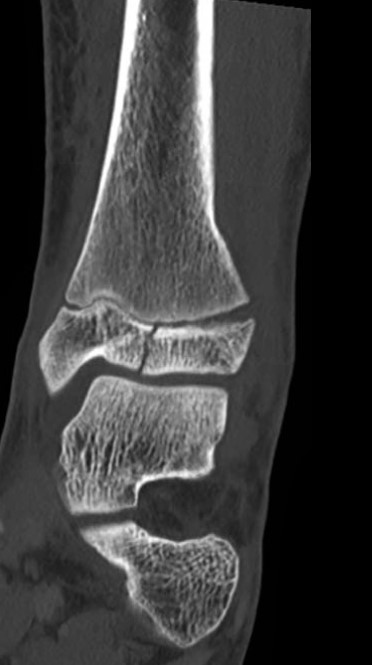 This patient's fracture places him at increased risk for which of the following complications?
 (Multiple Choice)
4.9/5 (77)
(77) 
Filters
- Essay(0)
- Multiple Choice(0)
- Short Answer(0)
- True False(0)
- Matching(0)