



 Chat with AI
Exam 4: Surgery

Exam 1: Medicine2 k Questions
Exam 2: Pediatric723 Questions
Exam 3: Psychiatry336 Questions
Exam 4: Surgery563 Questions
Exam 5: Obstetrics & Gynecology469 Questions
Select questions type


A 48-year-old woman comes to the emergency department due to sudden-onset right flank pain for 6 hours. She has never had abdominal pain before. Her only other medical problem is psoriasis at both knees, for which she uses topical vitamin D and beclomethasone. Vital signs are normal. The abdomen is soft with no tenderness. Bowel sounds are present. Abdominal imaging reveals a 3-mm stone in the right upper ureter and a few gallstones in the gallbladder. The liver and common bile duct are normal, the gallbladder is not distended, and there is no pericholecystic fluid or tenderness to ultrasound probe pressure. The patient is given analgesics and intravenous fluids; in a few hours she passes the ureteral stone in the urine with complete pain relief. Which of the following is the best next step in management of her gallstones?
(Multiple Choice)
4.9/5  (75)
(75) A 38-year-old construction worker is brought to the emergency department after falling from a 3.1 m (10 ft) height. Bystanders reported that the patient hit his head on the concrete and had jerking movements for 30 seconds. In the emergency department, blood pressure is 152/90 mm Hg, pulse is 92/min, and respirations are 16/min. On physical examination, the patient opens his eyes to verbal commands, makes incomprehensible sounds, and localizes pain. Glasgow coma scale score is 10. There is boggy swelling of the temporoparietal scalp. No major injuries of the chest, abdomen, or extremities are apparent. CT scan of the head shows linear fractures of the temporal and parietal bones, and multiple frontal, parietal, and temporal lobe contusions. There is no shift of midline structures. No cervical spine fracture or dislocation is present. Tranexamic acid is administered. Which of the following is the most likely mechanism of the beneficial effect of this drug?
(Multiple Choice)
4.8/5 (77)
(77) A 21-year-old woman comes to the emergency department after she slipped and fell at work, landing on her mouth 30 minutes ago. She brought a tooth with her that got avulsed secondary to the injury. The patient did not lose consciousness and has no other injuries. Vital signs are within normal limits. On examination, the patient has an avulsed left central incisor with a small amount of dry blood in the socket. The remainder of the teeth are stable without fractures. There is no injury to the gum or palate. There is no mandibular or maxillary tenderness or instability, and neurologic examination is normal. The patient has the avulsed tooth with her in a tissue, and it appears intact. Which of the following is the best next step in management of this patient?
(Multiple Choice)
4.8/5 (78)
(78) A 67-year-old man comes to the office due to a "sore" on the right side of his face. The sore has been growing slowly over the past year, and it bleeds and oozes at times. The patient recently retired from his job as a mail carrier and spent his entire career delivering mail outdoors. He is otherwise healthy and has a 30-pack-year history. Skin examination reveals a 1.5-cm lesion, as shown in the exhibit. Biopsy shows basal cell carcinoma. Which of the following is the best next step in management of this patient?
(Multiple Choice)
4.8/5 (97)
(97) A 43-year-old woman comes to the emergency department with acute-onset, left-sided weakness. The patient reports increased fatigue, low-grade fevers, and occasional palpitations over the last 3 months. She has lost 6 kg (13.2 lb) during this period. She has no prior medical conditions and takes no medications. She does not use tobacco, alcohol, or illicit drugs. Temperature is 37 C (98.6 F), blood pressure is 120/76 mm Hg, pulse is 80/min and regular, and respirations are 14/min. There are no carotid bruits. The thyroid is normal in size and there is no tenderness. Cardiac examination shows normal S1 and S2 and a middiastolic rumble at the apex. The lungs are clear on auscultation. Neurologic examination shows left-sided weakness. Laboratory results show a hemoglobin level of 10.2 g/dL and an erythrocyte sedimentation rate of 60 mm/hr. Brain imaging reveals multiple small, acute infarcts in the right parietal and temporal lobes. Transthoracic echocardiography shows a mass in the left atrium. Which of the following is the most likely diagnosis?
(Multiple Choice)
4.8/5 (68)
(68) A 37-year-old woman is brought to the hospital with abdominal pain and confusion that began 24 hours ago. The patient describes the pain as stabbing and unremitting. It is worse in the upper abdomen and associated with nausea and frequent nonbloody emesis. Medical history is significant for type 1 diabetes mellitus and major depression. The patient has been hospitalized for diabetic ketoacidosis in the setting of insulin noncompliance as well as for a suicide attempt as a teenager. Temperature is 38.9 C (102 F), blood pressure is 90/60 mm Hg, pulse is 110/min, and respirations are 24/min. The patient is oriented to person but not to place or time. The mucous membranes are dry, and capillary refill is delayed. Heart and lung sounds are unremarkable. The abdomen is markedly tender in the right upper quadrant and epigastrium but with no rebound or guarding. Laboratory results are as follows: 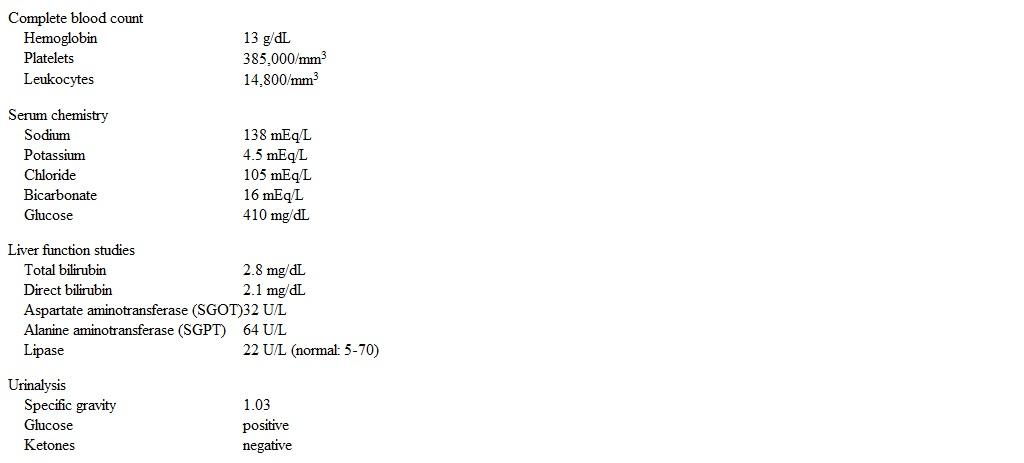 Which of the following is the most likely diagnosis?
 (Multiple Choice)
4.9/5 (98)
(98) A 16-year-old boy comes to the office due to occasional discomfort and heaviness of his scrotum over the past several months. He has had no trauma, dysuria, or urethral discharge. The patient is not sexually active. He is afebrile, and vital signs are within normal limits. On physical examination, an irregular, ropy mass is noted on both sides of the upper scrotum. The mass increases in size with Valsalva and reduces on supine positioning. There is no erythema, ulcers, or tenderness of the scrotal skin and no inguinal lymphadenopathy. The remainder of the examination is normal. Surgical correction is discussed with the patient and his parents. The primary reason to perform surgery is to prevent which of the following complications in this patient?
(Multiple Choice)
5.0/5 (77)
(77) An 88-year-old man is evaluated due to severe right calf pain several hours after undergoing a right femoral artery embolectomy. He also has a burning sensation in the posterior aspect of the right leg. The patient has persistent atrial fibrillation and hypertension. His medical history also includes an ischemic stroke, bleeding duodenal ulcer, type 2 diabetes mellitus, and diabetic nephropathy. Temperature is 36.5 C (97.7 F), blood pressure is 160/70 mm Hg, and pulse is 100/min and irregular. The right calf is swollen, tense, and exquisitely tender, with pain that is worse with passive dorsiflexion of the ankle. The skin is shiny and cool to the touch. Sensation over the leg is decreased and the patient is unable to move his toes. Dorsalis pedis and posterior tibial pulses are palpable. Which of the following is the most likely cause of this patient's symptoms?
(Multiple Choice)
4.8/5 (68)
(68) A 38-year-old woman comes to the office after feeling a lump in her left breast while showering. Examination reveals a firm, 3-cm (1.2-in) mass with ill-defined margins in the upper outer quadrant of the left breast. Enlarged lymph nodes are present in the left axilla, and fine-needle aspiration of the lymph nodes reveals adenocarcinoma. The patient undergoes left modified radical mastectomy including left axillary lymph node dissection, with removal of levels I and II axillary lymph nodes. During the surgery, which of the following muscles is used to distinguish between the different levels of axillary lymph nodes?
(Multiple Choice)
4.9/5 (79)
(79) A 52-year-old man is brought to the emergency department after a high-speed motor vehicle collision. When the patient was extracted from the damaged car, he was responsive and had a blood pressure of 180/90 mm Hg and a pulse of 120/min. The emergency medical team applied a cervical collar, placed him on a back board, and began intravenous fluid resuscitation. On arrival to the emergency department, the patient is awake, alert, anxious, and reporting neck pain. Temperature is 35.5 C (95.9 F), blood pressure is 84/52 mm Hg, pulse is 50/min, and respirations are 20/min. There are small facial abrasions and bruising over the chest and abdominal wall, but no other obvious external injuries or signs of active bleeding. Pupils are equal and reactive to light. Neck veins are flat. Bilateral breath sounds are equal, and heart sounds are normal. Abdominal examination reveals a palpable mass in the suprapubic region. The patient is unable to move any of his extremities, and deep tendon reflexes are diffusely absent. Sensation to pinprick is absent below the neck. Which of the following best explains this patient's current cardiovascular status?
(Multiple Choice)
4.8/5 (87)
(87) A 55-year-old woman comes to the clinic due to foot pain. For the past 4 weeks, the patient has had gradually increasing pain in her left heel. The symptoms are worse when she walks, and lately, it has become difficult to ambulate. The patient recently started an exercise program that includes running, swimming, and bicycling. Vital signs are normal. BMI is 34 kg/m2. Pedal pulses are full and symmetric bilaterally. The ankle has normal range of motion in all directions. Squeezing the heel laterally and medially reproduces the pain. Examination of the forefoot is normal, with no pain on dorsiflexion or plantar flexion of the toes. Which of the following is the most appropriate next step in management of this patient?
(Multiple Choice)
4.7/5 (84)
(84) A 39-year-old woman who recently underwent thyroidectomy for Grave's disease complains of anxiety, muscle cramps, and poor sleep. Her medications include daily multivitamin supplements and lansoprazole for acid reflux disease. Her temperature is 36.6 C (98 F), blood pressure is 142/85 mm Hg, and pulse is 82/min. Electrocardiogram shows normal sinus rhythm with prolongation of the corrected QT interval to 510 msec (normal <460 msec). Which of the following is the most likely diagnosis?
(Multiple Choice)
4.8/5 (80)
(80) A 42-year-old woman reports bloating with mild, diffuse abdominal discomfort 4 days after undergoing an elective cholecystectomy. She has not passed gas since the surgery. Perioperatively, she received antibiotics, morphine for pain, and metoclopramide for nausea. Medical history is significant for hypertension, diabetes mellitus, and hyperlipidemia. Blood pressure is 132/90 mm Hg and pulse is 76/min. BMI is 33 kg/m2. Physical examination shows a distended, tympanic abdomen with decreased bowel sounds. There is mild, diffuse tenderness but no rebound or guarding. The remainder of the examination shows no abnormalities. Which of the following is most likely contributing to this patient's current condition?
(Multiple Choice)
4.8/5 (72)
(72) A 55-year-old woman comes to the emergency department due to acute onset midepigastric pain that radiates to her back. She also has nausea and vomiting. Past medical history is significant for plantar fasciitis and hypertension, for which she takes amlodipine. The patient does not use tobacco, alcohol, or illicit drugs. Her temperature is 37.1 C (98.8 F), blood pressure is 117/76 mm Hg, pulse is 102/min, and respirations are 16/min. Examination shows tenderness to deep palpation in the epigastrium. The remainder of the examination is within normal limits. Laboratory test results are as follows: 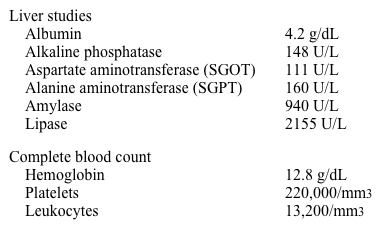 Abdominal ultrasound showed several gallstones without gallbladder wall thickening. The patient is admitted to the hospital and given supportive care with pain control, intravenous fluids, and nothing by mouth. She recovers rapidly and is able to eat within 2 days. Her enzymes begin to trend down, and the patient says she feels normal. Which of the following is the next best step in the management of this patient?
 (Multiple Choice)
4.8/5 (96)
(96) A 29-year-old nulligravid woman comes to the office due to left breast pain. She noticed a painful left breast lump last week while in the shower. The lump is very sensitive to touch, making wearing a bra uncomfortable. The patient has no medical conditions and has had no prior surgeries. Family history is significant for a cousin with breast cancer. Vital signs are normal. Physical examination reveals a 4 × 5 × 6 cm mobile mass in the left breast. Ultrasound shows a well-circumscribed anechoic structure with a thin wall and no Doppler enhancement. No echogenic debris or solid components are seen. Needle aspiration yields clear fluid with resolution of the mass. Which of the following is the best next step in management of this patient?
(Multiple Choice)
4.8/5 (73)
(73) A 62-year-old man comes to the office due to difficulty walking and mild pain in the left foot for the past several months. He now ambulates with a cane and recently began using an old ankle brace for support. The patient's medical history is significant for type 1 diabetes mellitus, hypertension, and hypercholesterolemia. Physical examination shows a significantly deformed left ankle and a mildly deformed left foot. X-ray of the left foot with weight bearing shows bone loss, large osteophytes, and several extraarticular bone fragments, as seen in the image below. 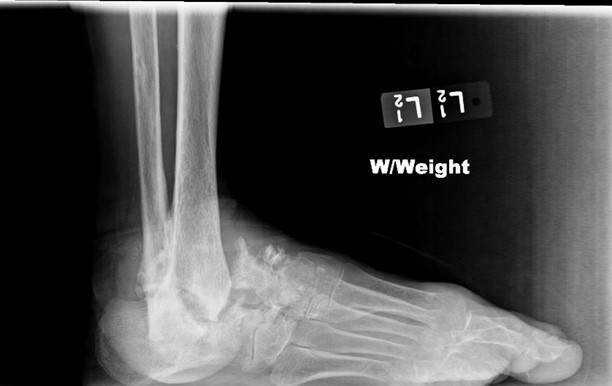 Which of the following is the most likely cause of this patient's foot pain?
 (Multiple Choice)
4.7/5 (79)
(79) A 65-year-old man comes to the office due to progressively worsening dyspnea and fatigue over the last 2 weeks. His lifestyle is mostly sedentary with limited activities around the house, but he has had dyspnea for the past 3 days while at rest. The patient was diagnosed with lung cancer a year ago and underwent surgical resection followed by chemotherapy. Other medical conditions include chronic kidney disease and hypertension. Temperature is 37 C (98.6 F), blood pressure is 114/70 mm Hg, pulse is 95/min, and respirations are 20/min. Pulse oximetry shows an oxygen saturation of 95% on room air. Lungs are clear to auscultation bilaterally. There are no heart murmurs. Extremities are without edema. Laboratory studies are as follows:  Chest x-ray is shown in the exhibit.
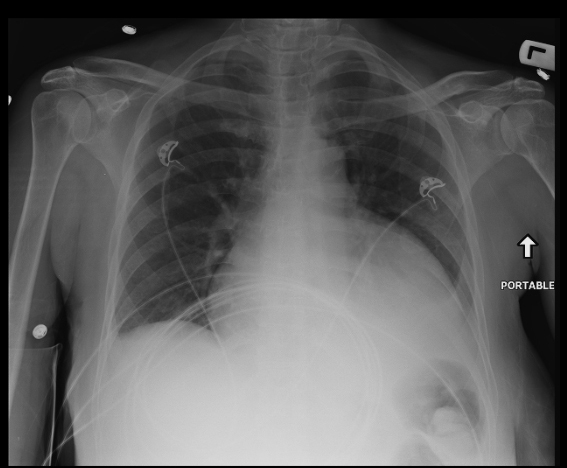 What is the most appropriate next step in management of this patient?
Chest x-ray is shown in the exhibit. What is the most appropriate next step in management of this patient? (Multiple Choice)
4.8/5 (73)
(73) A 63-year-old man comes to the office due to right shoulder pain and weakness for the past 3 days. The patient was moving boxes at his home when he tripped, fell, and landed on his right shoulder. He has had partial relief of his pain from over-the-counter analgesics and stretching exercises, but the weakness has persisted. Vital signs are normal. The right shoulder has no visible deformity or bony tenderness. There is full passive motion of the right shoulder, but active motion is limited. There is significant weakness with resisted abduction of the right shoulder compared to the left side. After passive abduction of the right arm above the head, the patient is asked to slowly lower his arm; as he is lowering it below horizontal, the arm suddenly drops rapidly, in association with moderate, sharp pain. Sensation is intact. Which of the following is the most likely diagnosis in this patient?
(Multiple Choice)
4.9/5 (75)
(75) A 29-year-old man comes to the emergency department with persistent vomiting and abdominal pain for the last 24 hours. The pain is crampy, diffuse, and getting worse. He had a normal bowel movement 3 days ago and has no diarrhea. The emesis appears green without blood or coffee grounds. The patient has not eaten since the onset of the pain due to nausea. His temperature is 36.8 C (98.2 F), pulse is 91/min, and blood pressure is 116/75 mm Hg while sitting and 94/65 mm Hg while standing. His abdomen is distended with hyperactive bowel sounds. Percussion reveals tympany, and the patient is diffusely tender to palpation. There is no rebound tenderness or guarding. Laboratory results are as follows: 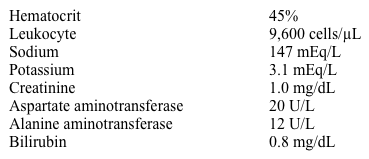 Which of the following historical findings would most likely be seen in this patient?
 (Multiple Choice)
4.9/5 (76)
(76) A 55-year-old man comes to the office due to chronic pain in his buttock, hip, and thigh muscles. The aching pain is present in both legs and usually is associated with walking. He has multiple medical problems and takes several medications. He has a 30-pack-year smoking history. His temperature is 36.7 C (98 F), blood pressure is 150/88 mm Hg, pulse is 80/min, and respirations are 16/min. Examination shows decreased femoral, popliteal, and dorsalis pedis pulses in both legs. Which of the following additional complaints is most likely in this patient?
(Multiple Choice)
4.9/5 (93)
(93) 
Filters
- Essay(0)
- Multiple Choice(0)
- Short Answer(0)
- True False(0)
- Matching(0)