



 Chat with AI
Exam 4: Surgery

Exam 1: Medicine2 k Questions
Exam 2: Pediatric723 Questions
Exam 3: Psychiatry336 Questions
Exam 4: Surgery563 Questions
Exam 5: Obstetrics & Gynecology469 Questions
Select questions type


A 72-year-old man is evaluated on day 2 after a coronary artery bypass graft surgery for severe coronary artery disease. He has no new symptoms except for mild sternal wound discomfort exacerbated by deep breathing. The patient's surgery was uncomplicated; he was extubated on postoperative day 1. Medical history is significant for type 2 diabetes mellitus and hyperlipidemia. He is afebrile. Blood pressure is 122/75 mm Hg, pulse is 75/min and regular, and respirations are 16/min. Oxygen saturation is 98% on room air. The sternal wound appears to be healing normally. Breath sounds are decreased at the left base. There is no abdominal distension or peripheral edema. Chest x-ray reveals a small, left-sided pleural effusion. Leukocyte count is 9,200/mm3 and serum creatinine is 1.1 mg/dL. Which of the following is the best next step in management of this patient?
(Multiple Choice)
4.8/5  (72)
(72) A 64-year-old woman is brought to the emergency department due to fever, chills, flank pain, and lethargy for the past 2 days. Temperature is 38.9 C (102 F), blood pressure is 100/60 mm Hg, and pulse is 120/min. The patient has right costovertebral angle tenderness. Leukocytes are 16,000/mm3 and urinalysis shows pyuria, many bacteria, and positive nitrites. ECG shows sinus tachycardia. A central venous catheter placement is planned for intravenous therapy and hemodynamic monitoring. After the patient's chest is appropriately prepared and draped, a needle is inserted just lateral to the angle of the left clavicle and a triple lumen catheter is placed into the left subclavian vein. Each lumen is flushed with sterile saline after obtaining blood return. The catheter is sutured in place to the skin and a sterile dressing is applied. Which of the following is the best next step in management of this patient?
(Multiple Choice)
4.8/5 (79)
(79) A 36-year-old woman comes to the office after discovering a lump in her right breast. She has no other symptoms. This patient regularly performs breast self-examinations after menses, and her last menstrual period ended 2 days ago. She has no significant medical history and has not seen a physician in 10 years. The patient takes no medications and has no allergies. Her grandmother died at age 78, 2 years after being diagnosed with breast cancer. Breast examination shows a 1-cm firm, round mass in the upper outer quadrant of the right breast. No axillary lymph nodes are palpable. Which of the following is the most appropriate next step in management of this patient?
(Multiple Choice)
4.9/5 (87)
(87) A 54-year-old man with a 30-pack-year smoking history undergoes laparoscopic cholecystectomy after an episode of biliary pancreatitis. On the third postoperative day, he is found to be mildly hypoxemic at 90% on room air. His temperature is 36.7° C (98° F), blood pressure is 130/80 mm Hg, heart rate is 90/min, and respirations are 22/min. Lung auscultation shows decreased breath sounds at the bases. Arterial blood gas analysis results are as follows: 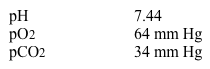 Which of the following most likely explains the observed findings?
 (Multiple Choice)
4.8/5 (79)
(79) A 65-year-old man comes to the office due to 3 days of progressive right flank pain. He also notes 4 weeks of dysuria and urinary frequency. The patient has a history of coronary artery disease and hypertension. His father died from prostate cancer. Temperature is 37.1 C (98.8 F), blood pressure is 130/86 mm Hg, pulse is 82/min, and respirations are 16/min. The abdomen is soft and nontender. No suprapubic tenderness is present, but there is mild right-sided costovertebral angle tenderness. The external genitalia are normal in appearance, and there is no penile discharge. Rectal examination shows mildly enlarged prostate without nodules or tenderness. Urinalysis results are as follows:  Urine gram stain is negative, and urine culture does not grow any organisms. Abdominal ultrasound reveals right-sided hydronephrosis and a normal left-sided kidney and ureter. Which of the following is the most appropriate next step?
 (Multiple Choice)
4.8/5 (70)
(70) A 40-year-old man comes to the office for evaluation of hoarseness. The patient first noticed the symptoms 4 months ago. Since then, his voice has gotten progressively more "raspy." He has no fever, throat pain, shortness of breath, or trouble swallowing. Medical history includes asthma and gastroesophageal reflux disease. Medications include inhaled budesonide, albuterol, and omeprazole. The patient smokes 3 or 4 cigarettes per day. Vital signs are within normal limits. Flexible laryngoscopy shows irregular, exophytic growths in clusters on the surfaces of the vocal cords. Pathology shows no malignant features. Which of the following is the most likely cause of this patient's laryngeal lesions?
(Multiple Choice)
4.7/5 (87)
(87) A 55-year-old man undergoes a conventional pancreaticoduodenectomy (Whipple procedure) for suspected pancreatic adenocarcinoma of the head of the pancreas. Prior to the procedure, the patient receives a dose of prophylactic antibiotics. Toward the end of the operation, he is given 2 units of packed red blood cells. The patient is then extubated and transferred to the postanesthesia care unit for recovery. One hour later, he develops fever and chills. Temperature is 38.5 C (101.3 F), blood pressure is 130/76 mm Hg, pulse is 90/min, and respirations are 16/min. The patient is mildly sedated but responds to commands appropriately. Examination shows a mildly tender abdominal wound without erythema. There is serosanguinous discharge from the pancreatic suction drain. The lungs are clear to auscultation. A Foley catheter and right subclavian central venous access are present, both placed at the time of surgery. Which of the following is the most likely cause of this patient's fever?
(Multiple Choice)
4.8/5 (71)
(71) A 78-year-old woman is brought from the nursing home to the emergency department due to worsening abdominal distension. Over the past 3 days, the patient has had decreased appetite and progressive abdominal distension that is now accompanied by diffuse abdominal discomfort. Her last bowel movement was 4 days ago. Medical history is significant for dementia, hypertension, osteoarthritis, osteoporosis, and chronic constipation. Surgical history includes open appendectomy and open cholecystectomy. Temperature is 37 C (98.6 F), blood pressure is 138/80 mm Hg, and pulse is 92/min. Physical examination shows a distended and tympanitic abdomen with diffuse tenderness to palpation but no rigidity or rebound tenderness. Blood counts and serum electrolytes are within normal limits. Abdominal x-ray is shown in the exhibit. 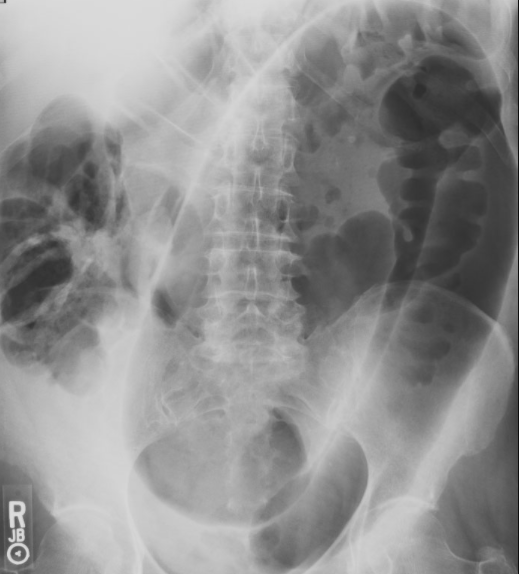 Which of the following is the best next step in management of this patient?
 (Multiple Choice)
4.7/5 (86)
(86) A 65-year-old man is brought to the emergency department after a motor vehicle collision. The patient was the restrained front passenger in a car that skidded on ice and hit a tree at 25 miles/hr. His right leg was pinned under the dashboard, and extrication took 2 hours. The patient has continued right leg pain, which is minimally relieved with morphine. He had a myocardial infarction 6 months ago for which he takes aspirin and clopidogrel. Blood pressure is 102/72 mm Hg and pulse is 111/min. On physical examination, the patient is mildly sedated. The right leg appears swollen, bruised, and shiny. Sensation is intact. Passive motion of the right ankle and toes causes pain. Bilateral pedal pulses are palpable. X-ray of the right lower extremity is negative for fracture. Which of the following is the best next step in management of this patient's leg pain?
(Multiple Choice)
4.8/5 (89)
(89) A 25-year-old man is brought to the emergency department due to a stab wound to the chest. The patient was returning to his parked car when he was mugged. He tried to resist, but the assailant stabbed him once in the left chest with a switchblade. During transport, the patient became unresponsive and required intubation. He also received 2 L of normal saline. Upon arrival, blood pressure is 80/42 mm Hg and pulse is 132/min. Pulse oximetry is 98% on 60% oxygen. Weight is 80 kg (176.4 lb) and height is 177.5 cm (5 ft 9 in). On physical examination, there is a fist-sized blood stain on the patient's shirt and a 3-cm linear wound in the left fifth intercostal space at the midaxillary line, with dried blood and no active external hemorrhage. Breath sounds are diminished in the left lung and normal in the right lung. Heart sounds are normal. The jugular veins are flat. The abdomen is nondistended and soft to palpation. Focused assessment with sonography for trauma (FAST) reveals left-sided intrathoracic free fluid. A left-sided chest tube is placed with immediate output of 2,000 mL of blood. Which of the following is the best next step in management of this patient?
(Multiple Choice)
4.8/5 (72)
(72) CT scan of the cervical spine shows a minimally displaced fracture of the right C5 lamina, with slight subluxation of the right C5-C6 facet joint. On further examination, the patient has mild weakness of right wrist extension and loss of pinprick sensation in the right thumb. Which of the following additional studies should be obtained?
(Multiple Choice)
4.9/5 (82)
(82) A 22-year-old man is brought to the emergency department by ambulance after sustaining a gunshot wound to the abdomen during a home invasion. The event occurred 45 minutes prior to arrival. Because of hypotension, paramedics administered 1 L of normal saline en route to the emergency department. On arrival, blood pressure is 98/62 mm Hg, pulse is 120/min, and respirations are 22/min. The patient is awake and moaning in pain. The lungs are clear to auscultation bilaterally, and heart sounds are normal. One bullet wound is noted in the left upper quadrant. The abdomen is tender and distended. The patient is moving all his extremities, but they are cool and clammy. Focused Assessment with Sonography for Trauma examination shows free fluid in the abdomen. Continuation of additional normal saline fluid boluses in this patient would likely result in which of the following?
(Multiple Choice)
4.8/5 (83)
(83) A 60-year-old man comes to the office due to a sore on his lip. He has a 3-month history of an enlarging lesion on his lower lip associated with ulceration and slight pain. Past medical history is unremarkable. The patient does not use alcohol, tobacco, or illicit drugs. He works as a farmer and has no new sexual contacts. Vital signs are normal. Examination shows a 3×7-mm partially encrusted ulcer in the vermilion zone of the lower lip, surrounded by a 6×12-mm area of induration. There are no palpable submental or submandibular lymph nodes, and the remainder of the physical examination is unremarkable. Biopsy of this lesion will most likely show which of the following?
(Multiple Choice)
4.9/5 (89)
(89) A 55-year-old man comes to the office due to progressive abdominal pain. The pain is greatest after eating. The patient has also had 6 months of fatigue, joint pain, and weight loss. On examination, temperature is 38 C (100.4 F), blood pressure is 150/100 mm Hg, pulse is 80/min, and respirations are 14/min. Cardiopulmonary examination is normal. The abdomen is tender to palpation with no rigidity or rebound. Complete blood count is normal. CT angiography of the abdomen reveals bilateral renal infarcts and several abdominal arteries with microaneurysms and distal abrupt cutoffs. Blood cultures are negative for growth after 48 hours. Which of the following is the most likely diagnosis?
(Multiple Choice)
4.9/5 (77)
(77) A 63-year-old man comes to the office due to anorexia and weight loss for the past 2 months. He has no chest pain, abdominal pain, cough, or fever. His medical problems include hypertension and latent tuberculosis treated 30 years ago. He does not use tobacco, alcohol, or illicit drugs. Temperature is 37.5 C (99.5 F), blood pressure is 124/80 mm Hg, pulse is 78/min, and respirations are 14/min. Physical examination reveals mucosal pallor and mild hepatomegaly. The abdomen is soft, nondistended, and nontender. Cardiopulmonary examination is normal. Fecal occult blood testing is positive. Laboratory results are as follows: 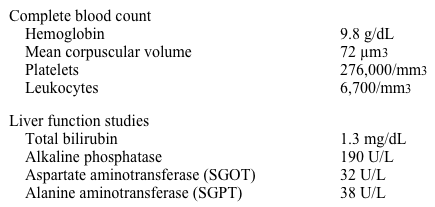 Ultrasound reveals a solitary liver lesion measuring 2x3 cm. Which is the most likely diagnosis?
 (Multiple Choice)
4.8/5 (98)
(98) A 59-year-old woman arrives at the emergency department due to right upper quadrant abdominal pain, nausea, vomiting, and fever since yesterday. She has no hematemesis, constipation, diarrhea, or shortness of breath. The patient's medical history is significant for hypertension, stable coronary artery disease, and type 2 diabetes mellitus. She does not use tobacco, alcohol, or illicit drugs. Temperature is 38.9 C (102 F), blood pressure is 112/76 mm Hg, pulse is 101/min, and respirations are 18/min. Oxygen saturation is 96% on room air. BMI is 34 kg/m2. Cardiopulmonary examination shows no abnormalities. There is marked tenderness and voluntary guarding to palpation in the right upper quadrant of the abdomen. Laboratory results are as follows. 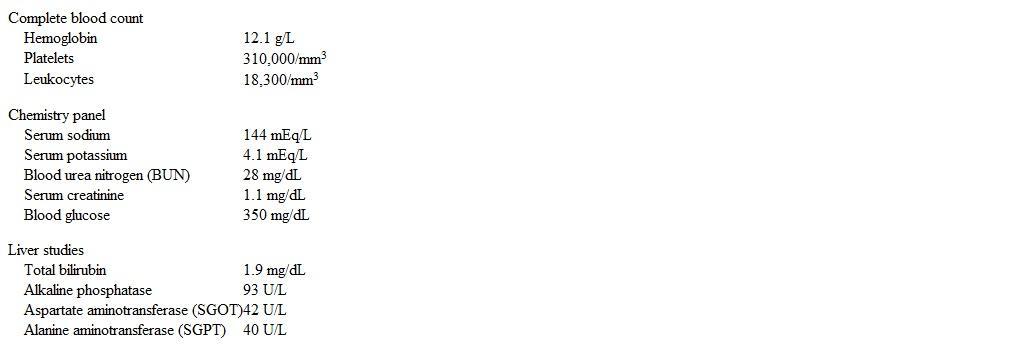 Abdominal imaging demonstrates a distended gallbladder with gas in the gallbladder wall and lumen. There is no gas in the biliary tree. What is the most likely diagnosis in this patient?
 (Multiple Choice)
4.8/5 (81)
(81) A 56-year-old man comes to the office due to pain, redness, and swelling in his right arm. The patient was recently diagnosed with unresectable lung cancer. He received the first cycle of chemotherapy 2 weeks ago through a right-sided peripherally inserted central catheter (PICC). Temperature is 36.9 C (98.4 F), blood pressure is 130/80 mm Hg, pulse is 78/min, and respirations are 14/min. Oxygen saturation is normal. Examination shows right arm swelling and mild erythema. Capillary refill is normal. No discharge is seen around the PICC line. The remainder of the examination is normal. Which of the following is the most appropriate next step in management?
(Multiple Choice)
4.9/5 (86)
(86) A 50-year-old woman comes to the office due to 3 months of progressive right shoulder pain radiating to her forearm. The patient has a history of rheumatoid arthritis and takes methotrexate and naproxen, which have controlled her morning stiffness and joint tenderness. She has smoked a pack of cigarettes daily for 25 years and drinks 1 or 2 cocktails on weekends. Vital signs are within normal limits. Physical examination shows mild drooping of the right upper eyelid and right pupillary constriction. Range of motion over the right shoulder is normal and does not elicit arm pain. There are bilateral hand joint deformities with no swelling and minimal tenderness. Which of the following is the best next step in the management of this patient?
(Multiple Choice)
4.7/5 (85)
(85) A 65-year-old man comes to the emergency department due to sudden-onset chest pain followed by syncope. The pain started an hour ago, during which he had an episode of syncope lasting 1-2 minutes. The patient has had no dyspnea or palpitations. He has never had similar symptoms before. Medical history is significant for hypertension and a 40-pack-year smoking history. Blood pressure is 190/110 mm Hg in both arms; pulse is 100/min and regular; and respirations are 24/min. Pulses are symmetric and equal in all extremities. Jugular venous pressure is normal. Breath sounds are normal on both sides. There is an S4 gallop. ECG shows changes consistent with left ventricular hypertrophy. Serum troponin is normal. D-dimer is elevated. Chest x-ray shows an enlarged cardiac silhouette but is otherwise unremarkable. CT scan of the chest is obtained and is shown below: 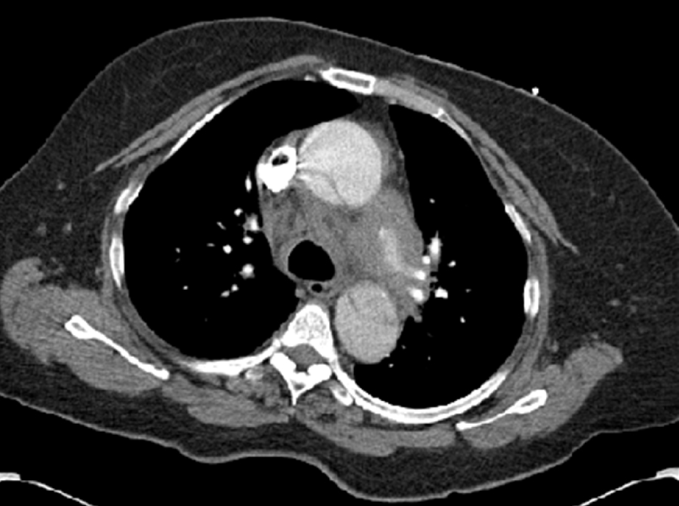 Which of the following is the best next step in management of this patient?
 (Multiple Choice)
4.8/5 (87)
(87) A 24-year-old man comes to the emergency department with a week of abdominal pain. It is localized in the right lower quadrant and exacerbated somewhat by motion. Over the past 2 days, the pain has radiated to the back. The patient initially had 2 episodes of vomiting and now has decreased appetite. He has no increased urinary frequency. His other medical problems include mild intermittent asthma and gastroesophageal reflux disease. One month ago, he traveled to Mexico for 5 days; he had no gastrointestinal symptoms during his stay. His mother was diagnosed with colon cancer at age 49. His temperature is 38.2 C (100.8 F), blood pressure is 122/77 mm Hg, and pulse is 109/min and regular. Physical examination shows moderate tenderness in the right lower quadrant, without rebound. Passive extension of the right hip with the patient in the left lateral decubitus position elicits significant abdominal pain. Laboratory results are as follows: 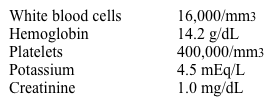 Which of the following is the most likely diagnosis?
 (Multiple Choice)
4.8/5 (70)
(70) 
Filters
- Essay(0)
- Multiple Choice(0)
- Short Answer(0)
- True False(0)
- Matching(0)