



 Chat with AI
Exam 4: Surgery

Exam 1: Medicine2 k Questions
Exam 2: Pediatric723 Questions
Exam 3: Psychiatry336 Questions
Exam 4: Surgery563 Questions
Exam 5: Obstetrics & Gynecology469 Questions
Select questions type


A 68-year-old man comes to the office for follow-up. The patient has a 10-year history of end-stage renal disease due to diabetic and hypertensive nephropathy and receives intermittent hemodialysis. Current medications are losartan, metoprolol, amlodipine, short- and long-acting insulins, and epoetin alpha. His calcium acetate and calcitriol therapy were stopped 3 months ago due to an elevated serum calcium level. The patient is adherent with medications and dietary restrictions. Laboratory results are as follows:  Which of the following is the most likely underlying cause of this patient's elevated serum calcium level?
 (Multiple Choice)
4.8/5  (72)
(72) A 29-year-old woman comes to the emergency department after spilling hot coffee on her left forearm. Medications include a daily oral contraceptive, and the patient has no other medical issues. Evaluation shows a full-thickness burn, and she is discharged with analgesics, topical antibiotics, and wound care instructions. Three days later, the patient returns due to worsening pain and swelling of the left hand. She describes the pain in her hand as severe and aching. Repeat examination shows previous burn injury healing with a circumferential eschar formation. Her left hand is tense and tender. Which of the following is the most likely cause of this patient's condition?
(Multiple Choice)
4.8/5 (72)
(72) A 28-year-old man comes to the office for evaluation of a left testicular mass. The mass has been present for 2 months and has increased in size. He has had no pain in the affected testis or weight loss. He is otherwise healthy and has no other symptoms. The patient does not use tobacco, alcohol, or illicit drugs. Vital signs are normal. The abdomen is soft and nontender with no palpable masses. A painless, hard nodule is noted in the left testicle. There is no inguinal lymphadenopathy. Scrotal ultrasound reveals a solid, hypoechoic 5-cm left testicular mass. What is the next best step in management of this patient?
(Multiple Choice)
4.9/5 (75)
(75) A 30-year-old school teacher presents with a three-day history of fever, chills, and sore throat. He also complains of difficulty swallowing that started yesterday. He denies any cough, chest pain, or difficulty breathing. He is married and denies any new sexual encounters. His temperature is 39.8° C (102.2° F), blood pressure is 118/76 mmHg, pulse is 102/min, and respirations are 19/min. On examination, his voice is muffled. Enlarged, tender cervical lymph nodes are palpated on the left, and his uvula is deviated to the right. What is the most appropriate treatment for this patient?
(Multiple Choice)
4.8/5 (87)
(87) A 20-year-old man was stabbed in the chest during a street fight. Blood pressure is 90/58 mm Hg, pulse is 124/min, and respirations are 30/min. The patient is in severe respiratory distress. Breath sounds are present on the left and absent on the right. Heart sounds are normal. The neck veins are distended. The patient becomes obtunded during examination. Which of the following is the best next step in management?
(Multiple Choice)
4.8/5 (81)
(81) A 38-year-old woman comes to the emergency department complaining of severe pain and swelling in her left leg. She fell 2 days ago while playing recreation-league soccer and suffered a mildly painful abrasion to her posterior left thigh. The pain has worsened steadily since and is now unbearable. Initially only her left proximal thigh was painful and red, but now the pain has spread to her buttock and proximal calf. The patient also complains of fatigue and chills. Her temperature is 39.4 C (102.7 F), blood pressure is 82/60 mm Hg, pulse is 104/min, and respirations are 18/min. Physical examination shows a swollen left thigh with moderate erythema over the left proximal thigh and buttock. The buttock and distal thigh are markedly tender to palpation, and the patient has no sensation to light touch over the proximal thigh. Blood pressure improves with intravenous fluids. CT scan of the affected area is shown in the exhibit. 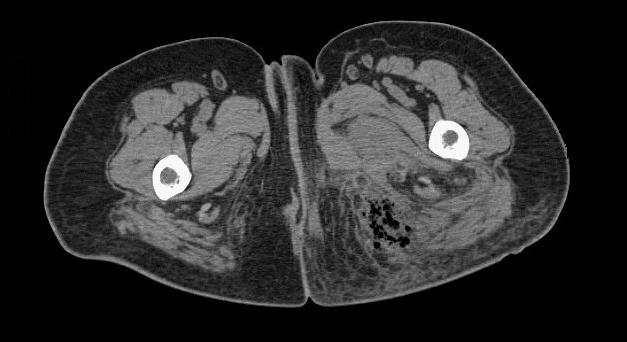 Which of the following is the most likely diagnosis in this patient?
 (Multiple Choice)
4.8/5 (82)
(82) An 80-year-old Asian man comes to the office for evaluation of fatigue and 4.5 kg (10 lb) weight loss. Medical history is notable for benign prostatic hyperplasia (which is treated with tamsulosin), coronary artery disease, and hypertension. The patient does not use tobacco and drinks 2 shots of whiskey daily. He eats a vegetarian diet. Vital signs are normal. Physical examination shows a nodular prostate and inguinal lymphadenopathy. Serum prostate-specific antigen level is 25 ng/mL (normal: <4.5 ng/mL). Biopsy of the prostate reveals adenocarcinoma. Which of the following risk factors is most strongly associated with development of cancer in this patient?
(Multiple Choice)
4.8/5 (73)
(73) A 34-year-old woman comes to the office due to fullness in her neck after noticing a difference in how jewelry rests around her neck as compared to before. The patient has no other symptoms. She has no medical issues and takes no medications. Family history includes thyroid surgery for an enlarged thyroid gland in her mother. Examination reveals a 1.4-cm firm, nontender, mobile nodule in her left thyroid lobe. The remainder of the physical examination is unremarkable. Laboratory evaluation shows serum TSH of 0.25 µU/mL, serum total thyroxine (T4) of 10 µg/dL, and serum triiodothyronine (T3) of 176 ng/dL. A thyroid ultrasound reveals a 1.4-cm left thyroid nodule with smooth margins and no microcalcifications or internal vascularity. Which of the following is the most appropriate next step?
(Multiple Choice)
4.7/5 (74)
(74) A 60-year-old man is hospitalized due to elective pancreaticoduodenectomy. The patient recently had worsening jaundice and was found to have a tumor in the head of the pancreas causing biliary obstruction. Further evaluation revealed early-stage pancreatic adenocarcinoma. A modified Whipple procedure with resection of the head of the pancreas, distal duodenum, common bile duct, and gallbladder, followed by pancreatic-enteric, biliary-enteric, and enteroenteric anastomoses, is performed. After the surgery, the patient begins enteral feeding. His pain is controlled, but a large amount of output is noted from the surgical drain placed at the pancreatic bed. The drainage fluid appears cloudy and has a high amylase level. A postoperative pancreatic leak is suspected, and nonoperative management is planned. This patient is at greatest risk for which of the following metabolic derangements due to this operative complication?
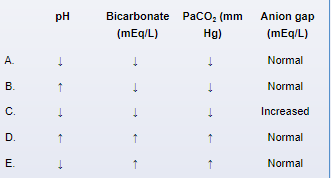
(Multiple Choice)
4.9/5 (79)
(79) A 72-year-old man comes to the office due to fatigue and lower extremity swelling for the last several weeks. He also has a feeling of pulsation in his neck when he lies down. He has no chest pain. The patient takes lisinopril and amlodipine for hypertension. He underwent permanent pacemaker implantation for sick sinus syndrome 6 months ago. He is a lifetime nonsmoker. The patient has no family history of cardiovascular disease. Blood pressure is 112/70 mm Hg and pulse is 79/min and regular. The jugular veins are distended with the patient in the sitting position. A 3/6 holosystolic murmur is heard over the left lower sternal border. The lungs are clear on auscultation. The liver is enlarged and mildly tender on palpation. Bilateral 3+ edema is present in the lower extremities. Which of the following is the most likely diagnosis?
(Multiple Choice)
4.9/5 (75)
(75) A 46-year-old man comes to the emergency department due to several episodes of vomiting. The last episode of emesis contained blood. Five hours ago, he had a fatty meal and several alcoholic drinks. The patient's medical history is notable for alcohol use disorder. He also has chronic dyspepsia, for which he was evaluated 3 days ago with upper gastrointestinal endoscopy and abdominal ultrasound. The ultrasound revealed an enlarged, hyperechoic liver and gallstones in the gallbladder, and the endoscopy found mild esophagitis and gastritis. His temperature is 36.6 C (97.9 F), blood pressure is 120/70 mm Hg, pulse is 95/min, and respirations are 15/min. The abdomen is soft and nontender. The rectal examination shows no melena. Laboratory results are as follows: 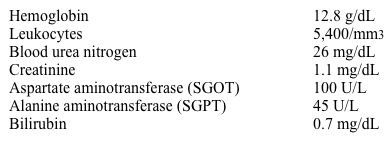 Nasogastric suction returns normal stomach contents mixed with bright red blood. Which of the following is the most likely explanation for this patient's bloody vomiting?
 (Multiple Choice)
4.9/5 (68)
(68) A 64-year-old man comes to the office due to a month of slowly progressive left-sided neck swelling. The swelling is not painful or erythematous. He has also had persistent nasal congestion, frequent epistaxis, and headaches. The patient has a history of rhinosinusitis and attributes his current symptoms to another episode of infection. He has been taking over-the-counter decongestants and antihistamines, but these have not provided relief. He has no other medical problems. The patient takes daily multivitamins and occasionally uses nonsteroidal anti-inflammatory medications for aches and pains. He immigrated to the United States from China 15 years ago. Vital signs are within normal limits. Several enlarged and hard cervical lymph nodes are present. Nasopharyngoscopy reveals a mass in the posterior nasal cavity, and biopsy demonstrates poorly differentiated carcinoma. Which of the following is most strongly associated with this patient's current condition?
(Multiple Choice)
4.7/5 (93)
(93) A 17-year-old high school student comes to urgent care with right shoulder pain. The pain started after he hit the shoulder on the ground while tackling another player during a rugby game. On examination, there is no gross deformity of the shoulders and arms. Adduction of the right arm across the torso elicits pain over the superior lateral shoulder. Range of motion of the neck and elbows and sensation of the arms are intact. Radial pulses are 2+ bilaterally. X-rays of the right shoulder and clavicle are normal. Which of the following is the most likely diagnosis?
(Multiple Choice)
4.9/5 (80)
(80) The patient's ECG shows sinus rhythm with no acute ST-segment or T-wave changes. Supplemental oxygen by nasal canula is started. Which of the following would have been most effective in preventing this patient's current condition?
(Multiple Choice)
4.8/5 (89)
(89) A 66-year-old man is hospitalized for elective surgical repair of an abdominal aortic aneurysm. The patient has had midabdominal and low back pain due to an enlarging infrarenal aortic aneurysm. Medical history also includes hypertension and prolonged tobacco use. Preoperative cardiopulmonary examination is normal, and blood cell counts and serum chemistry studies are within normal limits. During the surgery, prolonged clamping of the infrarenal aorta and iliac arteries is required due to complex aneurysm anatomy, but there are no other intraoperative complications. The patient's postoperative laboratory results are as follows: 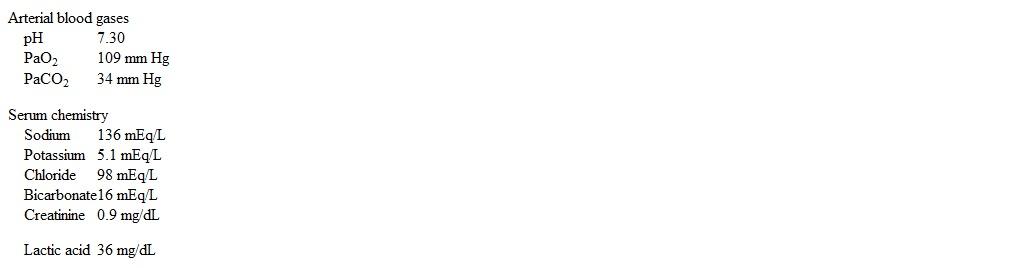 Over the next several hours, which of the following changes is most likely to occur in this patient in response to the acid-base imbalance?
 (Multiple Choice)
4.9/5 (83)
(83) A 24-year-old woman comes to the office due to a breast lump that she noticed 2 days ago. The patient's menses are regular, occurring every 26 days with 2 days of heavy bleeding and 2 days of light flow. Her last menstrual period was 3 weeks ago. She is sexually active and recently started using combined estrogen/progestin oral contraceptives. The patient is an avid jogger and wears a sports bra almost daily. Family history includes a paternal aunt diagnosed with breast cancer at age 62. Physical examination shows a 4-cm, firm, round, mobile mass in the superior outer quadrant of the right breast.
Which of the following is the most likely diagnosis in this patient?
(Multiple Choice)
4.9/5 (91)
(91) A 40-year-old man comes to the office for follow-up of hypertension. He was diagnosed with mild hypertension 6 months ago and has had good control with regular exercise and weight loss. The patient feels well and takes no medications. He does not smoke and drinks a few glasses of wine per week. The patient's medical history is otherwise unremarkable. His mother has osteoporosis that is treated with oral alendronate. On examination, inspection and palpation of the neck show no masses. Laboratory results are as follows: 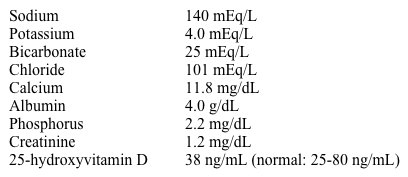 Serum parathyroid hormone level is 814 pg/mL. Further testing shows a high 24-hour urine calcium excretion of 325 mg. DXA scan reveals normal bone mineral density. Renal ultrasound shows multiple small (<5 mm) stones in both kidneys. Which of the following is the most appropriate next step in management of this patient?
 (Multiple Choice)
4.9/5 (79)
(79) A 25-year-old man comes to the office with pain over the intergluteal region. The pain has been present for several weeks and makes him uncomfortable when he sits at his desk at work. He has also noticed intermittent swelling with mucoid discharge, which recently became blood-tinged. The patient has no fever or chills. Bowel movements are regular and he has no urinary symptoms. His medical history is significant for an appendectomy 2 years ago. He works as a computer programmer. The patient is sexually active with a female partner. Temperature is 37 C (98.6 F), blood pressure is 123/79 mm Hg, and pulse is 78/min. BMI is 34 kg/m2. Examination shows a tender mass near the tip of the coccyx that drains mucoid fluid with pressure. The remainder of the examination shows no abnormalities. Which of the following is the most likely diagnosis?
(Multiple Choice)
4.9/5 (81)
(81) A 35-year-old woman is brought to the emergency department after being caught in a house fire. She has no chronic medical conditions and no known allergies. Temperature is 35 C (95 F), blood pressure is 80/58 mm Hg, pulse is 156/min, and respirations are 35/min. Oxygen saturation is 67% on room air. The patient is disoriented. Black soot is seen in the nose and mouth. At least 50% of the body has burns, and there are full-thickness burns on the arms and legs. Intravenous access is obtained, and the patient is intubated and sedated due to signs of smoke inhalation and severe injuries. The wounds are cleaned, and topical antibiotics are placed over the burns. Which of the following is the most appropriate fluid management for this patient during the next 24 hours?
(Multiple Choice)
4.8/5 (74)
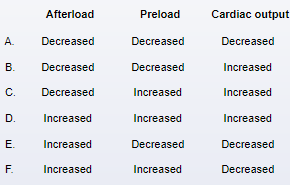
(74) A 46-year-old man with autosomal dominant polycystic kidney disease comes to the clinic after an arteriovenous fistula was placed 2 weeks ago in preparation for hemodialysis. He is feeling well and has no concerns. The surgical site shows good healing with no evidence of infection. Doppler interrogation shows high fistula flow rates. Compared to the presurgical state, which of the following is most likely present in this patient?
(Multiple Choice)
4.9/5 (79)
(79) 
Filters
- Essay(0)
- Multiple Choice(0)
- Short Answer(0)
- True False(0)
- Matching(0)