



 Chat with AI
Exam 4: Surgery

Exam 1: Medicine2 k Questions
Exam 2: Pediatric723 Questions
Exam 3: Psychiatry336 Questions
Exam 4: Surgery563 Questions
Exam 5: Obstetrics & Gynecology469 Questions
Select questions type


A 76-year-old man is brought to the office for evaluation of fecal incontinence. The patient has a history of lung cancer metastatic to the bones and liver. He takes opiate analgesics with adequate pain control. The patient has become increasingly debilitated over the past 6 months and requires assistance with most activities of daily living. His caregiver notes that the patient has chronic constipation with 1 or 2 hard bowel movements per week, but over the past 2 days he has been incontinent of small volume soft stools. The patient has also been having mild nausea and decreased appetite but has had no fever, chills, vomiting, or dysuria. There is no visible blood or mucus in the stool. Temperature is 37 C (98.6 F), blood pressure is 116/74 mm Hg, and pulse is 86/min. Abdomen is distended but soft with mild diffuse tenderness and normal bowel sounds. Which of the following is the most appropriate next step in management of this patient?
(Multiple Choice)
4.7/5  (78)
(78) A 51-year-old woman comes to the office to discuss colon cancer screening. She has normal bowel movements and has had no hematochezia, melena, or unexpected weight loss. Medical history is significant for hypertension. Her mother developed colon cancer at age 85. The patient does not use tobacco or alcohol. Vital signs are normal. Cardiopulmonary and abdominal examinations are unremarkable. The patient undergoes colonoscopy, during which two small (8 mm) hyperplastic polyps are found and removed. Which of the following is the best next step in management?
(Multiple Choice)
4.9/5 (82)
(82) A 50-year-old man comes to the office due to 2 months of progressive generalized weakness, anorexia, and abdominal distension. He has also had bilateral lower extremity swelling. The patient has a history of alcohol use disorder and liver cirrhosis, which was diagnosed 5 years ago. His last right upper quadrant ultrasound was performed 18 months ago; it showed surface nodularity and increased liver echogenicity but no free fluid in the abdomen. He has no other chronic medical conditions and takes no medications. Temperature is 37.3 C (99.1 F), blood pressure is 103/76 mm Hg, pulse is 82/min, and respirations are 14/min. Pulse oximetry shows 96% on room air. The patient is awake, alert, and oriented to time, place, and person. Temporal wasting is present. Cardiopulmonary examination is normal, and there is no jugular venous distension. The abdomen is distended, with shifting dullness to percussion, but nontender. There is bilateral lower extremity 1+ pitting edema. Palmar erythema and multiple spider angiomas are noted. Laboratory results are as follows: 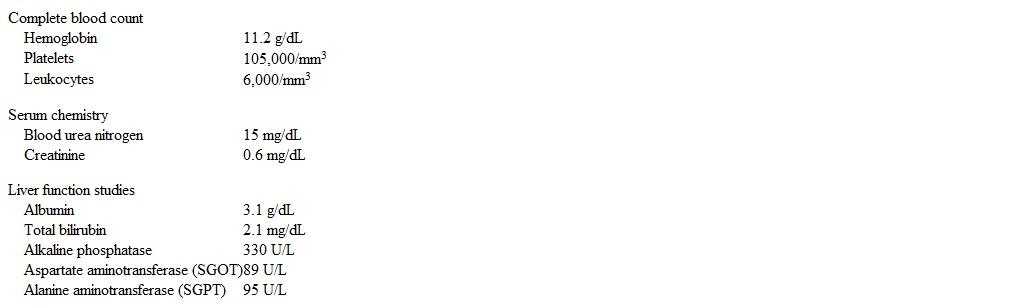 Serology is negative for viral hepatitis. Which of the following is the best next step in management of this patient?
 (Multiple Choice)
5.0/5 (72)
(72) A 51-year-old woman comes to the office due to progressive right arm and shoulder pain for 4 months. Washing her hair and reaching the upper shelves of the kitchen cabinets have been difficult. Heating pads and ice packs have not helped. She has had no fever, weight loss, or trauma. Medical history includes hypertension treated with lisinopril and hypothyroidism treated with levothyroxine. On examination, there is mild atrophy of the right deltoid muscle. Palpation of the neck, shoulders, and arms reveal no focal tenderness. Active and passive range of motion of the right shoulder is markedly reduced in abduction, flexion, and internal and external rotation compared to the left. Sensation in the upper extremities and strength in the hands and elbows are preserved. When she walks, the natural swing of the right arm is diminished. Which of the following is the best next step in management of this patient?
(Multiple Choice)
4.7/5 (74)
(74) A 44-year-old-woman comes to the emergency department due to worsening abdominal pain. Two weeks ago, the patient underwent a laparoscopic hysterectomy and bilateral salpingo-oophorectomy for adenomyosis. Her postoperative course was unremarkable, and the patient went home the day after the procedure. She was eating normally until 2 days ago, when she began experiencing increasing nausea and abdominal cramping after meals. Now, the patient has abdominal cramping every few minutes and has vomited her pain medication. Her last bowel movement was 3 days ago, and she has not passed flatus today. Vital signs are within normal limits. BMI is 34 kg/m2. The abdomen is distended and tympanic on percussion. There is abdominal tenderness to palpation, but no rebound or guarding. The skin is intact over all the abdominal incisions, but the right-sided incision has an underlying tender, palpable mass. Bowel sounds are hyperactive. Abdominal x-ray reveals multiple air-fluid levels within the small bowel and no air in the rectum. A nasogastric tube is placed. Which of the following is the best next step in management of this patient?
(Multiple Choice)
4.8/5 (89)
(89) A 67-year-old man comes to the office due to slowly worsening fatigue and shortness of breath. The symptoms began after a chest cold 8 months ago. Medical history is significant for type 2 diabetes mellitus, for which the patient takes metformin. He has a 25-pack-year smoking history and quit 2 years ago. The patient is a retired attorney. He started taking trumpet lessons 3 months ago. Temperature is 36.6 C (97.9 F), blood pressure is 122/80 mm Hg, pulse is 70/min, and respirations are 16/min. Oxygen saturation is 96% on room air. Heart sounds are normal. Pulmonary examination demonstrates fine inspiratory crackles. Muscle strength is 5/5 throughout. The joints appear normal with full range of motion. Skin examination is normal. A high-resolution CT scan of the chest reveals lower lobe subpleural honeycombing and reticular markings greatest at the periphery. Pulmonary function tests demonstrate moderate restriction and reduced diffusion lung capacity for carbon monoxide. Hemoglobin A1c is 8.2%. All other laboratory test results are within normal limits. What is the most appropriate therapy for this patient?
(Multiple Choice)
4.9/5 (66)
(66) A 34-year-old woman with chronic pelvic pain and dyspareunia due to endometriosis undergoes elective laparoscopic endometriosis resection. The patient has no other medical conditions, and preoperative medical evaluation shows no cardiac, pulmonary, or renal abnormalities. Surgery is performed under general anesthesia and is prolonged due to excessive pelvic adhesions. During surgery, the patient has a moderate amount of blood loss and receives a large-volume infusion of isotonic saline. After completion of the surgery and reversal of anesthesia, laboratory results are as follows:  Which of the following best explains this patient's postoperative acid-base imbalance?
 (Multiple Choice)
4.8/5 (89)
(89) A 45-year-old woman comes to the office due to reflux, nausea, and vomiting for the past 3 weeks. The patient has daily heartburn, regurgitation, and a sour taste in her mouth. She also has severe nocturnal reflux and has been sleeping in a recumbent chair. The patient has had postprandial, nonbloody, nonbilious emesis, initially with solid food but lately also with liquids. She has not had fevers, diaphoresis, dizziness, syncope, abdominal pain, diarrhea, or constipation. The patient underwent a laparoscopic Roux-en-Y gastric bypass 4 months ago and has since lost 20.5 kg (45.2 lb). Medical history includes morbid obesity, type II diabetes mellitus, and hypertension. She does not take aspirin or nonsteroidal anti-inflammatory medications and does not use tobacco, alcohol, or illicit drugs. Temperature is 37.5 C (99.5 F), blood pressure is 132/78 mm Hg, and pulse is 78/min without orthostatic changes. Physical examination shows well-healed surgical scars. There is mild epigastric tenderness without guarding or rebound tenderness. The remainder of the examination reveals no abnormalities. Which of the following is the best next step in management of this patient?
(Multiple Choice)
4.7/5 (76)
(76) A 4-year-old boy is brought to the clinic for evaluation of scrotal swelling. His mother first noticed swelling near his right testicle after giving him a bath 2 days ago. It has not been painful, and the patient has had no difficulty urinating. Neither the mother nor the patient recalls specific trauma to the area. The patient is otherwise healthy and takes no medications. Temperature is 37.1 C (98.8 F). Initial blood pressure is 160/96 mm Hg; a repeat assessment is 158/92 mm Hg. Physical examination shows an alert child who is active and cooperative. The abdomen is nontender, and bowel sounds are present. Genitourinary examination reveals Tanner stage 1 development with bilateral testicles within the scrotum. There is a palpable, nontender, soft, coiled mass superior to the right testicle. When a light is placed at the base of the scrotum, the mass does not transilluminate. In addition, the mass does not decrease in size when the patient is supine. Urinalysis reveals no blood, nitrites, or leukocyte esterase. Which of the following is the best next step in management of this patient?
(Multiple Choice)
4.9/5 (67)
(67) A 12-year-old boy is brought to the emergency department due to scrotal pain. Three hours ago, the patient performed a cannonball dive into a swimming pool. He felt immediate, sharp pain in his scrotum after hitting the water. The patient placed a cold compress to the area and took ibuprofen, but the pain persisted. He has no medical conditions and takes no medications. Temperature is 37.2 C (99 F), blood pressure is 120/85 mm Hg, respirations are 26/min, and pulse is 120/min. Physical examination shows an uncomfortable-appearing boy who is bent forward at the waist. Edema, faint ecchymosis, and tenderness are evident along the right hemiscrotum. The remainder of the examination is unremarkable. Which of the following is the best next step in management of this patient?
(Multiple Choice)
4.9/5 (79)
(79) An 18-year-old man is brought to the emergency department after falling and striking his chest. He had been playing an interactive video game when he lost his balance and hit his left chest against the coffee table. The patient now has moderate left-sided chest pain, worse with deep inspiration. He also feels lightheaded. On examination, the patient appears uncomfortable and is taking shallow breaths. Blood pressure is 88/50 mm Hg, pulse is 122/min, and respirations are 28/min. Jugular veins are flat. The trachea is midline. The left chest wall has intact, bruised skin and is exquisitely tender to palpation. Breath sounds are present on the right but diminished in the left lung base, which is dull to percussion. Heart sounds are normal without murmurs. The abdomen is soft, nondistended, and nontender. Which of the following is the most likely cause of this patient's condition?
(Multiple Choice)
4.9/5 (75)
(75) A 65-year-old man comes to the clinic with pain in his right shoulder over the past few weeks. He works as a house painter and has been experiencing pain when he reaches for objects or lifts his arm above his head. The patient has no recent history of trauma to the shoulder. Vital signs are normal. There is no tenderness distal to the lateral edge of the acromion or over the acromioclavicular joint. Strength, sensation, and arterial pulses in the upper extremities are normal and symmetric. Passive range of motion in the shoulder is full in all directions. However, when the shoulder is internally rotated, the thumb is pointed toward the floor, and the arm is passively raised in front of the patient, the patient experiences reproduction of his pain at 60 degrees of flexion; continued passive motion above the patient's head further increases the pain. Which of the following is most likely responsible for this patient's condition?
(Multiple Choice)
4.8/5 (74)
(74) A 37-year-old hospitalized man is evaluated for acute onset of intense periumbilical abdominal pain associated with nausea and vomiting. He has had 2 bowel movements since the pain started. The patient has a history of alcohol and intravenous heroin abuse. He was admitted 4 days ago for fever, chills, and shortness of breath and was diagnosed with acute bacterial endocarditis. His blood cultures grew Staphylococcus aureus, and an echocardiogram showed vegetations on the mitral valve. He is currently being treated with intravenous vancomycin. On examination, the patient appears in significant distress and is restless. Temperature is 37.5 C (99.5 F), blood pressure is 150/90 mm Hg, pulse is 110/min and regular, and respirations are 18/min. Pupils are equal, round, and 3 mm in size. Lungs are clear to auscultation. A 3/6 holosystolic murmur is present over the apex. There is no third heart sound. On abdominal palpation, mild diffuse tenderness is present. There is no rigidity or rebound. Bowel sounds are decreased. Extremities are warm with normal pulses. There is no tremor. Abdominal x-rays reveal no free air or obstruction. Which of the following is the most likely diagnosis?
(Multiple Choice)
4.8/5 (79)
(79) A previously healthy 24-year-old man is brought to the emergency department after a bicycle crash. The patient was mountain biking downhill when he struck a prominent tree root and was thrown from his bike. He tried to brace his fall with his hands, but his chest struck a large rock as he landed. He did not hit his head or lose consciousness. The patient has moderate central chest pain and severe right wrist pain. Blood pressure is 142/86 mm Hg, pulse is 110/min, and respirations are 20/min. Oxygen saturation is 98% on room air. Physical examination is significant for sternal bruising with point tenderness, abrasions on both palms, and a deformed right wrist with an overlying laceration. Breath sounds, heart sounds, and abdominal examination are normal. Focused assessment with sonography for trauma is negative for free intraabdominal or pericardial fluid. Noncontrast CT scan of the chest reveals a hairline sternal fracture. Radiographs of the right wrist reveal a severely displaced, open fracture of the right distal radius. The patient is hospitalized for operative irrigation, debridement, and fixation of the wrist fracture. Throughout the day, the patient is noted to be persistently tachycardic even though he is afebrile and normotensive, with normal respirations and oxygen saturation. Pain control is adequate. ECG shows sinus tachycardia with frequent premature ventricular contractions. Which of the following is the best next step in management of this patient?
(Multiple Choice)
5.0/5 (84)
(84) A 72-year-old man comes to the office for follow-up. He was recently diagnosed with a 4.2-cm adenocarcinoma of the cecum, with CT scans showing no evidence of metastases. The patient underwent right hemicolectomy, with histopathology indicating that the tumor involved only the mucosa and submucosa but not the muscular layers of the colon. Complete tumor resection was achieved with clear margins and without lymph node involvement. The patient feels well and has no symptoms. Medical history is significant for hypertension and obesity. Temperature is 37.5 C (99.5 F), blood pressure is 140/80 mm Hg, and pulse is 80/min. Heart and lung sounds are unremarkable. There is a well-healed surgical scar on the abdomen, which is otherwise soft and nontender. Which of the following is recommended for this patient?
(Multiple Choice)
4.8/5 (81)
(81) An 84-year-old woman comes to the office due to 2 months of bright red bleeding from the rectum. The patient also has intermittent crampy abdominal pain and a 6-kg (13.2-lb) unintentional weight loss. She reports no fevers, tenesmus, chest pain, palpitations, or vomiting. Medical history is significant for obesity and chronic kidney disease. Temperature is 37.6 C (99.7 F), blood pressure is 130/80 mm Hg, and pulse is 70/min. The patient appears cachectic. There is no palpable lymphadenopathy. Cardiac auscultation reveals normal rate and rhythm and no heart murmurs. Lung sounds are normal. The abdomen is nontender and nondistended. Which of the following is the most likely diagnosis?
(Multiple Choice)
4.8/5 (86)
(86) A 16-year-old boy is brought to the emergency department by his mother due to a possible hand injury. She noticed that the patient's right hand was swollen and that he was not using it despite being right-handed. He has a history of oppositional defiant disorder and refuses to say how his hand was injured. Temperature is 38 C (100.4 F), blood pressure is 110/72 mm Hg, and pulse is 80/min. The dorsum of the right hand is swollen. There is erythema centered over the long finger metacarpophalangeal (MCP) joint, where there is a small, linear scab; the area is fluctuant on palpation, and passive movement of the joint elicits severe pain. Right hand x-ray reveals soft tissue swelling, no retained foreign body, and no underlying fractures or dislocations. Which of the following is the best next step in management of this patient?
(Multiple Choice)
4.9/5 (80)
(80) A 69-year-old man has had 3 days of pain in the lower left abdomen. The pain was intermittent but has been constant over the past day. He has had nausea and fever for the past 2 days and is urinating more frequently than usual. The patient has a history of chronic constipation and right inguinal hernia repair 20 years ago. He currently takes no medications. His temperature is 38.6 C (101.3 F), blood pressure is 122/80 mm Hg, pulse is 98/min, and respirations are 16/min. His abdomen is soft but tender to palpation in the lower left quadrant. Deep palpation is difficult and reveals no masses or organomegaly. Bowel sounds are present. Rectal examination reveals normal prostate without nodules or enlargement. Costovertebral angle tenderness is absent. Laboratory results are as follows: 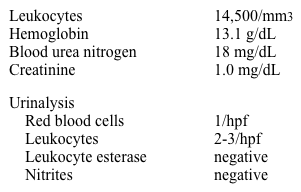 Which of the following is the most appropriate next test to diagnose this patient's condition?
A)Abdominal CT scan with contrast
B)Barium contrast enema
C)Sigmoidoscopy
D)Small bowel follow-through
E)Upright abdominal film
F)Urine culture
Which of the following is the most appropriate next test to diagnose this patient's condition?
A)Abdominal CT scan with contrast
B)Barium contrast enema
C)Sigmoidoscopy
D)Small bowel follow-through
E)Upright abdominal film
F)Urine culture (Not Answered)
This question doesn't have any answer yet
A 59-year-old man comes to the emergency department due to lower abdominal pain. The patient has had 2 days of fever, chills, dysuria, and pelvic pain; this morning, he was unable to pass any urine. He has never had similar symptoms before and has no history of chronic urinary or bowel issues. Medical history is significant for hyperlipidemia and coronary artery disease. Temperature is 39 C (102.2 F), blood pressure is 140/90 mm Hg, and pulse is 98/min. Suprapubic fullness and tenderness are present. Digital rectal examination shows an edematous and exquisitely tender prostate. The external genitalia are normal. A suprapubic catheter is placed, which drains 800 mL of urine. Laboratory examination reveals the following:  Which of the following is the most appropriate pharmacotherapy for this patient?
 (Multiple Choice)
5.0/5 (72)
(72) A 42-year-old man with a history of Crohn disease comes to the office for follow-up. He had a partial ileal resection due to a stricture and also had multiple surgeries to treat an enterocutaneous fistula. The patient has received parenteral nutrition for the past several weeks and recently restarted oral feeding. He reports nonbloody diarrhea but no fever or abdominal pain. The patient says that food does not taste the same as before. On examination, he has patchy alopecia and a pustular, crusting skin rash with scaling and erythema around the mouth and on the extremities. No abdominal tenderness is present and bowel sounds are normal. The jugular venous pulse is normal and there is no lower extremity edema. Which of the following is most likely to improve this patient's current condition?
(Multiple Choice)
4.9/5 (77)
(77) 
Filters
- Essay(0)
- Multiple Choice(0)
- Short Answer(0)
- True False(0)
- Matching(0)