



 Chat with AI
Exam 4: Surgery

Exam 1: Medicine2 k Questions
Exam 2: Pediatric723 Questions
Exam 3: Psychiatry336 Questions
Exam 4: Surgery563 Questions
Exam 5: Obstetrics & Gynecology469 Questions
Select questions type


A 28-year-old woman develops tachycardia in the postoperative recovery room. She was admitted for a right femur fracture following a motor vehicle collision and had an open reduction and internal fixation of the fracture. While in the recovery area, she began experiencing nausea and vomiting, and became anxious and agitated. The patient has no known medical problems. She drinks 1 or 2 glasses of wine on weekends. Her temperature is 39.4 C (103 F), blood pressure is 160/90 mm Hg, pulse is 148/min, and respirations are 24/min. Pulse oximetry shows 98% on room air. On examination, the patient is delirious and has fine tremor. Mild lid lag is present. She has no muscle rigidity and deep-tendon reflexes are 2+ in the bilateral extremities. Laboratory results are as follows: 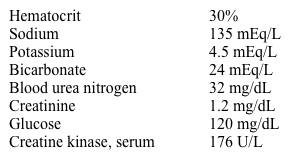 Which of the following is the best next step in management of this patient?
 (Multiple Choice)
4.9/5  (67)
(67) A 76-year-old woman comes to the emergency department with a 2-day history of lower abdominal pain. She also has mild nausea without vomiting. Her other medical problems include arthritis and constipation. Current medications include acetaminophen and docusate. Temperature is 37.9 C (100.2 F), blood pressure is 144/92 mm Hg, and pulse is 90/min. Physical examination shows left lower quadrant tenderness on deep palpation. CT scan of the abdomen shows sigmoid diverticula and perisigmoid stranding suggestive of inflammation. The patient is started on oral ciprofloxacin and metronidazole. Three days later, she returns to the emergency department due to persistent abdominal pain, nausea, and fever. Her last bowel movement was 12 hours ago. Examination shows left lower quadrant tenderness without guarding or rebound. Repeat CT scan shows a 5-cm rim-enhancing perisigmoid fluid collection. Laboratory results are as follows: 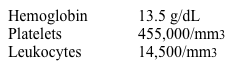 Which of the following is the most appropriate next step in management of this patient?
 (Multiple Choice)
4.8/5 (71)
(71) A 77-year-old woman comes to the office due to a skin lesion. The patient first noticed it a few weeks ago when it grew rapidly and became painful. However, since she scheduled her appointment 3 weeks ago, the lesion has become somewhat smaller and less painful. Skin examination findings are as shown below: 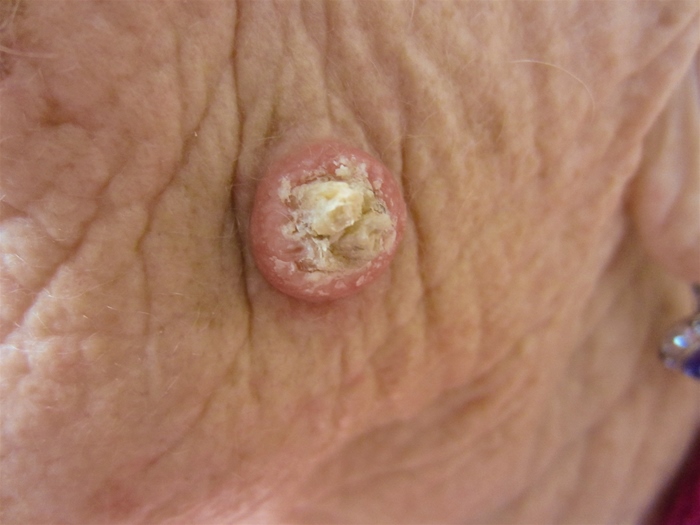 Which of the following is the most likely diagnosis of this patient's skin lesion?
 (Multiple Choice)
4.8/5 (81)
(81) A previously healthy 45-year-old woman is brought to the emergency department after she slipped and fell backward down half a flight of stairs. She did not hit her head or lose consciousness. The patient has right-sided back and chest pain. Blood pressure is 138/88 mm Hg, pulse is 88/min, and respirations are 24/min. Oxygen saturation is 98% on room air. On physical examination, the patient is alert and taking shallow breaths. Breath sounds are symmetric and heart sounds are normal. The right posterior chest wall is tender to palpation, without crepitus or bony step-offs. Chest x-ray reveals a minimally displaced, posterior fracture of the right sixth rib and bilateral basilar atelectasis, with no pneumothorax or pleural effusion. Which of the following is most essential for preventing pulmonary complications in this patient?
(Multiple Choice)
4.9/5 (84)
(84) A 17-year-old boy is brought to the emergency department following a motor vehicle accident. He is found to have an extensive cerebral hemorrhage leading to deep coma, as well as fractures of the C4 vertebra, pelvis, and right femur. Following admission to the hospital, he is intubated and central lines are placed. The patient develops acute renal failure due to rhabdomyolysis, which improves rapidly with treatment. He is extubated after regaining consciousness. He also undergoes percutaneous endoscopic gastrostomy tube placement due to persistent problems with swallowing. The patient is unable to ambulate due to quadriparesis resulting from cervical cord injury. Four weeks after his initial injury, he develops nausea and polyuria. His laboratory results are as follows: 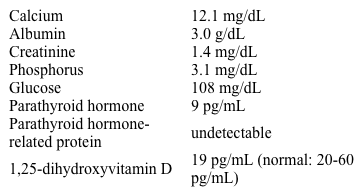 Which of the following is the most likely cause of this patient's hypercalcemia?
 (Multiple Choice)
4.8/5 (68)
(68) A 68-year-old woman comes to the office due to a groin bulge. She first noticed it 2 months ago and says that it gets larger with prolonged standing and shrinks with lying down, but it is not painful. There has been no trauma to the area. The patient has had no fever, nausea, anorexia, weight loss, abdominal pain, or urinary symptoms. She has a history of obstructive pulmonary disease with occasional exacerbations and hypertension. The patient has smoked a pack of cigarettes daily for 45 years. Temperature is 36.9 C (98.4 F), blood pressure is 140/80 mm Hg, pulse is 78/min, and respirations are 16/min. BMI is 34 kg/m2. Oxygen saturation is 95% on room air. Cardiopulmonary examination shows mildly decreased breath sounds bilaterally. The abdomen is soft and nontender; bowel sounds are normal. There is a 2-cm groin mass below the right inguinal ligament, which is medial to the right femoral artery; no tenderness, pulsations, or overlying erythema is present. The mass is tympanitic to percussion. Which of the following is the best next step in management of this patient?
(Multiple Choice)
4.8/5 (64)
(64) A 68-year-old man is recovering in the intensive care unit after coronary artery bypass graft surgery. Two weeks ago, he was seen in the office for progressive exertional angina and shortness of breath. The patient underwent coronary angiography, which indicated severe extensive coronary artery disease. After discussion about the risks and benefits, he agreed to proceed with open heart surgery. The patient has a family history of coronary artery disease but no sudden cardiac death, heart failure, or bleeding. On postoperative day 1, the nurses report that the patient is confused and has had reduced urine output. Temperature is 35.6 C (96 F), blood pressure is 80/50 mm Hg, pulse is 118/min and regular, and respirations are 22/min. There is no drainage from his sternal wound, and there has been no drainage in the chest tube over the last 4 hours. The lung fields are clear. No heart murmurs are appreciated. The abdomen is soft. His extremities are cool. ECG shows sinus tachycardia and nonspecific T-wave changes. Pulmonary artery catheter readings are as follows: Right atrium 20 mm Hg (normal: 2-8 mm Hg), right ventricle 35/20 mm Hg (normal: 15-30 mm Hg / 2-8 mm Hg), and pulmonary capillary wedge pressure 20 mm Hg (normal: 6-12 mm Hg). Which of the following is the most appropriate next step in management of this patient?
(Multiple Choice)
4.8/5 (76)
(76) A 42-year-old man comes to the emergency department due to epigastric abdominal pain. The pain started acutely this morning and is constant and unrelated to eating. The patient describes it as severe and worsening in intensity over time. He also has had chills, rigors, and shortness of breath but has no chest pain, vomiting, melena, diarrhea, or hematochezia. The patient was discharged from the hospital 3 days ago after a Roux-en-Y gastric bypass surgery with no intraoperative complications. Medical history is otherwise significant for morbid obesity and type II diabetes mellitus. He does not use tobacco or alcohol. Temperature is 38.4 C (101.1 F), blood pressure is 110/78 mm Hg, pulse is 125/min, and respirations are 21/min. Oxygen saturation is 96% on room air. Physical examination shows no scleral icterus and moist mucous membranes. Heart sounds are normal with no murmurs, rubs, or gallops. The lungs are clear to auscultation bilaterally. The abdomen is tender to palpation in the epigastrium and is moderately distended. There is no rebound tenderness or guarding. The surgical incision shows mild surrounding erythema with no bleeding or drainage. Laboratory studies are as follows:  Which of the following is the best next step in management of this patient?
 (Multiple Choice)
4.8/5 (73)
(73) A 34-year-old woman comes to the office due to vague chest discomfort. She has no other medical conditions, although she has recently had several upper respiratory tract infections. Temperature is 37.2 C (99 F), blood pressure is 122/78 mm Hg, pulse is 70/min, and respirations are 16/min. The patient is alert and in no distress. The lungs are clear to auscultation bilaterally. Heart sounds are normal and without murmurs. The abdomen is soft and nondistended. ECG shows a normal sinus rhythm. Chest x-ray reveals an enlarged mediastinum. CT scan of the chest reveals a mass in the middle mediastinum. Which of the following is the most likely diagnosis in this patient?
(Multiple Choice)
4.9/5 (74)
(74) A 34-year-old woman comes to the office due to difficulty hearing, especially in the left ear. The hearing loss has worsened over the past year, and she is now having trouble hearing people at work; however, when the environment is noisy, she can understand speech better than when she is in a quiet room. The patient also hears ringing in the left ear. She has no dizziness, vertigo, or ear pain. She has had no significant noise exposure. The patient has no other medical conditions and takes no medications. Her mother had surgery for hearing loss when she was in her 40s. On examination, the tympanic membranes are clear with a good light reflex, good landmarks, and no middle ear effusion. There is a slight reddish hue behind the left tympanic membrane. Which of the following is the most likely mechanism of this patient's condition?
(Multiple Choice)
4.8/5 (90)
(90) A 30-year-old woman comes to the office for evaluation of left knee pain. She was participating in a recreational hockey tournament over the weekend when she collided with another player, and they both hit the wall. The patient was able to skate off the ice but noted some tightness in the left knee. She had partial pain relief with ice and elevation of the left leg but noticed that her knee was somewhat swollen the next morning. On examination, the patient has a small left knee effusion without erythema or palpable warmth. There is tenderness at the medial aspect of the knee at the joint line, but gait is normal. With the patient standing on the left leg and the knee bent slightly, internal rotation on the knee elicits a click and significant, sharp pain. X-ray of the knee joint reveals no abnormalities. Which of the following is the most likely diagnosis in this patient?
(Multiple Choice)
4.7/5 (72)
(72) A 43-year-old construction worker is brought to the emergency department after falling 6.1 m (20 ft) from faulty scaffolding. The patient has severe chest pain and appears scared. Blood pressure is 136/92 mm Hg, and pulse is 120/min. Chest x-ray is shown below. 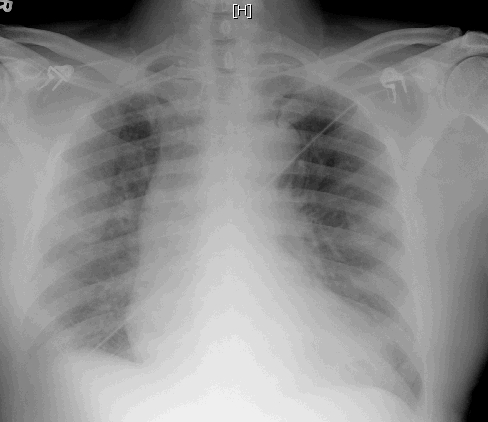 Which of the following is the most likely diagnosis in this patient?
 (Multiple Choice)
4.9/5 (74)
(74) A 37-year-old woman comes to the emergency department due to severe, left-sided flank pain that started a day ago. The pain began acutely, is intermittent and colicky, and radiates to the groin. The patient has had associated nausea, 2 episodes of vomiting, and hematuria. Today she developed fever and chills. The patient has no prior medical conditions and takes no medications. Temperature is 38.4 C (101.1 F), blood pressure is 140/86 mm Hg, pulse is 105/min, and respirations are 18/min. Physical examination shows left costovertebral angle tenderness to percussion. A CT scan of the abdomen and pelvis without contrast reveals a 5-mm stone in the left midureter with dilation of the proximal ureter. Which of the following is the strongest indication for an urgent urologic consultation with this patient?
(Multiple Choice)
4.8/5 (81)
(81) A 38-year-old hospitalized man is evaluated for persistent fever. He has a history of paraplegia after spinal injury and was admitted 2 weeks ago due to septic shock from an infected sacral pressure ulcer. His condition improved with broad-spectrum antibiotics, intravenous fluids, vasopressors, and wound debridement, but he has been having recurrent fevers for the past 4 days. The patient also has a history of asthma and takes an inhaled glucocorticoid and bronchodilator. Temperature is 38.3 C (101 F), blood pressure is 120/80 mm Hg, and pulse is 96/min. Several white patches are present on the oral mucosa. There is a peripherally inserted central venous catheter in the right arm with mild tenderness but no surrounding erythema. The sacral pressure ulcer has pink granulation tissue with a mild amount of serosanguinous fluid. A chronic indwelling urinary catheter is draining yellow-colored urine. Repeat blood cultures grow budding yeasts. Which of the following is the most likely source of the organism in this patient's blood culture?
(Multiple Choice)
4.7/5 (81)
(81) A 36-year-old man comes to the emergency department due to a week of progressive right upper quadrant pain, malaise, anorexia, and fever. Three months ago, he returned from a vacation in Nepal, where he hiked in the mountains. During his trip, the patient had several self-resolving episodes of diarrhea. He also had unprotected sexual intercourse with a woman he met during the trip. He received no prophylactic vaccinations or oral medications prior to travel. Temperature is 38.5 C (101.3 F), blood pressure is 120/70 mm Hg, and pulse is 96/min. Breath sounds are decreased in the right lung base. The liver is palpable 3 cm below the right costal margin with a tender, smooth edge. There is no splenomegaly. Laboratory results are as follows: Abdominal ultrasonography reveals a small, solitary hypoechoic lesion on the right lobe of the liver. Which of the following is the most likely cause of this patient's condition?
(Multiple Choice)
4.8/5 (77)
(77) A 55-year-old woman undergoes allogeneic hematopoietic stem cell transplantation from an HLA-matched, unrelated donor for treatment of acute myeloid leukemia. She received conditioning chemotherapy prior to the transplantation, and her immediate post-transplant course was uncomplicated. However, 3 weeks after the transplant, the patient develops worsening crampy abdominal pain and diarrhea. The diarrhea is watery and persistent, even at night, with output up to 3 liters daily. No particular food makes the symptoms better or worse. Medications include tacrolimus, prophylactic acyclovir, trimethoprim-sulfamethoxazole, and voriconazole. The patient has no other chronic medical conditions. She has been in the hospital since the transplantation and is on a low-microbial diet. Physical examination shows generalized maculopapular rash. Stool testing for Clostridioides (formerly Clostridium) difficile and PCR testing for cytomegalovirus are negative. Which of the following is the most likely cause of this patient's diarrhea?
(Multiple Choice)
4.8/5 (79)
(79) A 75-year-old man undergoes surgical repair of a large abdominal aortic aneurysm. Postoperatively, he develops left lower quadrant abdominal pain followed by bloody diarrhea. The patient has a history of prostate cancer and received radiation therapy several years ago. His other medical problems include type 2 diabetes mellitus, hypertension, and hypercholesterolemia. He eats a low-fiber diet and recently quit smoking. Vital signs show a low-grade fever. Examination shows tenderness in the left lower quadrant, with gross blood visible on rectal examination. CT scan of the abdomen demonstrates thickening of the colon at the rectosigmoid junction. On colonoscopy, ulcerations are seen in the same area, but the colon proximal and distal to the lesions is completely normal. Which of the following is the most likely cause of his symptoms?
(Multiple Choice)
4.9/5 (90)
(90) A 34-year-old man is admitted to the hospital following laparotomy for a gunshot wound. He received 5 units of packed red blood cells during surgery. Prophylactic perioperative ampicillin/sulbactam was given, and the patient performed incentive spirometry. On post-operative day 6, he develops a fever of 38.7 C (101.7 F). Blood pressure is 120/76 mm Hg, pulse is 97/min, and respirations are 14/min. On examination, the patient is alert and in no acute distress. The oropharynx is clear. Cardiopulmonary examination is normal. The abdomen is soft and nontender, and there is no discharge from the wound. He has a right internal jugular triple-lumen catheter and a Foley catheter in place. The extremities have no swelling or erythema. Two days later, blood cultures of samples taken from the triple-lumen catheter and a peripheral site grow coagulase-negative staphylococci in 4 of 4 bottles. What is the most likely cause of this patient's current condition?
(Multiple Choice)
5.0/5 (66)
(66) A 3-year-old boy is brought to the emergency department after swallowing a battery. About an hour ago, his father was changing his watch battery when the patient grabbed and swallowed it and then coughed for several minutes. Since then, he has been able to drink and talk normally. Vital signs are normal. The patient appears alert and comfortable. He is not drooling, and the posterior oropharynx is clear. The lungs are clear to auscultation bilaterally. Cardiac examination is unremarkable. The abdomen is soft and nontender. Chest x-ray on anteroposterior view shows a radiopaque, circular object with a halo sign. The lateral view is shown below: 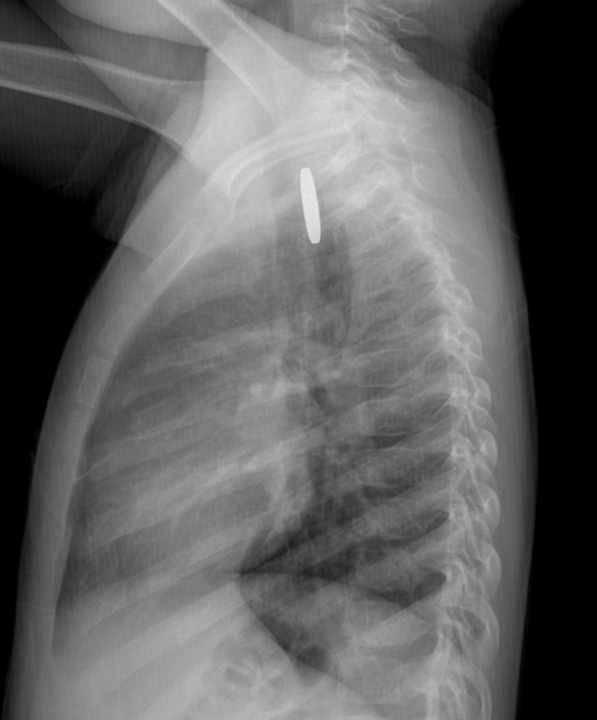 Which of the following is the best next step in management of this patient?
 (Multiple Choice)
4.9/5 (78)
(78) A 34-year-old man comes to the emergency department for right upper quadrant abdominal pain. The pain started abruptly 24 hours ago and is described as constant, severe, and progressive. The patient was hospitalized 6 months ago for similar symptoms that were resolved with antibiotics. Review of systems is positive for occasional bloody stools. There is no relevant family history, and the patient does not use tobacco, alcohol, or illicit drugs. Temperature is 39.8 C (103.6 F), blood pressure is 90/50, pulse is 120/min, and respirations are 22/min. The patient is lethargic and difficult to arouse. Scleral icterus is present. Cardiopulmonary examination is unremarkable. The abdomen is tender to palpation in the right upper quadrant. Laboratory evaluation reveals the following: 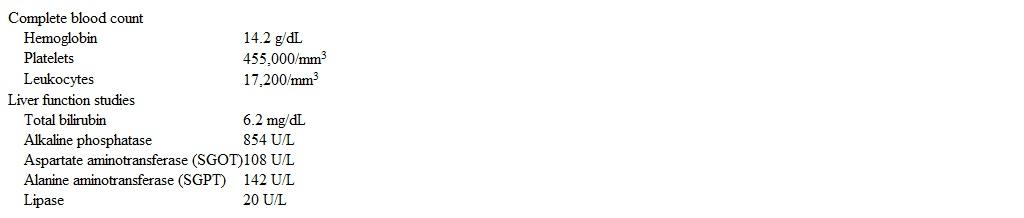 Right upper quadrant ultrasound is normal. Which of the following is the most likely cause of this patient's presentation?
 (Multiple Choice)
4.9/5 (92)
(92) 
Filters
- Essay(0)
- Multiple Choice(0)
- Short Answer(0)
- True False(0)
- Matching(0)