Multiple Choice
A 28-year-old woman develops tachycardia in the postoperative recovery room. She was admitted for a right femur fracture following a motor vehicle collision and had an open reduction and internal fixation of the fracture. While in the recovery area, she began experiencing nausea and vomiting, and became anxious and agitated. The patient has no known medical problems. She drinks 1 or 2 glasses of wine on weekends. Her temperature is 39.4 C (103 F) , blood pressure is 160/90 mm Hg, pulse is 148/min, and respirations are 24/min. Pulse oximetry shows 98% on room air. On examination, the patient is delirious and has fine tremor. Mild lid lag is present. She has no muscle rigidity and deep-tendon reflexes are 2+ in the bilateral extremities. Laboratory results are as follows: 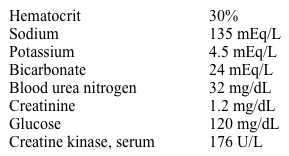 Which of the following is the best next step in management of this patient?
A) Echocardiogram
B) Fluid bolus and intravenous dexamethasone
C) Intravenous dantrolene
D) Intravenous lorazepam
E) Plasma free metanephrines
F) Thyroid function tests and propranolol
Correct Answer:

Verified
Correct Answer:
Verified
Q196: A 24-year-old woman comes to the office
Q197: A 40-year-old man comes to the office
Q198: A 25-year-old man comes to the office
Q199: A 35-year-old woman is brought to the
Q200: A 46-year-old man with autosomal dominant polycystic
Q202: A 76-year-old woman comes to the emergency
Q203: A 77-year-old woman comes to the office
Q204: A previously healthy 45-year-old woman is brought
Q205: A 17-year-old boy is brought to the
Q206: A 68-year-old woman comes to the office