



 Chat with AI
Exam 4: Surgery

Exam 1: Medicine2 k Questions
Exam 2: Pediatric723 Questions
Exam 3: Psychiatry336 Questions
Exam 4: Surgery563 Questions
Exam 5: Obstetrics & Gynecology469 Questions
Select questions type


A 3-year-old girl is evaluated for hoarseness that has been getting worse over the past 2 months. The patient has had no fever, shortness of breath, or change in activity level. She is eating normally, gaining weight well, and does not seem to be in pain. Vital signs are within normal limits. On physical examination, the ears are normal appearing with no middle ear fluid. The nasal mucosa is clear with no rhinorrhea, and the turbinates are normal in size. There are no oral mucosal lesions. The tonsils are small and nonobstructive. There is no cervical lymphadenopathy. Aside from hoarseness, examination of cranial nerves is normal. Flexible laryngoscopy shows several finger-shaped lesions on both vocal cords. Which of the following is the most likely cause of this patient's current condition?
(Multiple Choice)
4.9/5  (73)
(73) A 31-year-old man is brought to the emergency department after being involved in a motor vehicle collision as an unrestrained passenger. He was given 3 L of normal saline in the ambulance on the way to the hospital and has been receiving 5 L/min of oxygen by nasal cannula. The patient is agitated and moves all 4 extremities spontaneously. Blood pressure is 82/50 mm Hg, heart rate is 130/min, and respirations are 30/min. On examination, the pupils are symmetric and reactive to light. The neck veins are flat, and the trachea is shifted slightly to the right. Over the left chest, breath sounds are diminished and there is dullness to percussion. Which of the following is the most likely diagnosis?
(Multiple Choice)
4.7/5 (93)
(93) A 45-year-old woman comes to the emergency department with colicky pain in the right upper quadrant. Her pain started about an hour ago after a large, fatty meal and is associated with nausea. The patient had a similar episode a week ago that resolved spontaneously. She has no vomiting or diarrhea. The patient had a cholecystectomy 2 years ago due to symptomatic cholelithiasis. Her other medical problems include hyperlipidemia and obesity. The patient does not use tobacco, alcohol, or illicit drugs. Temperature is 37 C (98.6 F), blood pressure is 140/85 mm Hg, and pulse is 110/min. Cardiopulmonary examination is unremarkable except for tachycardia. She has right upper quadrant tenderness to deep palpation without guarding or rebound tenderness. Bowel sounds are normal. Rectal examination is normal and stool is negative for blood. Laboratory results are as follows:  Abdominal ultrasonography reveals a mildly dilated common bile duct but no stones. While in the emergency department, the patient receives morphine for pain control, but the pain worsens. Which of the following is the most likely diagnosis in this patient?
 (Multiple Choice)
4.8/5 (83)
(83) A 42-year-old woman comes to the office due to bloody discharge from her right nipple. She has had no breast pain, swelling, or trauma but stopped breastfeeding 3 months ago. She has never had mammography. The patient has no chronic medical conditions. Vital signs are normal. Examination reveals symmetric pendulous breasts without any ulceration, crusting, or scaling of the nipple-areolar complexes. Manual pressure elicits bloody discharge from a single duct of the right nipple. A firm, ill-defined, 2-cm mass is palpable in the lower outer quadrant of the right breast with retraction of the overlying skin. The left breast is normal to palpation, and no axillary or supraclavicular lymphadenopathy is present bilaterally. Which of the following is the most likely diagnosis in this patient?
(Multiple Choice)
4.9/5 (79)
(79) A 25-year-old man comes to the office due to decreased force of the urinary stream and incomplete emptying of the bladder. He has no urgency, frequency, nocturia, dysuria, or fever. Bowel movements are regular. The patient has no chronic medical conditions and takes no medications. Vital signs are within normal limits. The abdomen is soft and nontender. External genitalia are normal; no penile discharge is noted. No inguinal lymphadenopathy is present. Neurologic examination shows no abnormalities. Urinalysis is normal. Postvoid residual volume is high. What is the most likely cause of this patient's current condition?
(Multiple Choice)
4.9/5 (83)
(83) A 58-year-old man comes to the office due to a hard mass on the posterior left elbow. The mass has been growing for the past 3 years. The patient has had no fever, pain, weight loss, or trauma. Medical history includes hypertension, chronic kidney disease, and gout. On examination, there is a 3 × 3 cm, nontender, hard mass just under the skin in the posterior left elbow. The elbow is not red, warm, or tender. Elbow imaging shows a 3-cm, soft tissue mass and bone erosions with overhanging edges of cortical bone at the olecranon process. Serum creatinine is 1.7 mg/dL. Which of the following conditions most likely explains this patient's findings?
(Multiple Choice)
4.9/5 (74)
(74) A 48-year-old woman comes to the hospital for elective cholecystectomy. The patient has had postprandial upper abdominal pain and nausea for the past several months, and ultrasonography revealed gallstones. After discussion of risks and benefits, laparoscopic cholecystectomy was planned. Her other medical conditions include obesity and hypertension. In preparation for the surgery, general anesthesia with endotracheal intubation is administered. Immediately after a needle is placed into the intraperitoneal space and CO2 gas insufflation is performed, severe sinus bradycardia and transient atrioventricular block is noted. Which of the following is the most likely cause of the observed intraoperative finding in this patient?
(Multiple Choice)
4.8/5 (76)
(76) A 56-year-old man is admitted to the intensive care unit due to septic shock from pneumonia and is treated with intravenous fluids, antibiotics, and vasopressors. Four days later, the patient's hemodynamic and respiratory status has improved, but he has worsening anemia with positive stool occult blood. He has had no abdominal pain, nausea, vomiting, hematemesis, diarrhea, or hematochezia. Medical history includes hypertension but no prior gastrointestinal disorders. The patient is a smoker with a 40-pack-year history. Medications are intravenous ceftriaxone and azithromycin. Temperature is 37.2 C (99 F), blood pressure is 110/66 mm Hg, and pulse is 84/min. Physical examination reveals right lung crackles and no abdominal tenderness. Hemoglobin is 10.2 g/dL (12.6 g/dL at admission), platelets are 180,000/mm3, and leukocytes are 12,000/mm3. Which of the following is the most likely cause of this patient's anemia?
(Multiple Choice)
4.8/5 (85)
(85) A 35-year-old man comes to the office due to a 2-month history of a skin bump on his lower back. He noticed a similar bump in the same location 6 months ago, which spontaneously resolved after 3 weeks. The patient recalls no trauma preceding either occurrence. The bump has grown slightly larger in the past month, but there is no associated pruritus, pain, or other symptoms. His medical history is unremarkable, and he has no history of tobacco or alcohol use. Vital signs are within normal limits. Skin examination shows a firm, mobile nodule, as shown in the image below. There is no drainage from the lesion or tenderness to palpation. The lesion does not change shape when pinched at the edges. The remainder of the physical examination is within normal limits. 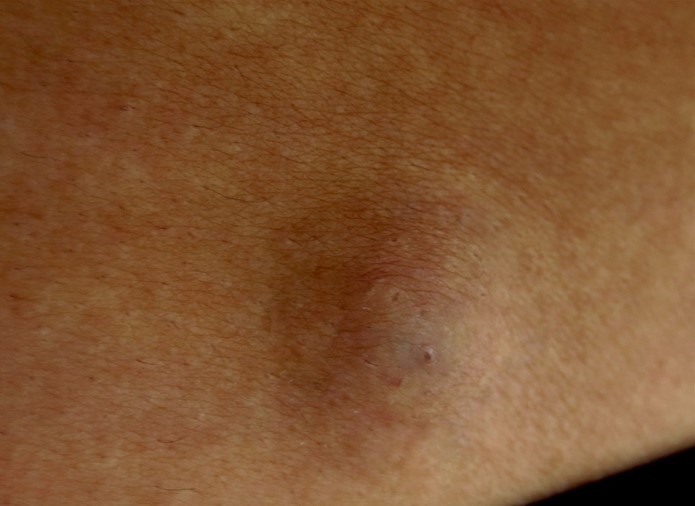 Which of the following is the most likely diagnosis?
 (Multiple Choice)
4.9/5 (83)
(83) A 34-year-old man is brought to the emergency department after a snowmobile accident. The patient was thrown 3 m (9.8 feet) and was dazed for several minutes afterward, although he was wearing a helmet and did not lose consciousness. He now has left mid-back pain. Blood pressure is 130/76 mm Hg and pulse is 98/min. Breath sounds are clear and symmetric. Heart sounds are normal. The abdomen is soft and nontender. There are no areas of spinal tenderness or step-offs. The left costovertebral area is tender to palpation. Focused Assessment with Sonography for Trauma reveals no pericardial or intraperitoneal free fluid, and chest and pelvic x-rays are normal. The patient provides a clear urine sample without pain or difficulty. Urinalysis shows 11-25 erythrocytes/hpf. Complete blood count, serum electrolytes, and creatinine are within normal limits. Which of the following is the best next step in management of this patient?
(Multiple Choice)
4.9/5 (70)
(70) A 54-year-old woman comes to the emergency department due to 2 days of abdominal pain. She has also had anorexia, nausea, hiccups, and shortness of breath. The patient was diagnosed with acute appendicitis and underwent a laparoscopic appendectomy 10 days ago. She had been recovering well until the abdominal pain returned. The patient has a history of type 2 diabetes mellitus and prior cholecystectomy for choleliths. Temperature is 39.3 C (102.8 F), blood pressure is 120/70 mm Hg, pulse is 94/min, and respirations are 24/min. BMI is 30 kg/m2. No scleral icterus or skin rash is present. Breath sounds are decreased at the right base. The abdomen is mildly distended, and palpation of the right upper quadrant elicits pain. The abdominal surgical incisions are mildly tender without surrounding erythema or discharge. Bowel sounds are decreased. Leukocyte count is 24,000/mm3, and chest x-ray reveals a right pleural effusion. Which of the following is the most likely cause of this patient's current condition?
(Multiple Choice)
4.9/5 (76)
(76) A 78-year-old man comes to the office due to lower extremity swelling. He has had progressive exertional dyspnea over the past 2 years. Over the past 2 months, the patient has noticed lower extremity swelling, decreased appetite, and increased abdominal girth. He has a history of poorly controlled hypertension but no known coronary artery disease. The patient is a lifetime nonsmoker. He has no history of prior surgeries. Blood pressure is 165/88 mm Hg and pulse is 72/min and regular. He is afebrile. On physical examination, the jugular veins are distended and there are prominent V waves. A holosystolic murmur is heard at the lower sternal border, and there is 3+ pitting edema of the lower extremities bilaterally. Which of the following best explains the physical examination findings in this patient?
(Multiple Choice)
4.8/5 (92)
(92) A 35-year-old man comes to the office due to a 1-week history of excruciating pain during defecation. The pain is so severe that he avoids defecating. The caliber of the patient's stool has not changed, but he has had visible bright red blood on the surface of the stool. His medical history is significant for chronic constipation. The patient is taking no medications and does not use tobacco, alcohol, or illicit drugs. Vital signs are normal. On examination, the abdomen is soft with normal bowel sounds. Rectal examination shows a posterior mucosal tear of the anus and a skin tag. In addition to stool softeners and sitz baths, which of the following is the most appropriate next step in management?
(Multiple Choice)
4.9/5 (64)
(64) A 56-year-old woman comes to the office due to eye irritation, painful eye movements, and diplopia. Over the last few weeks, she has also experienced weight loss and fatigue. The patient smokes a pack of cigarettes a day and has a 25-pack-year history. Other medical problems include chronic obstructive pulmonary disease treated with an inhaled corticosteroid and bronchodilators. She also suffered a head injury in a motor vehicle accident 6 months ago. Blood pressure is 146/70 mm Hg, pulse is 110/min, and respirations are 18/min. On physical examination, the patient is unable to maintain eye convergence and experiences diplopia on upward gaze. Her eyes are shown in the image below. 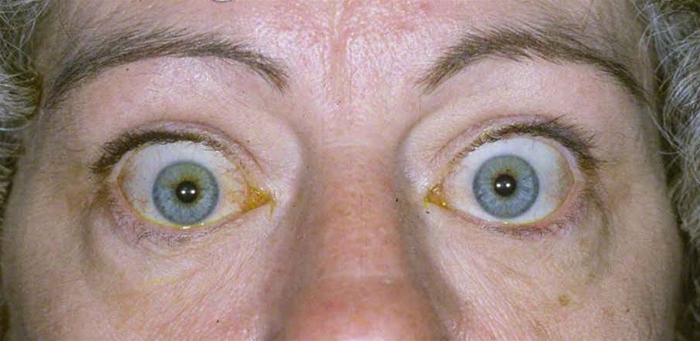 Which of the following is the most likely cause of this patient's examination findings?
 (Multiple Choice)
4.8/5 (69)
(69) A 45-year-old woman comes to the office for evaluation of right lateral hip pain. The pain, which started 2 months ago after a long hike in the mountains, is burning, constant, and worse when the patient rises from a chair or climbs stairs. She tried rest, heat, and high-dose naproxen therapy without relief. The patient's other medical conditions include obesity and plantar fasciitis. Vital signs are within normal limits. BMI is 39 kg/m2. Examination shows point tenderness over the greater trochanter. Passive leg abduction worsens the pain. Muscle power, deep tendon reflexes, and sensation are normal. Which of the following is the most appropriate therapy for this patient?
(Multiple Choice)
4.9/5 (76)
(76) A 44-year-old woman comes to the emergency department with severe epigastric pain that radiates to her back. The pain was sudden in onset and has remained steady for the past several hours. She has associated nausea and vomiting. Past medical history is notable for a surgically repaired femoral hernia and appendectomy as a child. The patient takes no medications and does not use tobacco, alcohol, or recreational drugs. Temperature is 37.2 C (98.9 F), blood pressure is 112/70 mm Hg, pulse is 98/min, and respirations are 18/min. BMI is 35 kg/m2. Examination shows an agitated woman who sits leaning forward on the bed. Her skin has no evidence of icterus or excoriations. Lungs are clear to auscultation and heart sounds are normal. There is moderate tenderness in the epigastrium but no guarding, rebound tenderness, or hepatosplenomegaly. Bowel sounds are normal. Laboratory results are as follows: 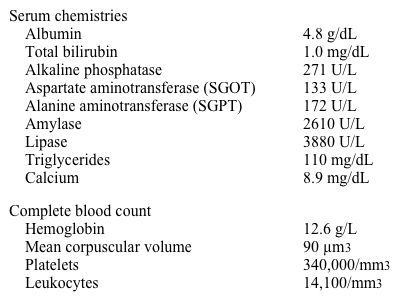 Which of the following is the best next step in evaluating the underlying etiology for this patient's acute condition?
 (Multiple Choice)
4.9/5 (77)
(77) A 41-year-old woman comes to the office for the evaluation of a lump on her left breast. She feels, "generally well," and denies having any medical problems. She takes a multivitamin and Tums daily. She stopped smoking after getting married 21 years ago. She drinks wine only on weekends. Her only surgery was a bilateral tubal ligation last year, after giving birth to her fourth child. Physical examination of the left breast reveals a 4 cm lump at the 11 o' clock position and two axillary nodes on the left side. Mammography shows irregular micro-calcifications. The result of the FNA is suggestive for infiltrating ductal carcinoma. Which of the following is the single most important prognostic factor in this patient?
(Multiple Choice)
4.8/5 (76)
(76) A 36-year-old woman undergoes an abdominal hysterectomy for symptomatic uterine fibroids. Medical history is otherwise unremarkable, and preoperative blood cell counts, serum chemistry, and coagulation studies are normal. There are no intraoperative complications and blood loss is minimal. She receives postoperative morphine sulfate by patient-controlled analgesia and an intravenous infusion of 5% dextrose in 0.45% saline. The following day, the patient experiences increasing global headache and severe nausea and is noted to be confused. Temperature is 36.7 C (98.1 F), blood pressure is 110/70 mm Hg, pulse is 88/min, and respirations are 14/min. Twenty-four-hour urine output is 1600 mL. On physical examination, the patient is lethargic and disoriented. The abdomen is soft with mild incisional tenderness and decreased bowel sounds. Neurologic examination shows no focal weakness or sensory loss. Laboratory results are as follows:  Which of the following is the most appropriate intervention for this patient?
 (Multiple Choice)
4.8/5 (87)
(87) A 52-year-old woman undergoes laparoscopic cholecystectomy due to recurrent episodes of biliary colic. During the surgery, a blunt trocar is inserted near the umbilicus under direct vision (ie, open technique), and pneumoperitoneum is achieved via insufflation of the abdomen with carbon dioxide. Three additional trocars are inserted, and the cholecystectomy is completed uneventfully. After a period of observation in the postanesthesia care unit, the patient is discharged home. Three days later, the patient returns to the emergency department due to persistent abdominal pain and nausea. She takes acetaminophen and hydrocodone every 6 hours. Temperature is 38 C (100.4 F), blood pressure is 120/68 mm Hg, and pulse is 104/min. Physical examination shows intact port incisions with no erythema or discharge. There is mild generalized tenderness of the abdomen with some guarding. Bowel sounds are diminished. The remainder of the examination is normal. Laboratory testing shows leukocytes at 16,000/mm3; serum electrolytes and bilirubin are normal. Abdominal x-ray reveals generalized distension of the small and large bowel, stool in the distal colon, and intraperitoneal free air. Which of the following is the best next step in management of this patient?
(Multiple Choice)
4.8/5 (84)
(84) A 48-year-old man comes to the office for a routine medical evaluation and is found to have a skin lesion on his upper back. The patient is unsure when the lesion appeared but first noticed it several weeks ago during a shower. It is not painful, and he has no other symptoms. He has no chronic medical conditions and takes no medications. The patient drinks 1 or 2 beers nightly and does not use tobacco or illicit drugs. He works as a surfing instructor. Vital signs are within normal limits. Skin examination findings are shown in the exhibit.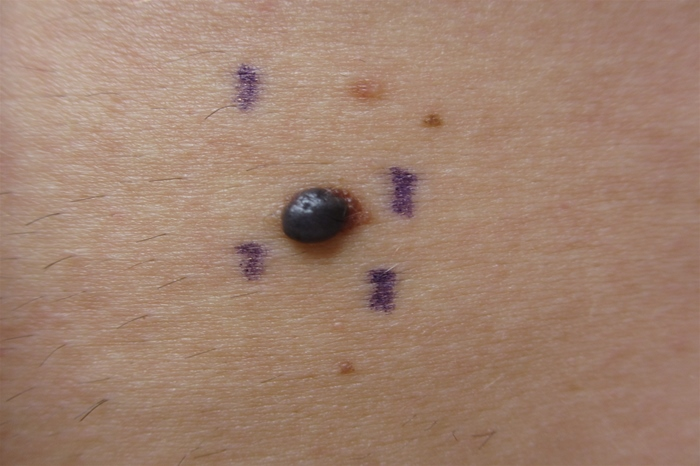 The remainder of the examination is normal. Which of the following is the most likely diagnosis?
 (Multiple Choice)
4.9/5 (78)
(78) 
Filters
- Essay(0)
- Multiple Choice(0)
- Short Answer(0)
- True False(0)
- Matching(0)