



 Chat with AI
Exam 4: Surgery

Exam 1: Medicine2 k Questions
Exam 2: Pediatric723 Questions
Exam 3: Psychiatry336 Questions
Exam 4: Surgery563 Questions
Exam 5: Obstetrics & Gynecology469 Questions
Select questions type


A 34-year-old roofer is brought to the emergency department due to an electrical injury. He was maneuvering an extended ladder when it contacted an overhead power line. The patient is alert and cooperative but has no recollection of the accident. Temperature is 37.8 C (100 F), blood pressure is 124/80 mm Hg, pulse is 92/min, and respirations are 20/min. Examination reveals that bilateral hands are charred, leathery, and insensate, and large, open wounds are present on the soles of both feet. ECG shows normal sinus rhythm. Based on these findings, the patient is at greatest risk for developing which of the following complications over the next several days?
(Multiple Choice)
4.8/5  (85)
(85) A 76-year-old man comes to the office due to constipation. He has infrequent bowel movements associated with straining during defecation. In addition, the patient has intermittent fecal leakage and hematochezia but no melena or unexpected weight loss. Medical history is notable for prostate cancer treated with external beam radiation and brachytherapy 18 months ago. Follow-up CT scans and prostate-specific antigen levels show no evidence of cancer recurrence. Temperature is 37.5 C (99.5 F), blood pressure is 132/80 mm Hg, pulse is 80/min, and respirations are 12/min. Conjunctival pallor is present. Cardiopulmonary examination is unremarkable. The abdomen is soft and nontender. Colonoscopy reveals rectal pallor with areas of mucosal hemorrhage and telangiectasias; the rest of the colon is unremarkable. Which of the following is most likely contributing to this patient's symptoms?
(Multiple Choice)
4.7/5 (87)
(87) A 4-month-old boy is brought to the office for "noisy breathing." The patient's parents first noticed a harsh sound when he cried at age 2 weeks, but it has gotten louder over the past month, especially when he is lying on his back. The noise seems to improve when the patient is held upright or during "tummy time." He does not appear to have labored breathing and has never turned blue. The patient has had occasional, small spit-ups after feeds but has been growing well along the 60th percentile for weight. He was born at full term without complications during pregnancy or labor and delivery. On physical examination, the patient has inspiratory stridor when he is supine that improves when he is prone. The remainder of the examination is normal. Which of the following would confirm the most likely diagnosis for this patient?
(Multiple Choice)
4.7/5 (89)
(89) A 28-year-old man is brought to the emergency department after a high-speed motor vehicle collision in which he was the restrained driver. The patient is awake and has left chest pain and vague abdominal discomfort. Blood pressure is 114/74 mm Hg and pulse is 112/min. Physical examination shows chest and abdominal ecchymoses and tenderness in the distribution of the seat belt. Breath sounds are equal bilaterally. Heart sounds are normal. The abdomen is mildly tender. Chest x-ray reveals a left sixth rib fracture without pneumothorax. Focused assessment with sonography is negative for free abdominal fluid. CT scan of the abdomen shows thickened proximal small bowel and a small mesenteric hematoma. The patient is hospitalized for monitoring and supportive care. Over the next 24 hours, he develops worsening abdominal pain, nausea, vomiting, and abdominal tenderness with guarding. Repeat CT scan of the abdomen is shown in the image below: 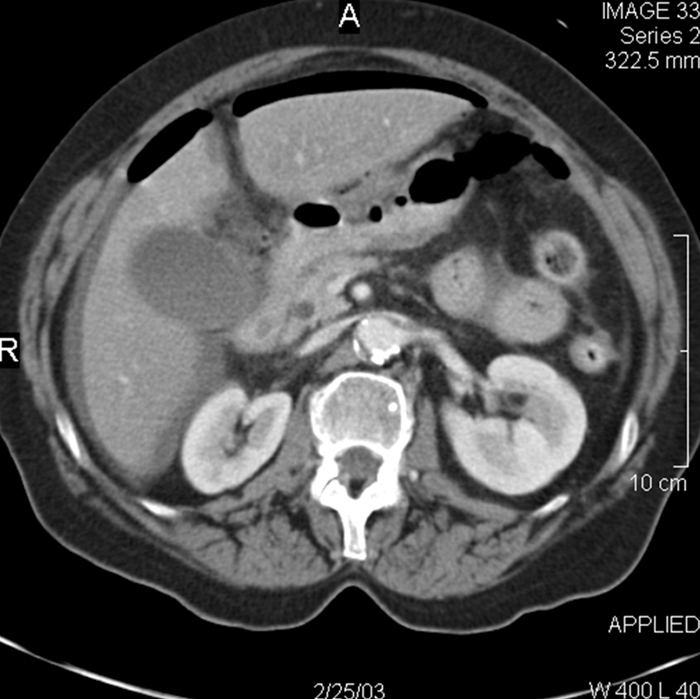 Which of the following is the best next step in management of this patient?
 (Multiple Choice)
4.9/5 (85)
(85) A 64-year-old man undergoes an emergency colonic resection for extensive ischemic colitis. He lives alone and consumes large amounts of alcohol. His family history is noncontributory. The patient is extubated on the 4th postoperative day. After extubation, he has episodes of confusion and agitation treated with lorazepam and haloperidol. He is also receiving piperacillin with tazobactam. The patient has had nothing by mouth since the surgery. On postoperative day 7, the nurse notices bleeding from a venipuncture site. His temperature is 36.7 C (98 F), blood pressure is 121/76 mm Hg, pulse is 80/min, and respirations are 16/min. Laboratory results are as follows: 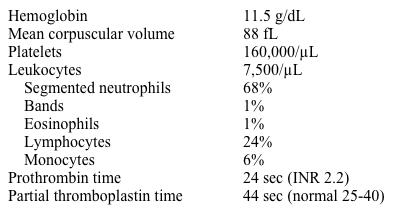 Which of the following is the most likely cause of this patient's current condition?
 (Multiple Choice)
4.8/5 (87)
(87) A 21-year-old man is brought to the emergency department after being stepped on by a bull approximately 30 minutes ago. The patient was bucked off of the bull, whose hind feet landed on his chest. On arrival, blood pressure is 75/50 mm Hg, pulse is 140/min, and respirations are 24/min. On examination, the patient moans in pain but does not answer questions. Two hoof prints are seen in the middle of the chest. He has decreased bilateral breath sounds, and crepitus is present over the anterior chest walls bilaterally. The abdomen is soft and nondistended. There is no obvious injury to the extremities, but they are cool, and capillary refill is decreased. Bilateral chest tubes are immediately placed, and 1.5 L of blood is returned from each side. Vital signs do not improve after placement of chest tubes. Four units of packed red blood cells are prepared for transfusion. What other blood products, if any, should also be administered at this time?
(Multiple Choice)
4.8/5 (76)
(76) A 16-year-old boy is evaluated due to new-onset jaundice. The patient was admitted to the hospital 24 hours ago after an emergency appendectomy, as well as drainage and irrigation of the peritoneal cavity, due to a perforated appendicitis. He has no chronic medical conditions. Current medications are intravenous morphine and piperacillin-tazobactam. The patient has not received blood products. Temperature is 38.1 C (100.6 F), blood pressure is 118/80 mm Hg, and pulse is 98/min. On examination, there is mild scleral icterus. Cardiopulmonary examination is normal. The laparotomy site is mildly tender; there is no rigidity or rebound tenderness. No drain was placed. Laboratory results are as follows: 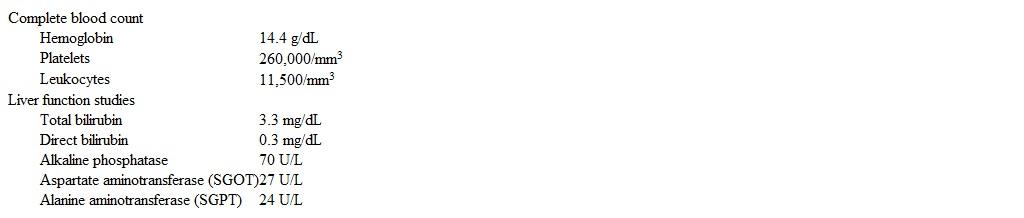 Which of the following is the most likely diagnosis?
 (Multiple Choice)
4.9/5 (92)
(92) A 24-year-old man comes to the office for evaluation of progressive enlargement of the breasts for 2 years. He reports normal early morning erections and has had no headaches, breast pain or discharge, or fatigue. The patient does not use alcohol or recreational drugs. Blood pressure is 110/70 mm Hg and pulse is 88/min. BMI is 35 kg/m2. Examination of the breast shows soft tissue enlargement without clearly defined, palpable borders or nodules. There is no tenderness, discharge, nipple retraction, or skin dimpling. The remainder of the physical examination is unremarkable. Which of the following is the most appropriate next step in management of this patient?
(Multiple Choice)
4.8/5 (86)
(86) A 64-year-old man comes to the emergency department with left ankle pain. The patient was playing tennis 2 days ago, attempted to pivot, and felt a sharp pain in his ankle. He has since had difficulty walking and stumbled on the stairs yesterday. On examination, the patient can bear weight, but it is painful. There is diffuse swelling of the ankle. Pulses and sensation in the left foot are normal. Passive range of motion is normal in all directions. Active plantar flexion and dorsiflexion are present. With the patient in the prone position, squeezing the left calf does not cause movement in the left foot. Left ankle x-ray shows soft tissue swelling but no fracture. Which of the following will be most impaired on physical examination?
(Multiple Choice)
4.9/5 (78)
(78) A 24-year-old man with hypoxic-ischemic brain injury is sent to the hospital from a nursing facility for evaluation of a skin ulcer. The patient has a history of injection drug use, and 6 months ago he was found unresponsive at home with agonal respirations and pulseless electrical activity. He required cardiopulmonary resuscitation, endotracheal intubation, and mechanical ventilation. Since then, the patient's neurocognitive functions have not improved, and he receives mechanical ventilation through a tracheostomy and feeding through a gastrostomy tube. Several days ago, the staff noticed a small ulceration over the patient's right heel, which has not healed. Temperature is 37 C (98.6 F), blood pressure is 110/70 mm Hg, and pulse is 68/min. He moans to painful stimuli but does not follow any instructions. Corneal and gag reflexes are present. Heart sounds are normal. Bilateral breath sounds are equal with no added sounds. The abdomen is soft and nontender. Skin examination shows an area of nonblanchable erythema overlying the sacral region. On the posterior aspect of the right heel, there is a skin ulcer that is 2 cm x 1 cm with exposed dermis. Which of the following would have been most effective in preventing this patient's skin lesions?
(Multiple Choice)
4.9/5 (88)
(88) A 19-year-old college student comes to the emergency department due to a 1-week history of malaise, fever, and a painful right knee that he says, "I probably just hurt playing football." He has no other symptoms and reports that he has been studying hard and looking forward to an upcoming football game. The patient has a history of depression that is currently treated with fluoxetine. His family history is significant for diabetes mellitus in his father. Temperature is 38.3 C (100.9 F), blood pressure is 130/80 mm Hg, pulse is 108/min, and respirations are 12/min. Physical examination shows a swollen, hot right knee joint that is tender to palpation with a restricted range of motion. The patient is informed about the need for a joint aspiration for possible septic arthritis but refuses, saying, "I prefer not to have anything done with needles; I'll take pain medication and just get some rest." The physician counsels him about the risks, benefits, and alternatives to the aspiration and explains that he can be given a local anesthetic to numb the pain. The patient reports understanding the information but continues to refuse the procedure. Which of the following is the most appropriate next step in management?
(Multiple Choice)
4.8/5 (72)
(72) A 68-year-old man is evaluated in the cardiac care unit for confusion and agitation 3 days after coronary artery bypass grafting. Other than blood transfusion for perioperative bleeding, the surgery was uncomplicated. After initial difficulty weaning, the patient was successfully extubated on postoperative day 2. His pain has been well controlled with IV morphine, and he was calm throughout the day. This evening, the patient suddenly became anxious and started to pull his IV catheter. Medical history is significant for type 2 diabetes mellitus, dyslipidemia, and peripheral artery disease. He does not drink alcohol. Temperature is 37.1 C (98.8 F), blood pressure is 138/86 mm Hg, pulse is regular at 96/min, and respirations are 18/min. Pulse oximetry is 96% on room air. The patient is oriented to person but not place or time. During examination, he tries to grab the bed rails and sit up but calms down easily with reorientation. The patient states that he is frightened by small animals hopping around his bed. He has no apparent focal weakness. Laboratory studies are normal. What is the best initial intervention to help prevent self-harm in this patient?
(Multiple Choice)
4.9/5 (70)
(70) A 25-year-old man comes to the emergency department due to pain and swelling in his right ear. The patient sustained several blows to his ear during a wrestling match a few hours ago. He had no loss of consciousness and has no headache, neck pain, or hearing loss. Blood pressure is 110/55 mm Hg, pulse is 84/min, and respirations are 14/min. On examination, the right ear is red and swollen, and there is an auricular hematoma. The tympanic membrane is normal without hemotympanum. The auditory canal is within normal limits. There is no mastoid erythema or tenderness to palpation. There is no facial swelling or tenderness, and the neurologic examination is intact. Which of the following is the best next step in management of this patient?
(Multiple Choice)
5.0/5 (85)
(85) A 22-year-old soccer player comes to the emergency department for evaluation of a knee injury. During practice earlier that day, the patient felt her knee buckle when planting her right foot to kick the ball. Other players on the field recalled hearing an audible pop as she fell to the ground. The patient was able to limp off the field with help and immediately placed ice on her right knee. Vital signs are normal. BMI is 22 kg/m2. On physical examination, the right knee is grossly swollen with limited range of motion due to pain. She is guarding on examination and has increased anterior translation of the tibia on the femur as compared to the contralateral side. Which of the following is the most likely diagnosis in this patient?
(Multiple Choice)
4.8/5 (85)
(85) A 44-year-old obese woman undergoes an open cholecystectomy for complicated acute cholecystitis. She is receiving intravenous hydration, hydromorphone, and antibiotics. On the second postoperative day, her temperature is 36.7° C (98.2° F), blood pressure is 110/80 mm Hg, pulse is 92/min, and respirations are 12/min. Oxygen saturation is 89% on room air. Her arterial blood gas results are as follows: 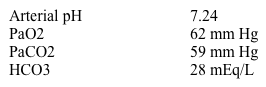 What is the most likely cause of hypoxemia in this patient?
 (Multiple Choice)
4.9/5 (73)
(73) A 76-year-old man comes for outpatient follow-up after recent coronary artery bypass grafting surgery. He has abundant, yellowish wound discharge from the lower part of the surgical midsternal wound. The patient has no chest pain, dyspnea, fevers, or abdominal swelling. He underwent uncomplicated coronary artery bypass grafting surgery for severe coronary artery disease 9 days ago, which included internal thoracic artery harvesting. Medical history also includes hypertension and type 2 diabetes mellitus. The patient is afebrile, and vital signs are within normal limits. On examination, the sternum appears stable to palpation. There is swelling and soft tissue separation at the lower part of the wound with copious discharge. Which of the following is the next best step in managing this patient?
(Multiple Choice)
4.8/5 (82)
(82) A 12-year-old girl is brought to the emergency department due to severe pain in the right upper quadrant, which started suddenly 12 hours ago. The patient has also had nausea, vomiting, fever, and rigors. Medical and family histories are both unremarkable. Temperature is 39.3 C (102.7 F), blood pressure is 110/60 mm Hg, pulse is 110/min, and respirations are 18/min. Scleral icterus is present. The abdomen is tender to palpation in the right upper quadrant without rebound or involuntary guarding. Laboratory results are as follows: 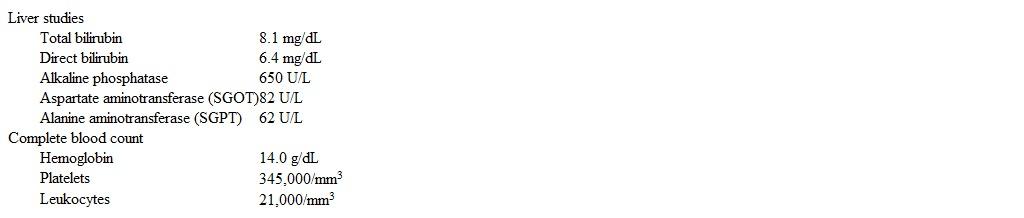 Abdominal imaging reveals mild gallbladder distension without stones or mucosal thickening; a cyst is present in the common bile duct with dilation of the intrahepatic ducts. Which of the following is the best next step in management?
 (Multiple Choice)
4.9/5 (91)
(91) A 45-year-old man is brought to the emergency department after a high-speed motor vehicle collision in which he was a restrained driver. Although the airbags deployed, the patient's leg smashed against the front console and he had to be extricated from the vehicle. The emergency medical team placed him in a rigid cervical collar and transported him to the hospital on a backboard. He received intravenous fluids en route. Blood pressure is 138/92 mm Hg, pulse is 105/min, and respirations are 14/min. The patient is alert and oriented but has significant leg pain. Bilateral breath sounds are equal with no chest tenderness. Heart sounds are normal. The abdomen is nondistended, soft, and nontender. There is no pelvic tenderness. The right lower leg is grossly deformed, with an exposed, broken tibia. Capillary refill is <2 seconds in both feet. Plain x-rays of the right leg show comminuted fractures of the tibia and fibula.
Which additional imaging study is most appropriate to obtain at this time?
(Multiple Choice)
4.8/5 (73)
(73) A 56-year-old man comes to the office for evaluation of a gradually enlarging, painless mass above the right angle of the jaw. He has also recently experienced right-sided facial weakness. When he was in his 20s, the patient had Hodgkin disease that was treated with radiation to the neck. Family history is significant for thyroid cancer in his mother. The patient does not use tobacco, alcohol, or illicit drugs. He had several male and female sexual partners in his 30s but has been sexually active with only one partner for the past 15 years. Vital signs are within normal limits. Physical examination shows a firm, nontender mass in the right parotid gland and weakness of all right-sided facial muscles. Which of the following is most concerning for malignancy in this patient?
(Multiple Choice)
4.9/5 (83)
(83) A 54-year-old man comes to the emergency department with cramping lower abdominal pain, mild nausea, and 2 episodes of watery diarrhea. The patient has no fever, vomiting, or urinary symptoms. His past medical history is unremarkable. The patient's father died at age 60 from abdominal aortic aneurysm rupture. He is a lifetime nonsmoker. His vital signs are normal. CT scan of the abdomen with contrast is shown in the image below: 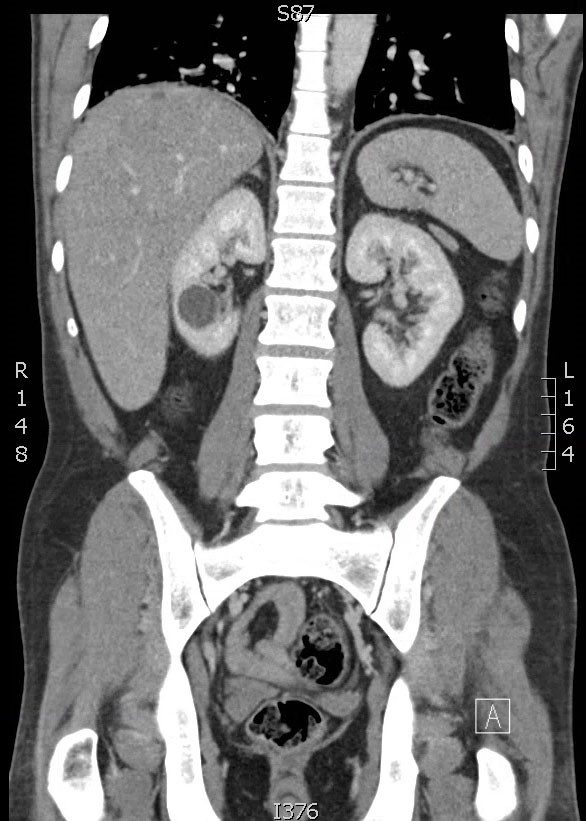 All gastrointestinal symptoms resolve in 2 hours without any intervention, and the patient wants to go home. Which of the following is the most appropriate management for the renal findings on the CT scan?
 (Multiple Choice)
4.7/5 (71)
(71) 
Filters
- Essay(0)
- Multiple Choice(0)
- Short Answer(0)
- True False(0)
- Matching(0)