Multiple Choice
A 72-year-old man undergoes coronary artery bypass graft (CABG) for severe coronary artery disease. He is extubated on the second postoperative day. His temperature is 36.6° C (97.9° F) , blood pressure is 120/70 mm Hg, pulse is 80/min, and respirations are 12/min. On the third postoperative day, he complains of dyspnea and worsening retrosternal pain despite continuous analgesia with morphine. His temperature is 38.6° C (101.5° F) , blood pressure is 112/52 mm Hg, pulse is 125/min and irregularly irregular, and respirations are 28/min. Examination shows normal heart sounds. A small amount of cloudy fluid is present in the sternal wound drain. His ECG shows atrial fibrillation with rapid ventricular response. An x-ray film of the chest shows widening of the mediastinum. Echocardiography reveals a small amount of pericardial fluid. Laboratory studies show: 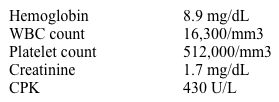 Which of the following will this patient most likely require?
A) Anticoagulation and electrical cardioversion
B) Broad-spectrum antibiotics alone
C) Nonsteroidal antiinflammatory agents alone
D) Pericardial puncture and nonsteroidal antiinflammatory agents
E) Surgical debridement and antibiotic therapy
Correct Answer:

Verified
Correct Answer:
Verified
Q357: A 49-year-old woman comes to the emergency
Q358: A 25-year-old man is brought to the
Q359: An 18-year-old woman is brought to the
Q360: A 73-year-old man is brought to the
Q361: A 62-year-old woman on the postoperative floor
Q363: A 37-year-old man comes to the office
Q364: A 72-year-old woman comes to the office
Q365: A previously healthy, 25-year-old man is brought
Q366: A 17-year-old girl is brought to the
Q367: A 56-year-old woman comes to the office