



 Chat with AI
Exam 37: Ecosystems

Exam 1: The Nature of Science and the Characteristics of Life75 Questions
Exam 2: Organizing the Diversity of Life75 Questions
Exam 3: Major Groups of Living Organisms74 Questions
Exam 4: Chemical Building Blocks77 Questions
Exam 5: Cell Structure and Internal Compartments76 Questions
Exam 6: Cell Membranes, Transport, and Communication73 Questions
Exam 7: Energy and Enzymes68 Questions
Exam 8: Photosynthesis and Cellular Respiration70 Questions
Exam 9: Cell Division77 Questions
Exam 10: Patterns of Inheritance65 Questions
Exam 11: Chromosomes and Human Genetics70 Questions
Exam 12: DNA62 Questions
Exam 13: From Gene to Protein73 Questions
Exam 14: Control of Gene Expression66 Questions
Exam 15: DNA Technology64 Questions
Exam 16: How Evolution Works65 Questions
Exam 17: Evolution of Populations64 Questions
Exam 18: Adaptation and Speciation66 Questions
Exam 19: The Evolutionary History of Life69 Questions
Exam 20: Maintaining the Internal Environment66 Questions
Exam 21: Animal Nutrition and Digestion68 Questions
Exam 22: Gas Exchange68 Questions
Exam 23: The Circulatory System68 Questions
Exam 24: Animal Hormones69 Questions
Exam 25: The Nervous System69 Questions
Exam 26: Sensing the Environment66 Questions
Exam 27: Skeletons, Muscles, and Movement65 Questions
Exam 28: Defenses against Disease67 Questions
Exam 29: Reproduction and Development68 Questions
Exam 30: Animal Behavior61 Questions
Exam 31: Plant Structure, Nutrition, and Transport63 Questions
Exam 32: Plant Growth and Reproduction67 Questions
Exam 33: The Biosphere67 Questions
Exam 34: Growth of Populations65 Questions
Exam 35: Interactions among Organisms70 Questions
Exam 36: Communities of Organisms65 Questions
Exam 37: Ecosystems68 Questions
Exam 38: Global Change65 Questions
Exam 39: Biodiversity and People72 Questions
Exam 40: Cancer: Cell Division Out of Control69 Questions
Exam 41: Harnessing the Human Genome62 Questions
Exam 42: Humans and Evolution60 Questions
Exam 43: Smoking--Beyond Lung Cancer63 Questions
Exam 44: Feeding a Hungry Planet55 Questions
Exam 45: Building a Sustainable Society47 Questions
Select questions type


Cutting a forest to produce paper bags that are quickly discarded could be considered shortsighted; with the majority of its trees removed the forest will
(Multiple Choice)
4.9/5  (78)
(78) In the absence of _____, nutrient recycling within the ecosystem would completely stop.
(Multiple Choice)
4.9/5 (73)
(73) Which of the following groups of organisms would not be considered to be consumers?
(Multiple Choice)
4.7/5 (77)
(77) With respect to the following values, rain with a pH of _____ would be the most acidic.
(Multiple Choice)
4.8/5 (74)
(74) In the Hubbard Brook Experimental Forest in New Hampshire, a portion of the forest was first clear-cut, then sprayed with herbicides for 3 years to prevent growth. A second portion of the forest was not clear-cut or sprayed and served as a control plot. The graph below shows that nitrate, a form of nitrogen that is important to plants, was lost from the ecosystem in streams at a much higher rate in the clear-cut portion of the forest than in the control portion. 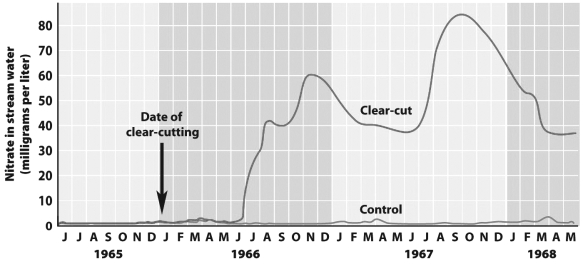 What best explains the small releases of nitrogen from the control portion of the forest at the Hubbarb Brook Experimental Forest?
 (Multiple Choice)
5.0/5 (76)
(76) Coral reefs and swamps are among Earth's most productive ecosystems.
(True/False)
4.9/5 (84)
(84) Which of the following describes the ultimate disposition of most energy in an ecosystem?
(Multiple Choice)
4.8/5 (83)
(83) Biologists use the term _______ to refer to the weight of organisms per unit area.
(Short Answer)
4.8/5 (73)
(73) Eventually, all biomass produced by any organism is consumed by _______.
(Short Answer)
4.7/5 (66)
(66) What best explains this observation: consumers directly use approximately 20 percent of a forest's net primary productivity (NPP) while decomposers directly use approximately 80?
(Multiple Choice)
4.8/5 (80)
(80) Which of the following would most likely take longest to replace if lost from a terrestrial ecosystem?
(Multiple Choice)
4.9/5 (98)
(98) The primary contribution of decomposers to an ecosystem occurs when they
(Multiple Choice)
4.9/5 (78)
(78) 
Filters
- Essay(0)
- Multiple Choice(0)
- Short Answer(0)
- True False(0)
- Matching(0)