



 Chat with AI
Exam 11: Chromosomes and Human Genetics

Exam 1: The Nature of Science and the Characteristics of Life75 Questions
Exam 2: Organizing the Diversity of Life75 Questions
Exam 3: Major Groups of Living Organisms74 Questions
Exam 4: Chemical Building Blocks77 Questions
Exam 5: Cell Structure and Internal Compartments76 Questions
Exam 6: Cell Membranes, Transport, and Communication73 Questions
Exam 7: Energy and Enzymes68 Questions
Exam 8: Photosynthesis and Cellular Respiration70 Questions
Exam 9: Cell Division77 Questions
Exam 10: Patterns of Inheritance65 Questions
Exam 11: Chromosomes and Human Genetics70 Questions
Exam 12: DNA62 Questions
Exam 13: From Gene to Protein73 Questions
Exam 14: Control of Gene Expression66 Questions
Exam 15: DNA Technology64 Questions
Exam 16: How Evolution Works65 Questions
Exam 17: Evolution of Populations64 Questions
Exam 18: Adaptation and Speciation66 Questions
Exam 19: The Evolutionary History of Life69 Questions
Exam 20: Maintaining the Internal Environment66 Questions
Exam 21: Animal Nutrition and Digestion68 Questions
Exam 22: Gas Exchange68 Questions
Exam 23: The Circulatory System68 Questions
Exam 24: Animal Hormones69 Questions
Exam 25: The Nervous System69 Questions
Exam 26: Sensing the Environment66 Questions
Exam 27: Skeletons, Muscles, and Movement65 Questions
Exam 28: Defenses against Disease67 Questions
Exam 29: Reproduction and Development68 Questions
Exam 30: Animal Behavior61 Questions
Exam 31: Plant Structure, Nutrition, and Transport63 Questions
Exam 32: Plant Growth and Reproduction67 Questions
Exam 33: The Biosphere67 Questions
Exam 34: Growth of Populations65 Questions
Exam 35: Interactions among Organisms70 Questions
Exam 36: Communities of Organisms65 Questions
Exam 37: Ecosystems68 Questions
Exam 38: Global Change65 Questions
Exam 39: Biodiversity and People72 Questions
Exam 40: Cancer: Cell Division Out of Control69 Questions
Exam 41: Harnessing the Human Genome62 Questions
Exam 42: Humans and Evolution60 Questions
Exam 43: Smoking--Beyond Lung Cancer63 Questions
Exam 44: Feeding a Hungry Planet55 Questions
Exam 45: Building a Sustainable Society47 Questions
Select questions type


This chromosomal disorder known as Cri du Chat Syndrome is the result of missing a part of chromosome 5, an example of chromosome _____.

Free
(Multiple Choice)
4.8/5  (78)
(78) Correct Answer: Verified
B
During ______ _______ diagnosis, cells are removed from the early embryo and tested for genetic disorders before being implanted in the uterus.
Free
(Short Answer)
4.8/5 (70)
(70) Correct Answer:Verified
Verifiedpreimplantation genetic
Two chromosomes that have the same set of genes, but perhaps different versions of those genes, are called ______________ chromosomes.
Free
(Short Answer)
4.7/5 (84)
(84) Correct Answer:Verified
Verifiedhomologous
Lethal recessive mutations are not eliminated from a population because they can be "hidden" in symptom-free individuals also carrying dominant alleles.
(True/False)
4.8/5 (76)
(76) Among children with parents who are both carriers of a Tay-Sachs, an autosomal recessive disorder, chances are that
(Multiple Choice)
4.8/5 (93)
(93) If a female carrier of a recessive X-linked gene (genotype XᴬXᵃ) that causes a disorder mates with a normal male (genotype XᴬY),
(Multiple Choice)
4.8/5 (77)
(77) We now know that the gene for flower color and the gene for seed color are both on chromosome 1 of the pea plants once studied by Mendel. According to Mendel's results, flower color and seed color undergo independent assortment. Which of the following explanations is most likely?
(Multiple Choice)
4.8/5 (90)
(90) Which of the following genotypes represents a human female?
(Multiple Choice)
4.8/5 (74)
(74) Sex-linked genes are found on either the X chromosome or the Y chromosome but not both.
(True/False)
4.7/5 (91)
(91) Which of the following combinations of sex chromosomes would most probably have the most serious effects?
(Multiple Choice)
4.9/5 (87)
(87) This figure shows a pattern of inheritance. 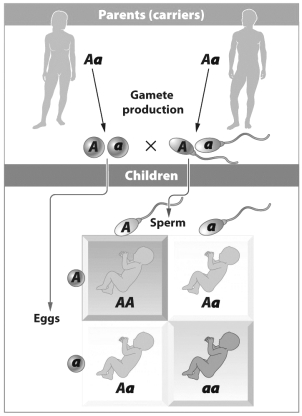 The disorder shown in the figure
 (Multiple Choice)
4.9/5 (79)
(79) Human males have one chromosome that females do not, known as the _______ chromosome.
(Short Answer)
4.8/5 (72)
(72) During cell division a piece of a chromosome breaks away and becomes part of its homologue. This is an example of
(Multiple Choice)
4.8/5 (74)
(74) Even though it is deadly, the Huntington's disease allele can remain in the population, because
(Multiple Choice)
4.8/5 (86)
(86) What is the effect of the independent assortment of chromosomes on the overall variety of individuals produced?
(Multiple Choice)
4.9/5 (73)
(73) Which of the following statements about crossing-over is true?
(Multiple Choice)
4.9/5 (88)
(88) What effect does gene linkage have on the overall variety of individuals produced?
(Multiple Choice)
5.0/5 (79)
(79) Both members of a couple are carriers for a recessive disease allele. If the couple has four children, which of the following must be true?
(Multiple Choice)
4.9/5 (75)
(75) 
Filters
- Essay(0)
- Multiple Choice(0)
- Short Answer(0)
- True False(0)
- Matching(0)