



 Chat with AI
Exam 14: Control of Gene Expression

Exam 1: The Nature of Science and the Characteristics of Life75 Questions
Exam 2: Organizing the Diversity of Life75 Questions
Exam 3: Major Groups of Living Organisms74 Questions
Exam 4: Chemical Building Blocks77 Questions
Exam 5: Cell Structure and Internal Compartments76 Questions
Exam 6: Cell Membranes, Transport, and Communication73 Questions
Exam 7: Energy and Enzymes68 Questions
Exam 8: Photosynthesis and Cellular Respiration70 Questions
Exam 9: Cell Division77 Questions
Exam 10: Patterns of Inheritance65 Questions
Exam 11: Chromosomes and Human Genetics70 Questions
Exam 12: DNA62 Questions
Exam 13: From Gene to Protein73 Questions
Exam 14: Control of Gene Expression66 Questions
Exam 15: DNA Technology64 Questions
Exam 16: How Evolution Works65 Questions
Exam 17: Evolution of Populations64 Questions
Exam 18: Adaptation and Speciation66 Questions
Exam 19: The Evolutionary History of Life69 Questions
Exam 20: Maintaining the Internal Environment66 Questions
Exam 21: Animal Nutrition and Digestion68 Questions
Exam 22: Gas Exchange68 Questions
Exam 23: The Circulatory System68 Questions
Exam 24: Animal Hormones69 Questions
Exam 25: The Nervous System69 Questions
Exam 26: Sensing the Environment66 Questions
Exam 27: Skeletons, Muscles, and Movement65 Questions
Exam 28: Defenses against Disease67 Questions
Exam 29: Reproduction and Development68 Questions
Exam 30: Animal Behavior61 Questions
Exam 31: Plant Structure, Nutrition, and Transport63 Questions
Exam 32: Plant Growth and Reproduction67 Questions
Exam 33: The Biosphere67 Questions
Exam 34: Growth of Populations65 Questions
Exam 35: Interactions among Organisms70 Questions
Exam 36: Communities of Organisms65 Questions
Exam 37: Ecosystems68 Questions
Exam 38: Global Change65 Questions
Exam 39: Biodiversity and People72 Questions
Exam 40: Cancer: Cell Division Out of Control69 Questions
Exam 41: Harnessing the Human Genome62 Questions
Exam 42: Humans and Evolution60 Questions
Exam 43: Smoking--Beyond Lung Cancer63 Questions
Exam 44: Feeding a Hungry Planet55 Questions
Exam 45: Building a Sustainable Society47 Questions
Select questions type


Once a gene has been translated, no further regulation of gene expression is possible.

Free
(True/False)
4.9/5  (93)
(93) Correct Answer: Verified
False
Why do organisms have the ability to change gene expression?
Free
(Multiple Choice)
4.8/5 (86)
(86) Correct Answer:Verified
VerifiedD
In E. coli when tryptophan is present in the environment,
Free
(Multiple Choice)
4.9/5 (70)
(70) Correct Answer:Verified
VerifiedC
This table shows which of these four genes are on or off in three different cell types. 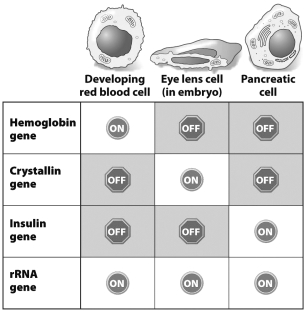 Why is the expression of the rRNA gene so different from the expression of the other genes in the table?
 (Multiple Choice)
4.9/5 (78)
(78) At any given time, most of the genes in the genome of an organism are actively undergoing gene expression.
(True/False)
4.8/5 (74)
(74) Which of the following are removed from mRNA after transcription?
(Multiple Choice)
4.9/5 (78)
(78) Organisms control when, where, and how much of each gene product is made.
(True/False)
5.0/5 (79)
(79) The DNA sequences of human beings and chimpanzees are approximately 99 percent alike. What might explain the seemingly large differences that exist between these two closely related organisms?
(Multiple Choice)
4.8/5 (91)
(91) In this figure, are the genes that encode the enzymes needed to make tryptophan on or off? 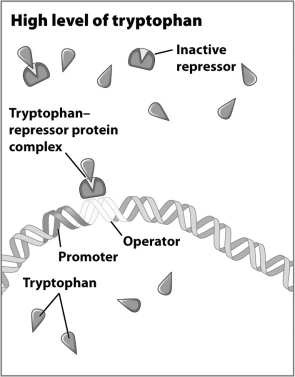
(Multiple Choice)
4.8/5 (80)
(80) A change in an organism's environment generally results in a change in ________ ________, leading to the production of different types of proteins.
(Short Answer)
4.8/5 (82)
(82) A cell has a repressor protein for substance A. If substance A is present in sufficient quantities,
(Multiple Choice)
4.9/5 (85)
(85) The amount of DNA in a prokaryotic cell is _______ than the amount of DNA in a eukaryotic cell.
(Short Answer)
4.8/5 (66)
(66) The benefit of putting a group of related genes under the control of a single _____________ is that the activation of this single regulatory sequence can lead to the production of all the proteins needed to respond to an environmental change.
(Short Answer)
4.8/5 (87)
(87) Which of the following statements is not true of eukaryotic DNA?
(Multiple Choice)
4.8/5 (84)
(84) Why is regulating transcription the main way the cells control gene expression?
(Essay)
4.8/5 (75)
(75) 
Filters
- Essay(0)
- Multiple Choice(0)
- Short Answer(0)
- True False(0)
- Matching(0)