



 Chat with AI
Exam 15: DNA Technology

Exam 1: The Nature of Science and the Characteristics of Life75 Questions
Exam 2: Organizing the Diversity of Life75 Questions
Exam 3: Major Groups of Living Organisms74 Questions
Exam 4: Chemical Building Blocks77 Questions
Exam 5: Cell Structure and Internal Compartments76 Questions
Exam 6: Cell Membranes, Transport, and Communication73 Questions
Exam 7: Energy and Enzymes68 Questions
Exam 8: Photosynthesis and Cellular Respiration70 Questions
Exam 9: Cell Division77 Questions
Exam 10: Patterns of Inheritance65 Questions
Exam 11: Chromosomes and Human Genetics70 Questions
Exam 12: DNA62 Questions
Exam 13: From Gene to Protein73 Questions
Exam 14: Control of Gene Expression66 Questions
Exam 15: DNA Technology64 Questions
Exam 16: How Evolution Works65 Questions
Exam 17: Evolution of Populations64 Questions
Exam 18: Adaptation and Speciation66 Questions
Exam 19: The Evolutionary History of Life69 Questions
Exam 20: Maintaining the Internal Environment66 Questions
Exam 21: Animal Nutrition and Digestion68 Questions
Exam 22: Gas Exchange68 Questions
Exam 23: The Circulatory System68 Questions
Exam 24: Animal Hormones69 Questions
Exam 25: The Nervous System69 Questions
Exam 26: Sensing the Environment66 Questions
Exam 27: Skeletons, Muscles, and Movement65 Questions
Exam 28: Defenses against Disease67 Questions
Exam 29: Reproduction and Development68 Questions
Exam 30: Animal Behavior61 Questions
Exam 31: Plant Structure, Nutrition, and Transport63 Questions
Exam 32: Plant Growth and Reproduction67 Questions
Exam 33: The Biosphere67 Questions
Exam 34: Growth of Populations65 Questions
Exam 35: Interactions among Organisms70 Questions
Exam 36: Communities of Organisms65 Questions
Exam 37: Ecosystems68 Questions
Exam 38: Global Change65 Questions
Exam 39: Biodiversity and People72 Questions
Exam 40: Cancer: Cell Division Out of Control69 Questions
Exam 41: Harnessing the Human Genome62 Questions
Exam 42: Humans and Evolution60 Questions
Exam 43: Smoking--Beyond Lung Cancer63 Questions
Exam 44: Feeding a Hungry Planet55 Questions
Exam 45: Building a Sustainable Society47 Questions
Select questions type


DNA from one organism will not bond to DNA from another organism.

Free
(True/False)
4.9/5  (73)
(73) Correct Answer: Verified
False
The genes for the normal and sickle cell anemia alleles of hemoglobin are cut with the restriction enzyme DdeI. The resulting DNA fragments were separated by gel electrophoresis, producing the gel shown in the figure below. 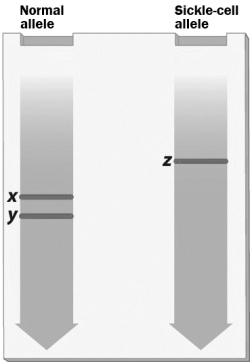 Why are the patterns produced by these two alleles different?
Free
(Multiple Choice)
4.8/5 (75)
(75) Correct Answer:Verified
VerifiedC
A restriction enzyme cuts DNA into fragments
Free
(Multiple Choice)
5.0/5 (78)
(78) Correct Answer:Verified
VerifiedD
The immune disorder adenosine deaminase (ADA) deficiency, is the result of a mutation in one gene. How could gene therapy be used to treat this disorder?
(Multiple Choice)
4.9/5 (76)
(76) Deliberately transferring a gene from one species to another is an example of
(Multiple Choice)
5.0/5 (84)
(84) The poplar, a type of tree, does not produce flowers until it is eight years old. How does this characteristic make the poplar a good candidate for genetic engineering?
(Multiple Choice)
4.8/5 (80)
(80) Cloning and sequencing are important in the study of inherited diseases, because
(Multiple Choice)
4.8/5 (88)
(88) In RFLP analysis, which regions of DNA would provide the strongest evidence of a genetic relationship?
(Multiple Choice)
4.9/5 (85)
(85) Because the ____________ regions of DNA show the highest level of variation between individuals, they are most commonly analyzed during DNA fingerprinting.
(Short Answer)
4.8/5 (92)
(92) Genetic engineering has been used to mass-produce insulin for diabetics.
(True/False)
4.8/5 (75)
(75) The most efficient method of determining the base sequence of a piece of DNA is to
(Multiple Choice)
4.8/5 (82)
(82) You are shown the following result of gel electrophoresis in the figure below. 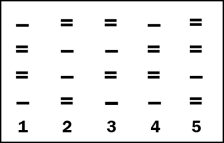 Column 1 represents blood found on the arm of a crime victim, but is not the victim's blood. The other columns are blood taken from various suspects. Which suspect is most likely the guilty one?
 (Multiple Choice)
4.7/5 (76)
(76) A DNA _______ that binds to a certain sequence can be used to test for the presence of an allele or gene.
(Short Answer)
4.7/5 (79)
(79) A DNA _______ is a collection of one organism's DNA fragments that are stored in another organism.
(Short Answer)
4.7/5 (72)
(72) The polymerase chain reaction (PCR) technique could be developed only after the discovery of bacterial enzymes that were able to withstand high temperatures. Why was it necessary to use such enzymes?
(Multiple Choice)
4.8/5 (92)
(92) The restriction enzyme SmaI cuts DNA between the last C and the first G in the sequence CCCGGG. What sequences of DNA would be produced if the following sequence were treated with SmaI?
AGTTTCGAGAGCGGATGCCCGGGCCACGGGGATTATACGCAGAGTCCAC
TCAAAGCTCTCGCCTACGGGCCCGGTGCCCCTAATATGCGTCTCAGGTG
(Essay)
4.8/5 (71)
(71) 
Filters
- Essay(0)
- Multiple Choice(0)
- Short Answer(0)
- True False(0)
- Matching(0)