



 Chat with AI
Exam 22: Gas Exchange

Exam 1: The Nature of Science and the Characteristics of Life75 Questions
Exam 2: Organizing the Diversity of Life75 Questions
Exam 3: Major Groups of Living Organisms74 Questions
Exam 4: Chemical Building Blocks77 Questions
Exam 5: Cell Structure and Internal Compartments76 Questions
Exam 6: Cell Membranes, Transport, and Communication73 Questions
Exam 7: Energy and Enzymes68 Questions
Exam 8: Photosynthesis and Cellular Respiration70 Questions
Exam 9: Cell Division77 Questions
Exam 10: Patterns of Inheritance65 Questions
Exam 11: Chromosomes and Human Genetics70 Questions
Exam 12: DNA62 Questions
Exam 13: From Gene to Protein73 Questions
Exam 14: Control of Gene Expression66 Questions
Exam 15: DNA Technology64 Questions
Exam 16: How Evolution Works65 Questions
Exam 17: Evolution of Populations64 Questions
Exam 18: Adaptation and Speciation66 Questions
Exam 19: The Evolutionary History of Life69 Questions
Exam 20: Maintaining the Internal Environment66 Questions
Exam 21: Animal Nutrition and Digestion68 Questions
Exam 22: Gas Exchange68 Questions
Exam 23: The Circulatory System68 Questions
Exam 24: Animal Hormones69 Questions
Exam 25: The Nervous System69 Questions
Exam 26: Sensing the Environment66 Questions
Exam 27: Skeletons, Muscles, and Movement65 Questions
Exam 28: Defenses against Disease67 Questions
Exam 29: Reproduction and Development68 Questions
Exam 30: Animal Behavior61 Questions
Exam 31: Plant Structure, Nutrition, and Transport63 Questions
Exam 32: Plant Growth and Reproduction67 Questions
Exam 33: The Biosphere67 Questions
Exam 34: Growth of Populations65 Questions
Exam 35: Interactions among Organisms70 Questions
Exam 36: Communities of Organisms65 Questions
Exam 37: Ecosystems68 Questions
Exam 38: Global Change65 Questions
Exam 39: Biodiversity and People72 Questions
Exam 40: Cancer: Cell Division Out of Control69 Questions
Exam 41: Harnessing the Human Genome62 Questions
Exam 42: Humans and Evolution60 Questions
Exam 43: Smoking--Beyond Lung Cancer63 Questions
Exam 44: Feeding a Hungry Planet55 Questions
Exam 45: Building a Sustainable Society47 Questions
Select questions type


When you exercise intensely, your rate of gas exchange rises because

Free
(Multiple Choice)
4.9/5  (76)
(76) Correct Answer: Verified
C
Unlike aquatic organisms, humans have their gas exchange surfaces on the inside rather than the outside. This adaptation evolved to
Free
(Multiple Choice)
4.8/5 (80)
(80) Correct Answer:Verified
VerifiedA
The human _______ system is used for the internal transport of oxygen and carbon dioxide.
Free
(Short Answer)
4.9/5 (89)
(89) Correct Answer:Verified
Verifiedcirculatory
The higher the gas concentration in the environment relative to the gas concentration inside an organism, the more quickly the gas will passively enter the organism.
(True/False)
4.9/5 (81)
(81) In humans, the equivalent of an insect's tracheoles in terms of size would be ___________.
(Short Answer)
4.9/5 (75)
(75) The liquid portion of human blood cannot absorb enough oxygen to meet the body's demands. However, _______ in our red blood cells greatly increases the oxygen-carrying capacity of human blood.
(Multiple Choice)
5.0/5 (82)
(82) One way animals carry large amounts of oxygen to cells is by means of oxygen-binding _______ that bind reversibly to oxygen.
(Short Answer)
4.8/5 (77)
(77) A mitochondrion in a cell undergoing cellular respiration would
(Multiple Choice)
4.9/5 (81)
(81) The concentration of oxygen in blood plasma near an alveolus is lowered when
(Multiple Choice)
4.8/5 (87)
(87) The breaking open of alveoli in people with emphysema decreases their rate of gas exchange because
(Multiple Choice)
4.9/5 (85)
(85) _________ is the process of expelling carbon dioxide from the lungs and taking oxygen into the lungs.
(Short Answer)
4.7/5 (82)
(82) The figure below illustrates the inhalation step of gas exchange in humans.
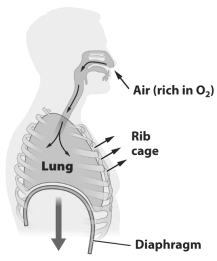 In this figure, the diaphragm and the muscle of the ribcage are _________ [relaxed or contracted?].
 (Short Answer)
4.9/5 (92)
(92) Which of the following responses will not be temporarily expressed by visitors to high altitudes?
(Multiple Choice)
4.7/5 (69)
(69) Which of the following statements about oxygen-binding pigments is false?
(Multiple Choice)
4.9/5 (80)
(80) Which of the following best describes the environment around a cell performing cellular respiration?
(Multiple Choice)
4.7/5 (76)
(76) 
Filters
- Essay(0)
- Multiple Choice(0)
- Short Answer(0)
- True False(0)
- Matching(0)