



 Chat with AI
Exam 45: Building a Sustainable Society

Exam 1: The Nature of Science and the Characteristics of Life75 Questions
Exam 2: Organizing the Diversity of Life75 Questions
Exam 3: Major Groups of Living Organisms74 Questions
Exam 4: Chemical Building Blocks77 Questions
Exam 5: Cell Structure and Internal Compartments76 Questions
Exam 6: Cell Membranes, Transport, and Communication73 Questions
Exam 7: Energy and Enzymes68 Questions
Exam 8: Photosynthesis and Cellular Respiration70 Questions
Exam 9: Cell Division77 Questions
Exam 10: Patterns of Inheritance65 Questions
Exam 11: Chromosomes and Human Genetics70 Questions
Exam 12: DNA62 Questions
Exam 13: From Gene to Protein73 Questions
Exam 14: Control of Gene Expression66 Questions
Exam 15: DNA Technology64 Questions
Exam 16: How Evolution Works65 Questions
Exam 17: Evolution of Populations64 Questions
Exam 18: Adaptation and Speciation66 Questions
Exam 19: The Evolutionary History of Life69 Questions
Exam 20: Maintaining the Internal Environment66 Questions
Exam 21: Animal Nutrition and Digestion68 Questions
Exam 22: Gas Exchange68 Questions
Exam 23: The Circulatory System68 Questions
Exam 24: Animal Hormones69 Questions
Exam 25: The Nervous System69 Questions
Exam 26: Sensing the Environment66 Questions
Exam 27: Skeletons, Muscles, and Movement65 Questions
Exam 28: Defenses against Disease67 Questions
Exam 29: Reproduction and Development68 Questions
Exam 30: Animal Behavior61 Questions
Exam 31: Plant Structure, Nutrition, and Transport63 Questions
Exam 32: Plant Growth and Reproduction67 Questions
Exam 33: The Biosphere67 Questions
Exam 34: Growth of Populations65 Questions
Exam 35: Interactions among Organisms70 Questions
Exam 36: Communities of Organisms65 Questions
Exam 37: Ecosystems68 Questions
Exam 38: Global Change65 Questions
Exam 39: Biodiversity and People72 Questions
Exam 40: Cancer: Cell Division Out of Control69 Questions
Exam 41: Harnessing the Human Genome62 Questions
Exam 42: Humans and Evolution60 Questions
Exam 43: Smoking--Beyond Lung Cancer63 Questions
Exam 44: Feeding a Hungry Planet55 Questions
Exam 45: Building a Sustainable Society47 Questions
Select questions type


Which of the following represents a sustainable source of energy?

Free
(Multiple Choice)
4.9/5  (87)
(87) Correct Answer: Verified
B
In comparison to conventional farming, organic farming can be considered more environmentally friendly, because
Free
(Multiple Choice)
4.7/5 (93)
(93) Correct Answer:Verified
VerifiedB
Examine the graph below. 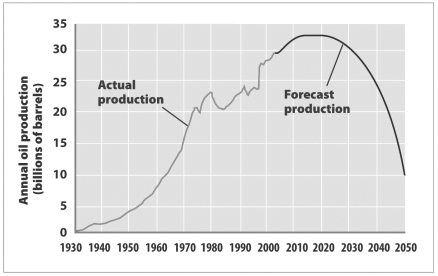 What best explains the reduction in the forecast for future world oil production shown in this graph?
Free
(Multiple Choice)
4.7/5 (86)
(86) Correct Answer:Verified
VerifiedC
Which of the following would make a meaningful contribution to sustainability?
(Multiple Choice)
4.9/5 (85)
(85) In which of the following continents is the availability of fresh water most limited?
(Multiple Choice)
4.8/5 (75)
(75) A cap and trade system for sulfur dioxide emissions in the United States resulted in
(Multiple Choice)
4.9/5 (73)
(73) The world is very close to attaining a sustainable human society now that
(Multiple Choice)
4.8/5 (72)
(72) Government regulations and international agreements have resulted in many environmental improvements, but to date none has been able to
(Multiple Choice)
5.0/5 (69)
(69) Overuse of aquifers can cause cities to subside as it has done in Mexico City.
(True/False)
4.9/5 (78)
(78) How can awareness and education affect our ability to build a sustainable society?
(Essay)
4.8/5 (84)
(84) Many people bring empty containers to recycling centers. What does this mean in terms of contributing to a sustainable society?
(Multiple Choice)
4.9/5 (88)
(88) Life-cycle engineering refers to documenting the environmental impact of products from manufacture to the sale and disposal of the products.
(True/False)
4.9/5 (92)
(92) Greenroof buildings are one of the major contributions to the greenhouse effect and global climate change.
(True/False)
4.9/5 (79)
(79) The green roof projects undertaken in Japan, Europe, and North America
(Multiple Choice)
5.0/5 (82)
(82) One means of increasing the amount of calories available for human consumption would be to
(Multiple Choice)
4.8/5 (88)
(88) In 1990 polls taken in the United States and around the globe concerning the environment indicated most people
(Multiple Choice)
4.9/5 (73)
(73) To build a sustainable society the capabilities of humans to affect both density-dependent and density-independent factors must be taken into consideration.
(True/False)
5.0/5 (61)
(61) 
Filters
- Essay(0)
- Multiple Choice(0)
- Short Answer(0)
- True False(0)
- Matching(0)