



 Chat with AI
Exam 17: Evolution of Populations

Exam 1: The Nature of Science and the Characteristics of Life75 Questions
Exam 2: Organizing the Diversity of Life75 Questions
Exam 3: Major Groups of Living Organisms74 Questions
Exam 4: Chemical Building Blocks77 Questions
Exam 5: Cell Structure and Internal Compartments76 Questions
Exam 6: Cell Membranes, Transport, and Communication73 Questions
Exam 7: Energy and Enzymes68 Questions
Exam 8: Photosynthesis and Cellular Respiration70 Questions
Exam 9: Cell Division77 Questions
Exam 10: Patterns of Inheritance65 Questions
Exam 11: Chromosomes and Human Genetics70 Questions
Exam 12: DNA62 Questions
Exam 13: From Gene to Protein73 Questions
Exam 14: Control of Gene Expression66 Questions
Exam 15: DNA Technology64 Questions
Exam 16: How Evolution Works65 Questions
Exam 17: Evolution of Populations64 Questions
Exam 18: Adaptation and Speciation66 Questions
Exam 19: The Evolutionary History of Life69 Questions
Exam 20: Maintaining the Internal Environment66 Questions
Exam 21: Animal Nutrition and Digestion68 Questions
Exam 22: Gas Exchange68 Questions
Exam 23: The Circulatory System68 Questions
Exam 24: Animal Hormones69 Questions
Exam 25: The Nervous System69 Questions
Exam 26: Sensing the Environment66 Questions
Exam 27: Skeletons, Muscles, and Movement65 Questions
Exam 28: Defenses against Disease67 Questions
Exam 29: Reproduction and Development68 Questions
Exam 30: Animal Behavior61 Questions
Exam 31: Plant Structure, Nutrition, and Transport63 Questions
Exam 32: Plant Growth and Reproduction67 Questions
Exam 33: The Biosphere67 Questions
Exam 34: Growth of Populations65 Questions
Exam 35: Interactions among Organisms70 Questions
Exam 36: Communities of Organisms65 Questions
Exam 37: Ecosystems68 Questions
Exam 38: Global Change65 Questions
Exam 39: Biodiversity and People72 Questions
Exam 40: Cancer: Cell Division Out of Control69 Questions
Exam 41: Harnessing the Human Genome62 Questions
Exam 42: Humans and Evolution60 Questions
Exam 43: Smoking--Beyond Lung Cancer63 Questions
Exam 44: Feeding a Hungry Planet55 Questions
Exam 45: Building a Sustainable Society47 Questions
Select questions type


In any given population the genotype frequency is usually the same as the allele frequency.

Free
(True/False)
4.9/5  (77)
(77) Correct Answer: Verified
False
The genetic variation of a population is a result of differences in the _______ sequences of individuals and provides the raw material for evolution.
Free
(Short Answer)
4.9/5 (81)
(81) Correct Answer:Verified
VerifiedDNA
Antibiotic resistance in bacteria could be combated by all of the following methods, except
Free
(Multiple Choice)
4.9/5 (83)
(83) Correct Answer:Verified
VerifiedD
Larger male elephant seals have more mates than smaller male elephant seals because they are better at defending their territory (and mates). This is an example of __________ ___________.
(Short Answer)
4.8/5 (87)
(87) A few members of a species establish themselves on a small island far from other populations of that species. They may experience a genetic bottleneck due to the _______ effect.
(Short Answer)
4.9/5 (78)
(78) A gene has two alleles, D and d.The frequency of the D allele is 0.2. What is the frequency of the d allele? Show your work.
(Essay)
4.9/5 (77)
(77) Which of the following factors is not likely to cause major changes in allele frequencies?
(Multiple Choice)
4.8/5 (86)
(86) In your backyard, you step on a dandelion and one of its seeds gets trapped in the tread of your shoes. The next day, you go on a long hike in the wilderness wearing the same shoes. When you step in a mud puddle, the seed sticks in the mud. The seed grows into a dandelion, but no other dandelions are present to mate with it. This is an example of
(Multiple Choice)
4.9/5 (72)
(72) In __________ selection individuals with one extreme of an inherited phenotypic trait have an advantage over other individuals in the population.
(Short Answer)
4.9/5 (95)
(95) A gene has two alleles, B and b. If the b allele becomes "fixed" in the population, its frequency will be _______ percent.
(Multiple Choice)
4.9/5 (83)
(83) In the Hardy-Weinberg equation, _______ represents the predicted frequency of the heterozygous genotype.
(Short Answer)
4.9/5 (81)
(81) The human allele that causes six fingers per hand is dominant over the allele that produces five fingers per hand. Yet most humans have five fingers per hand. Why is this so?
(Multiple Choice)
4.9/5 (90)
(90) Mutations generally cause rapid changes in allele frequencies in populations.
(True/False)
4.9/5 (78)
(78) In the figure below, the flying bird moves permanently into the population shown on land. 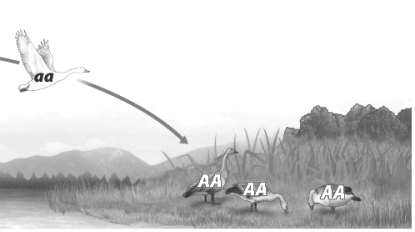 As a result, the allele frequency of A changes from
 (Multiple Choice)
4.8/5 (77)
(77) A new allele spreads from one large population to another as a result of genetic flow.
(True/False)
4.9/5 (73)
(73) If a given population has 30 RR individuals, 10 Rr individuals, and 10 rr individuals, what is the allele frequency of R?
(Multiple Choice)
5.0/5 (90)
(90) Scientists have hypothesized that the reason European men have darker skin color than European women is that more than 10,000 years ago, these men preferred to mate with lighter-skinned females. If this is true, skin color is an example of ________ in Europeans.
(Multiple Choice)
4.9/5 (78)
(78) Which of the following processes does not lead to an increase in recombination?
(Multiple Choice)
4.9/5 (82)
(82) 
Filters
- Essay(0)
- Multiple Choice(0)
- Short Answer(0)
- True False(0)
- Matching(0)