



 Chat with AI
Exam 8: Photosynthesis and Cellular Respiration

Exam 1: The Nature of Science and the Characteristics of Life75 Questions
Exam 2: Organizing the Diversity of Life75 Questions
Exam 3: Major Groups of Living Organisms74 Questions
Exam 4: Chemical Building Blocks77 Questions
Exam 5: Cell Structure and Internal Compartments76 Questions
Exam 6: Cell Membranes, Transport, and Communication73 Questions
Exam 7: Energy and Enzymes68 Questions
Exam 8: Photosynthesis and Cellular Respiration70 Questions
Exam 9: Cell Division77 Questions
Exam 10: Patterns of Inheritance65 Questions
Exam 11: Chromosomes and Human Genetics70 Questions
Exam 12: DNA62 Questions
Exam 13: From Gene to Protein73 Questions
Exam 14: Control of Gene Expression66 Questions
Exam 15: DNA Technology64 Questions
Exam 16: How Evolution Works65 Questions
Exam 17: Evolution of Populations64 Questions
Exam 18: Adaptation and Speciation66 Questions
Exam 19: The Evolutionary History of Life69 Questions
Exam 20: Maintaining the Internal Environment66 Questions
Exam 21: Animal Nutrition and Digestion68 Questions
Exam 22: Gas Exchange68 Questions
Exam 23: The Circulatory System68 Questions
Exam 24: Animal Hormones69 Questions
Exam 25: The Nervous System69 Questions
Exam 26: Sensing the Environment66 Questions
Exam 27: Skeletons, Muscles, and Movement65 Questions
Exam 28: Defenses against Disease67 Questions
Exam 29: Reproduction and Development68 Questions
Exam 30: Animal Behavior61 Questions
Exam 31: Plant Structure, Nutrition, and Transport63 Questions
Exam 32: Plant Growth and Reproduction67 Questions
Exam 33: The Biosphere67 Questions
Exam 34: Growth of Populations65 Questions
Exam 35: Interactions among Organisms70 Questions
Exam 36: Communities of Organisms65 Questions
Exam 37: Ecosystems68 Questions
Exam 38: Global Change65 Questions
Exam 39: Biodiversity and People72 Questions
Exam 40: Cancer: Cell Division Out of Control69 Questions
Exam 41: Harnessing the Human Genome62 Questions
Exam 42: Humans and Evolution60 Questions
Exam 43: Smoking--Beyond Lung Cancer63 Questions
Exam 44: Feeding a Hungry Planet55 Questions
Exam 45: Building a Sustainable Society47 Questions
Select questions type


In mitochondria, ATP is produced in conjunction with proteins in the membrane that surrounds a region in the mitochondrion known as the ____________.

Free
(Short Answer)
4.8/5  (74)
(74) Correct Answer: Verified
matrix
The inner membrane of a mitochondrion is highly folded. Which of the following explains why this is the case?
Free
(Multiple Choice)
5.0/5 (81)
(81) Correct Answer:Verified
VerifiedB
NAD⁺ becomes NADH when it gains two high-energy _____ and one proton.
Free
(Short Answer)
4.8/5 (83)
(83) Correct Answer:Verified
Verifiedelectrons
Humans' large brains require a significant share of the body's production of _______, the most commonly used energy carrier.
(Short Answer)
4.8/5 (68)
(68) Cellular respiration is, essentially, the opposite of photosynthesis.
(True/False)
4.8/5 (78)
(78) The muscles of a very active organism would contain fewer mitochondria than the muscles of a less active organism.
(True/False)
4.9/5 (82)
(82) A funnel is used to channel substances collected over a wide area into a narrow necked container. A funnel might be a good analogy for the
(Multiple Choice)
4.7/5 (89)
(89) Which of the following elements does not become incorporated into the sugars produced by photosynthesis?
(Multiple Choice)
4.8/5 (81)
(81) Energy is used to force protons from the thylakoid space back into the stroma.
(True/False)
4.7/5 (84)
(84) Most of the oxidation reactions that produce NADH in a cell take place in
(Multiple Choice)
4.8/5 (86)
(86) An electron transport chain is made up of a group of electron-accepting _______ embedded in a membrane.
(Short Answer)
4.8/5 (81)
(81) Which of the following best describes the process by which ADP becomes ATP?
(Multiple Choice)
4.8/5 (77)
(77) This is a diagram of the Calvin cycle, which is a series of enzymatic reactions that manufacture sugars. 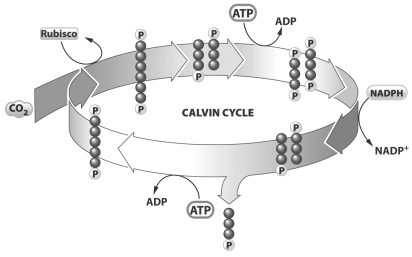 How many times must this cycle "turn" to make one molecule of glucose (six carbons)?
 (Multiple Choice)
4.8/5 (83)
(83) _______ reactions break down and gradually oxidize food molecules to produce energy.
(Short Answer)
4.9/5 (86)
(86) The green pigment most commonly associated with photosynthesis is _______.
(Short Answer)
4.9/5 (72)
(72) You have been shrunk to molecular size and find yourself in a chamber in a chloroplast where protons are being pumped into another chamber. You are in the ___________.
(Short Answer)
4.9/5 (84)
(84) The number and arrangement of membranes within a chloroplast are important to the chloroplast's functions. How would the absence of these membranes affect the manufacture of ATP within a chloroplast?
(Multiple Choice)
4.9/5 (75)
(75) 
Filters
- Essay(0)
- Multiple Choice(0)
- Short Answer(0)
- True False(0)
- Matching(0)