



 Chat with AI
Exam 28: Defenses against Disease

Exam 1: The Nature of Science and the Characteristics of Life75 Questions
Exam 2: Organizing the Diversity of Life75 Questions
Exam 3: Major Groups of Living Organisms74 Questions
Exam 4: Chemical Building Blocks77 Questions
Exam 5: Cell Structure and Internal Compartments76 Questions
Exam 6: Cell Membranes, Transport, and Communication73 Questions
Exam 7: Energy and Enzymes68 Questions
Exam 8: Photosynthesis and Cellular Respiration70 Questions
Exam 9: Cell Division77 Questions
Exam 10: Patterns of Inheritance65 Questions
Exam 11: Chromosomes and Human Genetics70 Questions
Exam 12: DNA62 Questions
Exam 13: From Gene to Protein73 Questions
Exam 14: Control of Gene Expression66 Questions
Exam 15: DNA Technology64 Questions
Exam 16: How Evolution Works65 Questions
Exam 17: Evolution of Populations64 Questions
Exam 18: Adaptation and Speciation66 Questions
Exam 19: The Evolutionary History of Life69 Questions
Exam 20: Maintaining the Internal Environment66 Questions
Exam 21: Animal Nutrition and Digestion68 Questions
Exam 22: Gas Exchange68 Questions
Exam 23: The Circulatory System68 Questions
Exam 24: Animal Hormones69 Questions
Exam 25: The Nervous System69 Questions
Exam 26: Sensing the Environment66 Questions
Exam 27: Skeletons, Muscles, and Movement65 Questions
Exam 28: Defenses against Disease67 Questions
Exam 29: Reproduction and Development68 Questions
Exam 30: Animal Behavior61 Questions
Exam 31: Plant Structure, Nutrition, and Transport63 Questions
Exam 32: Plant Growth and Reproduction67 Questions
Exam 33: The Biosphere67 Questions
Exam 34: Growth of Populations65 Questions
Exam 35: Interactions among Organisms70 Questions
Exam 36: Communities of Organisms65 Questions
Exam 37: Ecosystems68 Questions
Exam 38: Global Change65 Questions
Exam 39: Biodiversity and People72 Questions
Exam 40: Cancer: Cell Division Out of Control69 Questions
Exam 41: Harnessing the Human Genome62 Questions
Exam 42: Humans and Evolution60 Questions
Exam 43: Smoking--Beyond Lung Cancer63 Questions
Exam 44: Feeding a Hungry Planet55 Questions
Exam 45: Building a Sustainable Society47 Questions
Select questions type


A fever is the product of an out-of-control immune response to a parasite.

Free
(True/False)
4.9/5  (83)
(83) Correct Answer: Verified
False
The human immune system contains trillions of specialized cells of several kinds, all of which help destroy invaders. What are these cells called?
Free
(Multiple Choice)
4.9/5 (73)
(73) Correct Answer:Verified
VerifiedB
Which of the following statements about infection by HIV, the virus that causes AIDS, is false?
Free
(Multiple Choice)
4.8/5 (69)
(69) Correct Answer:Verified
VerifiedC
The body responds to tissue damage by mounting an immediate and coordinated sequence of events called the
(Multiple Choice)
4.8/5 (69)
(69) The antibodies released by activated B cells specifically target
(Multiple Choice)
4.8/5 (77)
(77) Why is it important that white blood cells are able to travel outside the human circulatory system?
(Multiple Choice)
4.7/5 (91)
(91) While pruning your roses, you get scratched by a thorn. A few days later, you notice that the scratch is filled with yellowish pus. What is this pus?
(Multiple Choice)
4.8/5 (77)
(77) Lymphocytes surround and digest the damaged host cells and the marked cells of the invading organism.
(True/False)
4.9/5 (87)
(87) Interferons are thought to "interfere" with viral infection because they
(Multiple Choice)
4.9/5 (74)
(74) This graph depicts the immune response following a vaccine and a booster shot.
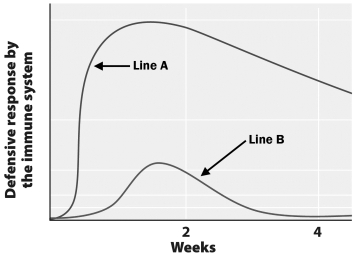 The line labeled with the letter _____ represents the response after the initial vaccine.
 (Short Answer)
4.8/5 (75)
(75) The immune system can detect cancerous cells because they display different cell surface proteins and carbohydrates than normal self cells.
(True/False)
4.9/5 (76)
(76) Why does an area with tissue damage become warm and red during the inflammatory response?
(Essay)
4.9/5 (87)
(87) At the site of a wound or cut, platelets combine with proteins in our blood to form
(Multiple Choice)
4.9/5 (79)
(79) At various points along the lymphatic ducts lie _____ _____, pockets of tissue containing huge numbers of white blood cells that trap bacteria, viruses, and foreign proteins.
(Short Answer)
4.8/5 (66)
(66) 
Filters
- Essay(0)
- Multiple Choice(0)
- Short Answer(0)
- True False(0)
- Matching(0)