



 Chat with AI
Exam 42: Humans and Evolution

Exam 1: The Nature of Science and the Characteristics of Life75 Questions
Exam 2: Organizing the Diversity of Life75 Questions
Exam 3: Major Groups of Living Organisms74 Questions
Exam 4: Chemical Building Blocks77 Questions
Exam 5: Cell Structure and Internal Compartments76 Questions
Exam 6: Cell Membranes, Transport, and Communication73 Questions
Exam 7: Energy and Enzymes68 Questions
Exam 8: Photosynthesis and Cellular Respiration70 Questions
Exam 9: Cell Division77 Questions
Exam 10: Patterns of Inheritance65 Questions
Exam 11: Chromosomes and Human Genetics70 Questions
Exam 12: DNA62 Questions
Exam 13: From Gene to Protein73 Questions
Exam 14: Control of Gene Expression66 Questions
Exam 15: DNA Technology64 Questions
Exam 16: How Evolution Works65 Questions
Exam 17: Evolution of Populations64 Questions
Exam 18: Adaptation and Speciation66 Questions
Exam 19: The Evolutionary History of Life69 Questions
Exam 20: Maintaining the Internal Environment66 Questions
Exam 21: Animal Nutrition and Digestion68 Questions
Exam 22: Gas Exchange68 Questions
Exam 23: The Circulatory System68 Questions
Exam 24: Animal Hormones69 Questions
Exam 25: The Nervous System69 Questions
Exam 26: Sensing the Environment66 Questions
Exam 27: Skeletons, Muscles, and Movement65 Questions
Exam 28: Defenses against Disease67 Questions
Exam 29: Reproduction and Development68 Questions
Exam 30: Animal Behavior61 Questions
Exam 31: Plant Structure, Nutrition, and Transport63 Questions
Exam 32: Plant Growth and Reproduction67 Questions
Exam 33: The Biosphere67 Questions
Exam 34: Growth of Populations65 Questions
Exam 35: Interactions among Organisms70 Questions
Exam 36: Communities of Organisms65 Questions
Exam 37: Ecosystems68 Questions
Exam 38: Global Change65 Questions
Exam 39: Biodiversity and People72 Questions
Exam 40: Cancer: Cell Division Out of Control69 Questions
Exam 41: Harnessing the Human Genome62 Questions
Exam 42: Humans and Evolution60 Questions
Exam 43: Smoking--Beyond Lung Cancer63 Questions
Exam 44: Feeding a Hungry Planet55 Questions
Exam 45: Building a Sustainable Society47 Questions
Select questions type


The publication of Darwin's Origin of Species led scientists to

Free
(Multiple Choice)
4.9/5  (81)
(81) Correct Answer: Verified
B
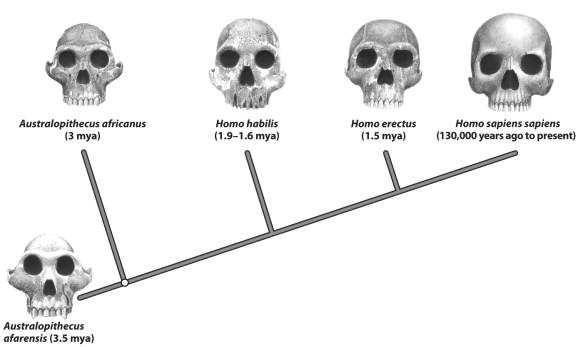
Based on the evolutionary tree in the figure below, Homo sapiens sapiens and Homo erectus both evolved from Homo habilis.
Free
(True/False)
4.8/5 (81)
(81) Correct Answer:Verified
VerifiedFalse
Those involved in the ___________ movement strive to breed better humans by discouraging people with "bad" genes from breeding.
Free
(Short Answer)
4.8/5 (76)
(76) Correct Answer:Verified
Verifiedeugenics
Why is the DNA of a human so similar to the DNA of a chimpanzee?
(Multiple Choice)
4.8/5 (80)
(80) The first members of the genus Homo arose approximately _______ years ago.
(Multiple Choice)
4.7/5 (80)
(80) Overuse of antibiotics has led to the evolution of _________ strains of bacteria that are not killed by these drugs.
(Short Answer)
4.7/5 (81)
(81) Based on the extinctions of birds and mammals known to have occurred over the last 400 years, human actions seem to have
(Multiple Choice)
4.7/5 (75)
(75) Which phrase does not describe an evolutionary trend in primates?
(Multiple Choice)
5.0/5 (70)
(70) When comparing different species, brain size relative to body size provides a rough estimate of _______.
(Short Answer)
4.8/5 (86)
(86) Living humans evolved from ape ancestors without intermediate steps.
(True/False)
4.8/5 (87)
(87) Homo sapiens is the genus and species designation for modern _______.
(Short Answer)
5.0/5 (82)
(82) The evidence of a partially opposable big toe in early hominid foot bone fossils suggests that early hominids
(Multiple Choice)
5.0/5 (74)
(74) There is extensive fossil evidence that early Homo sapiens interbred with more ancient Homo populations.
(True/False)
4.8/5 (96)
(96) Which of the following human activities could affect gene flow and genetic drift of other species?
(Multiple Choice)
4.8/5 (84)
(84) Humans split from the evolutionary line that led to chimpanzees 5 to 7 _______ years ago.
(Short Answer)
4.9/5 (68)
(68) The _______ hypothesis of human origins suggests that modern humans evolved from H. erectus populations located throughout the world.
(Short Answer)
4.8/5 (77)
(77) Which of the following is a characteristic of hominids but not of other primates?
(Multiple Choice)
4.8/5 (77)
(77) All regions of our DNA are closer to the DNA of chimpanzees than to the DNA of gorillas.
(True/False)
4.9/5 (95)
(95) 
Filters
- Essay(0)
- Multiple Choice(0)
- Short Answer(0)
- True False(0)
- Matching(0)